
A Guide to Conversational AI Chatbots in Australia

When you think of a "chatbot," what comes to mind? Many of us recall frustrating, dead-end conversations with systems that feel more like a clunky vending machine than a helpful assistant. You put in a specific query, and if you're lucky, you get a pre-packaged answer. Ask something slightly differently, and the whole thing breaks down.
Conversational AI is different. It’s the difference between that vending machine and a skilled barista who remembers your usual coffee order, understands what you mean when you say "the usual but make it a bit stronger today," and can suggest a new blend you might like. These are intelligent programs that don't just follow scripts; they understand, adapt, and learn from human conversation.
Why Conversational AI Is Reshaping How Businesses Operate

Let's ground this in a real-world scenario. While a basic, rule-based bot operates on rigid logic, a genuine conversational AI chatbot is far more dynamic. It focuses on the intent behind your words, not just the keywords themselves.
Imagine you need to change a flight. You tell a basic bot, "My meeting finished early, so I'm hoping to get on an earlier plane." It will probably get stuck, waiting for a specific command like "change flight." A conversational AI, on the other hand, gets it. It picks up the context, checks your booking details, and replies with something genuinely helpful: "No problem. There's an earlier flight at 3 PM with seats available. Shall I move your booking?"
The Australian Adoption Boom
This ability to handle nuanced, human-like dialogue is precisely why companies all over Australia are making the switch. From agile tech startups in Melbourne to major financial institutions in Sydney, businesses are moving away from scripted bots that frustrate customers and embracing systems that actually solve problems.
And it’s not just a corporate fad; the public is already on board. Australia is a world leader in generative AI adoption. Recent figures show about 45% of Australians have tried tools like ChatGPT, and an impressive 28% use them every week—that’s nearly double the global average of 15%.
This comfort with AI is fueling business investment. Forecasts indicate 64% of small and medium businesses in Australia plan to have conversational AI fully integrated by 2026. That's a huge leap from 38% in 2024.
This rapid uptake has clear implications for the local job market. It’s creating a strong demand for professionals who can build, manage, and refine these sophisticated systems. The required skills go well beyond coding; we're talking about a blend of data science, user experience (UX) design, and even linguistics to create conversations that feel natural and effective.
The real difference is simple but profound: A basic chatbot just follows a map. A conversational AI can read the terrain, understand where you want to go, and find the best path to get you there.
For anyone looking to build a career in AI, this shift is a massive opportunity. To give you a better sense of what this all means, here's a quick summary.
Conversational AI Chatbots At A Glance
| Concept | What It Means For Users | Why It Matters For Your Career |
|---|---|---|
| Intent Recognition | The AI understands what you want to do, not just the words you use. You get real solutions, faster. | You'll need skills in Natural Language Understanding (NLU) to train models that can accurately interpret user goals. |
| Contextual Dialogue | The chatbot remembers what you've already discussed, leading to smoother, more natural conversations. | Your focus will be on dialogue management, designing systems that maintain context and manage multi-turn interactions. |
| Dynamic Responses | Instead of canned answers, the AI generates relevant, personalised responses on the fly. | Expertise in Natural Language Generation (NLG) and large language models (LLMs) is becoming essential. |
| Real-World Impact | Better customer service, efficient internal support, and personalised user experiences. | You'll be building systems that deliver measurable business value, making your skills highly sought-after. |
This table shows how the technical concepts directly translate into better user experiences and, most importantly, in-demand career skills.
As you dive deeper into this guide, you’ll notice how the components, architectures, and skills we discuss align perfectly with the roles being advertised by innovative AI startups in Australia. The need for engineers, data scientists, and AI specialists who can turn this technology into tangible business outcomes is only going to grow.
The Three Pillars of Conversational AI
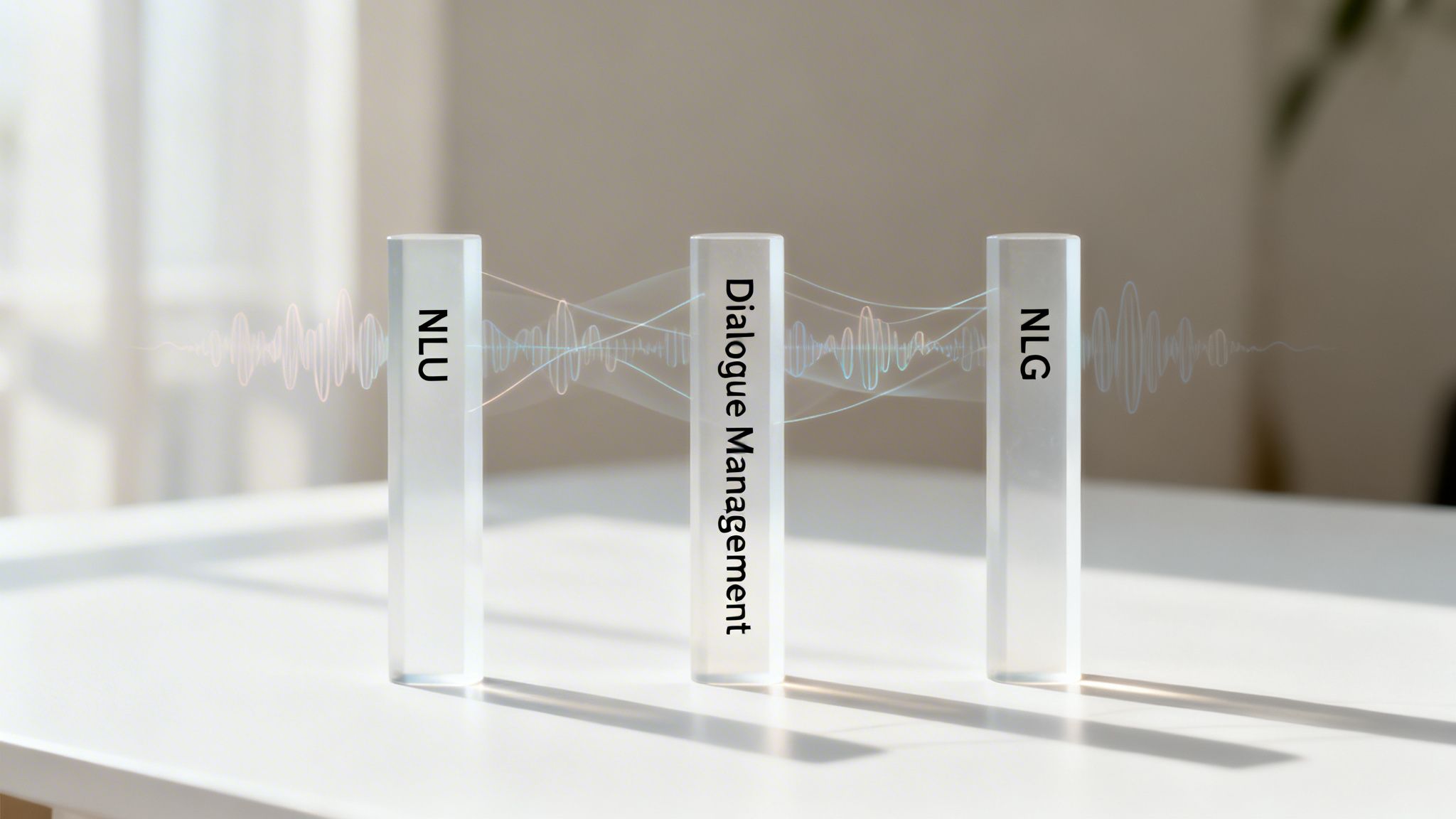
From the outside, talking to a chatbot feels like a single, fluid experience. But under the bonnet, there’s a sophisticated process at play. Think of it just like a human conversation: we have to listen, think, and then speak. For a machine, this is all handled by what's known as the Natural Language Processing (NLP) pipeline.
This pipeline is made up of three core components. Each one hands off its work to the next, turning your raw message into a sensible, helpful reply. Getting your head around these three pillars is the first real step for anyone looking to build or manage AI in Australia.
1. Natural Language Understanding (The Ears)
First up is Natural Language Understanding (NLU). This is where the magic starts. NLU is the system's ability to actually comprehend what a user is trying to say, not just what words they typed. It’s the chatbot’s ears.
It’s not about just spotting keywords. A good NLU model can decipher the user's true intent. For instance, if someone types, "I wanna book a flight to Brissy for next weekend," the NLU breaks that down into something a computer can use:
- Intent:
book_flight - Entities:
destination: Brisbane,departure_date: next weekend
Notice how it understands slang like "Brissy" and relative terms like "next weekend." This is a world away from old-school bots that would get stuck if you didn't type the exact, pre-programmed phrase. NLU essentially translates messy, unstructured human language into clean, structured data for the system to act on.
The real job of NLU is to answer two simple questions: "What does the user want to do?" (the intent) and "What are the crucial details?" (the entities). Nail this, and you've laid the foundation for a great conversational experience.
Without a solid NLU model, your chatbot will constantly be saying, "Sorry, I don't understand." It’s what makes sure the conversation even gets off the ground.
2. Dialogue Management (The Brain)
Okay, so the bot has figured out what you want. What happens next? That’s where Dialogue Management comes in—it's the brains of the operation. This component is the conductor of the conversation, keeping track of the context and deciding on the next move.
This is what turns a simple Q&A bot into a true conversational partner. If you say, "I need a hotel in Melbourne," the Dialogue Manager knows the next logical step isn't to give you an answer, but to ask another question: "For which dates?" It maintains the conversation's 'state', remembering what's already been said so it doesn't have to ask you the same things over and over.
The Dialogue Manager is constantly juggling a few key jobs:
- State Tracking: It remembers all the information collected so far, like your chosen destination and travel dates.
- Policy Learning: It decides the bot’s next action. Should it ask for more details? Call an external system (like a booking API) to check for rooms? Or ask you to confirm?
- Turn Management: It makes sure the back-and-forth moves logically towards getting the job done.
A chatbot without decent Dialogue Management would have the memory of a goldfish. This component provides the crucial intelligence needed to handle anything more complex than a single question.
3. Natural Language Generation (The Mouth)
We've understood the request and decided on a response. The final piece of the puzzle is Natural Language Generation (NLG). This is the chatbot's mouth, responsible for turning the system's internal decision into something that sounds like a real person wrote it.
The system's decision is just a piece of structured data, like offer_hotel_option(name: 'The Langham', price: '$450'). A basic NLG model might just drop that into a template: "I found a hotel: The Langham. Price: $450." It works, but it’s clunky and robotic.
This is where more advanced NLG shines. It can craft dynamic, personalised, and grammatically correct sentences that reflect a specific tone of voice—be it friendly, professional, or even a bit quirky. A better response might be, "Great news! I've found a room at The Langham for you, available for $450 per night. Does that sound good?"
This final step is what truly shapes how a user feels about the chatbot. A well-crafted response can make the entire interaction feel helpful, intelligent, and surprisingly human.
Exploring Advanced Chatbot Architectures

While the three pillars of NLU, Dialogue Management, and NLG are the bedrock of any chatbot, the systems that really impress today are built on much more sophisticated architectures. These models go well beyond just understanding and talking; they can reason, pull in outside knowledge, and actually get things done.
For AI professionals here in Australia, getting your head around these concepts isn't just a nice-to-have anymore. It's becoming a must-have for landing the best roles. Two architectures, in particular, show just how far we've come: Retrieval-Augmented Generation (RAG) and LLM-based Agents.
Giving Chatbots an Open-Book Exam with RAG
Picture this: you ask a standard Large Language Model (LLM) a question about your company’s brand-new internal policy. The LLM, which was trained on the vast, public internet, has never seen your specific document. It will likely either refuse to answer or, worse, "hallucinate" an answer that sounds plausible but is completely wrong. This is a massive roadblock for any serious business application.
This is where Retrieval-Augmented Generation (RAG) comes in. Think of it as giving your chatbot access to a private, curated library for an open-book exam. Instead of just relying on its built-in memory, a RAG system first retrieves relevant information from a knowledge source you provide.
This source could be almost anything:
- A company’s entire internal wiki of policies and procedures.
- The full product catalogue from an e-commerce website.
- A database of technical support guides.
Only after it finds the right documents does the model generate an answer. This simple-sounding step ensures the response is anchored in factual, current, and context-specific information.
RAG transforms a generalist LLM into a subject matter expert. It bridges the gap between the model's broad linguistic skills and the specific, proprietary knowledge a business needs to operate effectively.
This approach is a massive step forward for building reliable conversational AI chatbots. It drastically cuts down on factual errors and gives users answers they can trust because you can often trace them back to the source. That transparency is crucial.
From Talking to Doing with LLM-Based Agents
If RAG gives a chatbot a library, then an LLM-based Agent gives it a toolbox and a to-do list. An Agent is the next logical evolution: a chatbot that doesn't just talk, but acts. It’s a system that uses an LLM as its brain to break down a complex request, figure out a plan, and then execute the steps needed to complete it.
An LLM-based Agent can interact with external tools and APIs to achieve real-world goals. For instance, a user might say, "Find the best-rated Italian restaurant near me, book a table for two for 8 PM tonight, and add it to my calendar."
A proper Agent would tackle this by:
- Thinking: First, it breaks the request down into a sequence of smaller, manageable tasks.
- Using Tools: It then calls a maps API to find restaurants, a reviews API to check their ratings, and a booking API to secure the reservation.
- Taking Action: Finally, it connects to a calendar API to create the event.
This architecture turns chatbots from passive information windows into active problem-solvers. The possibilities are huge, from automating complex business workflows to managing our personal schedules. As these systems get more capable, they'll completely change what we expect from a digital assistant.
This move towards autonomous, agentic systems is already making waves across Australia. By 2026, Australian small-to-medium businesses (SMBs) are expected to be in the middle of a major adoption boom, especially in cities like Brisbane. This growth is being driven by Autonomous Agentic AI chatbots that do more than just answer questions—they can analyse images of broken parts sent by customers or process voice notes to find instant solutions, creating multi-modal interactions that feel genuinely helpful. You can read more about these AI adoption trends among Australian SMBs on ailabaustralia.com.
Getting a firm grasp of both RAG and LLM-based Agents is fundamental for anyone targeting senior AI engineering roles on platforms like AI Jobs Australia. These architectures are at the forefront of what’s possible with conversational AI chatbots, turning them into powerful, independent partners for businesses and individuals alike.
Real-World Applications in Australian Industries
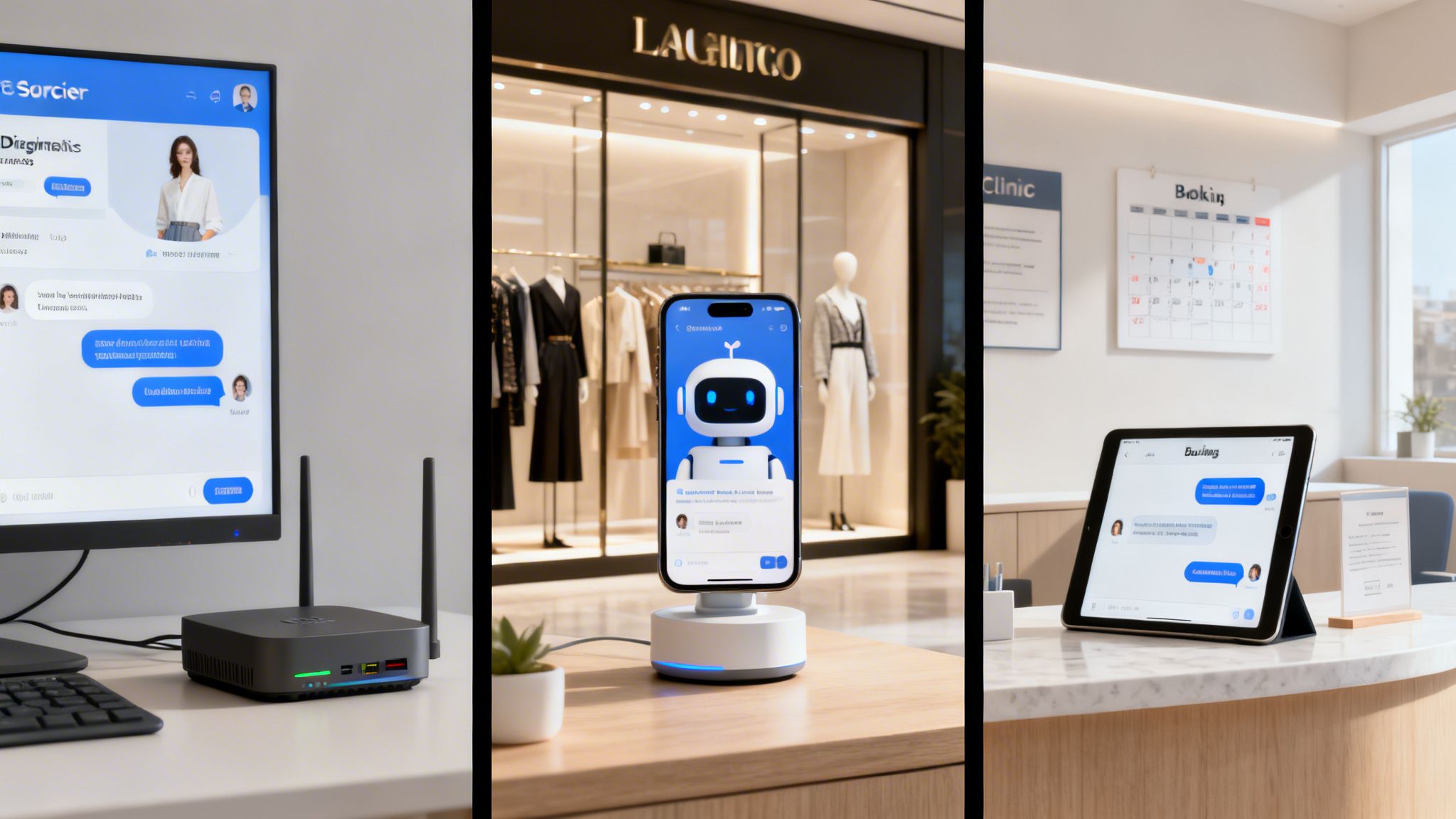
It’s one thing to talk about advanced architectures like RAG and LLM Agents in theory. It’s another to see them solving real problems for Australian businesses. We're moving well beyond basic FAQ bots and into a new era where sophisticated conversational AI chatbots are delivering serious results.
Let's dive into some specific examples of how this technology is being put to work to drive efficiency, grow revenue, and create genuinely better customer experiences.
Driving Efficiency in Telecommunications
For a major Sydney-based telco, diagnosing NBN connection faults was a huge drain on their customer service team. The process was predictable and mind-numbingly repetitive, creating long phone queues and leaving customers frustrated before they even spoke to a person.
They turned this entire workflow on its head by deploying a conversational AI chatbot. Now, when a customer flags an NBN issue, the bot kicks off a smart diagnostic sequence.
It can:
- Ask simple, clarifying questions to pinpoint the exact nature of the problem.
- Securely check the customer’s account for any known network outages in their area.
- Walk the user through a guided process for rebooting their modem and checking physical connections.
- Run automated line tests behind the scenes and interpret the results instantly.
This single change now handles the vast majority of common connection faults without a human ever getting involved. The result is a massive drop in call volumes and wait times. Better yet, it allows their skilled technicians to focus on the tricky, complex issues that actually require their expertise, making their jobs far more engaging.
The bot isn't just a passive Q&A machine; it's an active problem-solver. This is the crucial shift we’re seeing—from providing information to performing a service.
Personalising the eCommerce Experience
In Melbourne's cut-throat fashion retail market, an online brand was struggling to replicate the magic of an in-store personal shopping experience. They needed a way to give style advice that felt authentic and truly personal.
Their answer was an AI-powered "style advisor." This chatbot plugs directly into their product catalogue and customer data, allowing it to act as a virtual stylist. A customer can start a conversation with something as natural as, "I need an outfit for a winter wedding in the Yarra Valley."
The bot immediately grasps the context—a formal event in a cold climate—and follows up with questions about preferred styles, colours, or budget. It then serves up a curated lookbook of dresses, coats, and accessories, explaining why each piece is a great fit. This kind of guided selling has delivered a clear lift in both conversion rates and average order value.
Across the country, this kind of adoption is taking off, especially in small to medium-sized businesses (SMBs) where chatbots are helping them punch above their weight. We're seeing real outcomes like 35% higher conversions and incredible scalability.
To illustrate how this adoption is playing out, here’s a look at which Australian sectors are leaning in and why.
Conversational AI Adoption By Australian Sector
| Industry | Primary Use Case | Key Business Benefit |
|---|---|---|
| Healthcare | Appointment management & patient pre-screening | Reduces administrative load, improves patient access |
| Retail & eCommerce | Personalised shopping & order support | Increases conversions, boosts average order value |
| Telecommunications | Technical support & fault diagnosis | Lowers call centre costs, resolves issues faster |
| Real Estate | Lead qualification & property inquiries | Captures and nurtures leads 24/7, frees up agents |
| Financial Services | Onboarding & routine banking queries | Improves customer experience, ensures compliance |
| Education | Student support & course inquiries | Provides instant answers, streamlines enrolment |
While healthcare leads overall adoption with a 20.1% compound annual growth rate, the fastest-growing segment is SMBs, rocketing ahead at 25.1%. For local service businesses, 82% of website visitors now say they prefer interacting with a bot for quick answers. In many cases, these bots successfully handle up to 90% of all inquiries for lead generation. If you want to dig deeper into these numbers, you can explore a full analysis of the AI chatbot revolution for SMBs at lmgroup.au.
Streamlining Healthcare Administration
Over in Perth, a network of medical clinics was drowning in administrative tasks. Reception staff spent almost their entire day on the phone scheduling appointments and answering the same basic questions about opening hours, services offered, and how to prepare for a procedure.
They brought in a healthcare chatbot to take over these routine duties. The bot is now the first point of contact on their website and is able to:
- Book, cancel, and reschedule appointments: It syncs in real-time with the clinics' scheduling software to show what’s available.
- Answer frequently asked questions: It gives instant, accurate answers about clinic locations, parking information, and fees.
- Send out reminders: It automates appointment reminders and sends pre-procedure instructions via SMS or email.
This has freed up a huge amount of time for the administrative team, letting them focus on giving a warmer, more helpful experience to the patients physically present in the clinic. For patients, it offers a simple, 24/7 way to manage their healthcare without ever needing to pick up the phone.
How to Engineer and Deploy Robust Chatbots
Getting a chatbot to work in a lab is one thing; making it thrive in the real world is another beast entirely. The journey from a promising prototype to a reliable, production-ready system is where the real engineering begins. For anyone building conversational AI, this is where theory gets its hands dirty.
It all starts with the data. Think of it less as fuel and more as the curriculum you're using to teach your model. Raw, messy data won't cut it. It needs to be carefully cleaned, structured, and, most importantly, adapted for the audience it will serve.
For a chatbot in Australia, this means going beyond generic datasets. You have to teach it to understand local slang, recognise our unique place names, and even interpret different Aussie accents. Without this vital step, you're building a bot that will feel foreign and frustrating to its users.
Measuring What Truly Matters
So, you’ve trained your model. How can you be sure it's actually good? A simple right-or-wrong accuracy score is dangerously misleading. A bot can provide a technically correct answer that is tonally deaf, unhelpful, or sounds completely robotic.
That’s why we lean on more sophisticated metrics to get a clearer picture of text quality.
- BLEU (Bilingual Evaluation Understudy): This metric is great for checking grammar and phrasing. It compares the bot's output to a set of ideal, human-written responses to see how well they match up.
- ROUGE (Recall-Oriented Understudy for Gisting Evaluation): This one focuses more on content coverage. It checks if the key words and phrases from a human reference text are present in the chatbot's answer, making it especially useful for summarisation tasks.
Automated metrics are fantastic for spotting issues at scale, but they don't tell the whole story. A chatbot can achieve a perfect BLEU score and still deliver a clunky, unsatisfying user experience.
This is exactly why a blended evaluation strategy is non-negotiable. You need to combine these automated scores with structured human feedback. Real people can assess the subtle but critical qualities that metrics miss, like empathy, tone, and genuine helpfulness.
Adopting MLOps for Conversational AI
A chatbot isn’t a one-and-done project. It’s a dynamic system that demands constant care and improvement. This is where Machine Learning Operations (MLOps) becomes your most important toolkit, applying the rigour of software development to the machine learning lifecycle.
For conversational AI, this means putting a few key practices in place.
Versioning Models and Data: Just like you version code, you absolutely must version your datasets and models. This practice is your safety net, allowing you to trace performance changes, roll back to a stable version if an update goes wrong, and ensure your experiments are always reproducible.
Continuous Integration and Continuous Deployment (CI/CD): A solid CI/CD pipeline automates the grunt work of testing and deploying new models. When you have a better model or an improved dataset, the pipeline can automatically run your evaluation suite and push it live with zero downtime—but only if it meets your quality standards. If you're building out your technical skills, exploring the top Python libraries for machine learning is a great place to start.
Monitoring and Feedback Loops: Once your bot is live, its real-world performance must be monitored relentlessly. You’ll want to track task completion rates and user satisfaction, but the real gold is in the conversations that failed. Capturing this data and feeding it back into your training set creates a powerful cycle of continuous improvement.
Mastering these engineering and MLOps principles is what separates a good AI practitioner from a great one. It’s how you build conversational systems that are not just clever, but also scalable, dependable, and capable of delivering real business value—a skill set highly sought after in the Australian AI job market.
Building Ethical and Safe AI Conversations
As conversational AI chatbots become more powerful and woven into our daily lives, the potential for them to cause real harm grows right alongside their capabilities. With this increasing power comes a serious responsibility. Making sure these systems are designed ethically and safely isn't just a "nice-to-have"—it's a business necessity. Getting this wrong is a fast track to destroying user trust and tanking a brand's reputation.
The risks aren't just theoretical; they're tangible and serious. Picture a healthcare chatbot accidentally leaking a user's private medical information due to a simple data handling mistake. Or think about an e-commerce bot, trained on biased data, that consistently pushes lower-quality products to people living in certain postcodes. These scenarios are real-world failures with significant fallout.
Establishing Guardrails for Trust
To build conversational AI chatbots that are genuinely helpful, we have to be proactive about safety from day one. The aim is to create systems that are not only intelligent but also fair, transparent, and completely respectful of user privacy. This means taking a layered approach to responsible AI development.
Here are the key things you need to get right:
- Robust Data Anonymisation: Before any data ever touches a training model, all personally identifiable information (PII) must be rigorously scrubbed. This is the absolute first step to protecting user privacy and staying compliant with regulations like Australia's Privacy Act.
- Regular Bias Audits: Algorithmic bias often seeps in from the very data used to train the model. You have to regularly check your chatbot’s responses for any signs of demographic, cultural, or gender bias to ensure it treats every user fairly.
- Radical Transparency: People deserve to know when they’re talking to an AI. Clearly disclosing that the conversation is with a chatbot builds immediate trust and sets the right expectations from the start.
A strong grasp of ethical AI is no longer a soft skill; it's a core competency. For professionals in the Australian market, showing you understand AI governance and safety is a massive advantage, especially when going for leadership or senior engineering roles.
Putting these safeguards in place requires a specific set of skills. To get a better handle on what it takes, you can find some great insights in our guide to risk management courses for AI governance.
Ultimately, the most successful conversational AI will be the one that people feel they can genuinely trust. This focus on responsible innovation is quickly becoming a defining feature of top AI teams across the country.
Frequently Asked Questions About Conversational AI
As conversational AI becomes more common, we get a lot of the same questions from business leaders and aspiring developers alike. Let's tackle some of the most frequent ones we hear across the Australian market, with some straightforward, practical answers.
What Is the Real Difference Between a Basic Chatbot and Conversational AI?
The easiest way to think about it is to compare a vending machine to a great shop assistant.
A basic, rule-based chatbot is the vending machine. You need to use the exact keyword—the right button—to get a pre-programmed response. If you ask a question it doesn't recognise, it just gives you an error. The conversation hits a dead end.
On the other hand, conversational AI chatbots are like that genuinely helpful shop assistant. They use Natural Language Understanding (NLU) to figure out what you actually mean, not just what you typed. They remember what you said earlier in the chat and can handle curveballs.
So, while a basic bot would freeze if you said, "My flight got moved," a proper conversational AI understands the situation. It would probably respond with something like, "Oh, that's a hassle. Let me check hotel availability for your new arrival date. What's your booking reference?"
How Can a Small Business in Australia Start Using a Chatbot on a Budget?
You absolutely don't need a massive budget to get started with conversational AI. Thanks to modern platforms, it's more accessible than ever for small businesses. The trick is to start small and be strategic.
- Pinpoint Your Biggest Bottleneck: Look for the single most repetitive, time-consuming task your team deals with. Is it answering questions about opening hours? Tracking customer orders? Booking appointments? Start there.
- Use a No-Code Platform: There are plenty of fantastic, user-friendly tools that let you build a powerful bot with a simple drag-and-drop interface. This completely removes the need for a developer, keeping your initial costs way down.
- Focus on One Channel First: Don't try to be everywhere at once. Launch your first bot on the channel where you get the most customer traffic, whether that's your website chat or Facebook Messenger. Get it right there before you expand.
This approach gives you a fast, tangible return on your time and lets you learn what works before you invest more.
The most effective entry-level chatbots solve one problem exceptionally well. Don't try to build an all-knowing assistant from day one. Instead, create a specialist that frees up valuable human time.
What Skills Are Most In-Demand for a Conversational AI Role?
These days, employers are looking for people with a mix of sharp technical skills and a real knack for user experience. On the technical side, knowing Python, having your head around NLU/NLG frameworks, and being comfortable with LLM APIs are the table stakes.
But what really makes a candidate stand out is the ability to think critically about the conversation itself. This means having solid skills in dialogue design, being clever with prompt engineering, and knowing how to use data to make the user's journey better over time.
Ultimately, companies aren't just looking for someone who can build a functional bot. They want someone who can create an experience that is genuinely helpful and, dare we say, even pleasant to talk to.
Ready to find your next role building the future of conversation? AI Jobs Australia connects you with the country's top AI employers. Browse verified AI and machine learning roles today.