
Top 12 Risk Management Courses in Australia for AI Governance (2026)

In an era where AI and machine learning models drive critical business decisions, understanding risk is no longer just for the finance department. From biased algorithms to data privacy breaches and operational failures, the potential for things to go wrong is immense. For data scientists, ML engineers, and AI governance specialists, mastering risk management is now a crucial competency for building robust, trustworthy, and compliant systems. This guide dives into the best risk management courses available in Australia and online, helping you identify the right training to protect your projects, advance your career, and become an indispensable asset to your team. We'll explore how these qualifications translate directly to roles advertised on platforms like AI Jobs Australia, where demand for risk-aware tech talent is visibly growing.
This resource is designed to help you quickly find the ideal course for your specific needs, whether you're a graduate starting out, an ML engineer building production models, or a data scientist aiming for a leadership role. We've analysed a range of options, from Australian university microcredentials to globally recognised professional certifications, focusing on their relevance to AI and data-centric job functions.
Each entry includes a direct link to the course provider, a clear breakdown of key details like cost and duration, and our analysis of its practical value. You'll find guidance on who the course is best for and how its curriculum maps to real-world responsibilities in model risk, operational risk, and enterprise risk management. Our goal is to cut through the marketing copy and give you a clear, honest assessment to help you make the best educational investment for your career.
1. Risk Management Institute of Australasia (RMIA) — Enterprise Risk Management (ERM) + CPRA/CPRM pathway
For AI and data professionals in Australia seeking formal recognition within the local risk community, the Risk Management Institute of Australasia (RMIA) is the definitive starting point. Its signature Enterprise Risk Management (ERM) course is built around the globally recognised AS ISO 31000 standard but is taught with a distinct Australian focus, making it particularly relevant for practitioners working within local regulatory and business environments. This course provides a direct, structured pathway towards achieving RMIA's professional accreditations.
The primary advantage of RMIA's training is its integration into a larger professional ecosystem. Completing the ERM course prepares you for the Certified Practising Risk Associate (CPRA) and Certified Practising Risk Manager (CPRM) accreditation exams. These credentials are well-regarded by Australian employers, especially in finance, government, and consulting, signalling a committed and standards-aligned approach to risk. By connecting with RMIA, you gain access to a strong professional network, local chapter events, and mentorship opportunities that are invaluable for career progression. For data scientists building risk models, understanding the foundational ERM principles taught here is crucial for ensuring their quantitative work aligns with broader business strategy, moving beyond just predictive analytics to holistic risk mitigation.
Key Information:
Best For: Data professionals and ML engineers seeking recognised Australian credentials and local networking opportunities.
Cost: Courses start from approx. $1,800 AUD for members. Accreditation and exam fees are separate.
Delivery: Online and in-person sessions available in major Australian cities.
Pros: Strong local recognition; direct pathway to CPRA/CPRM accreditation; excellent networking.
Cons: Accreditation requires separate exams and ongoing study; popular course dates can fill up quickly.
Website: RMIA Available Courses
2. BSI Training Academy (Australia) — ISO 31000 Risk Management (Intro, eLearning, Implementation)
For teams and individuals who prioritise global standards, the BSI Training Academy offers authoritative risk management courses centred on the ISO 31000 framework. BSI, as a key player in developing these standards, provides training that is recognised internationally, making it an excellent choice for professionals working in multinational corporations or in sectors where ISO compliance is critical. The academy provides distinct learning pathways, including a one-day introduction, a detailed two-day implementation course, and flexible on-demand eLearning modules, all with published schedules convenient for Australian time zones.
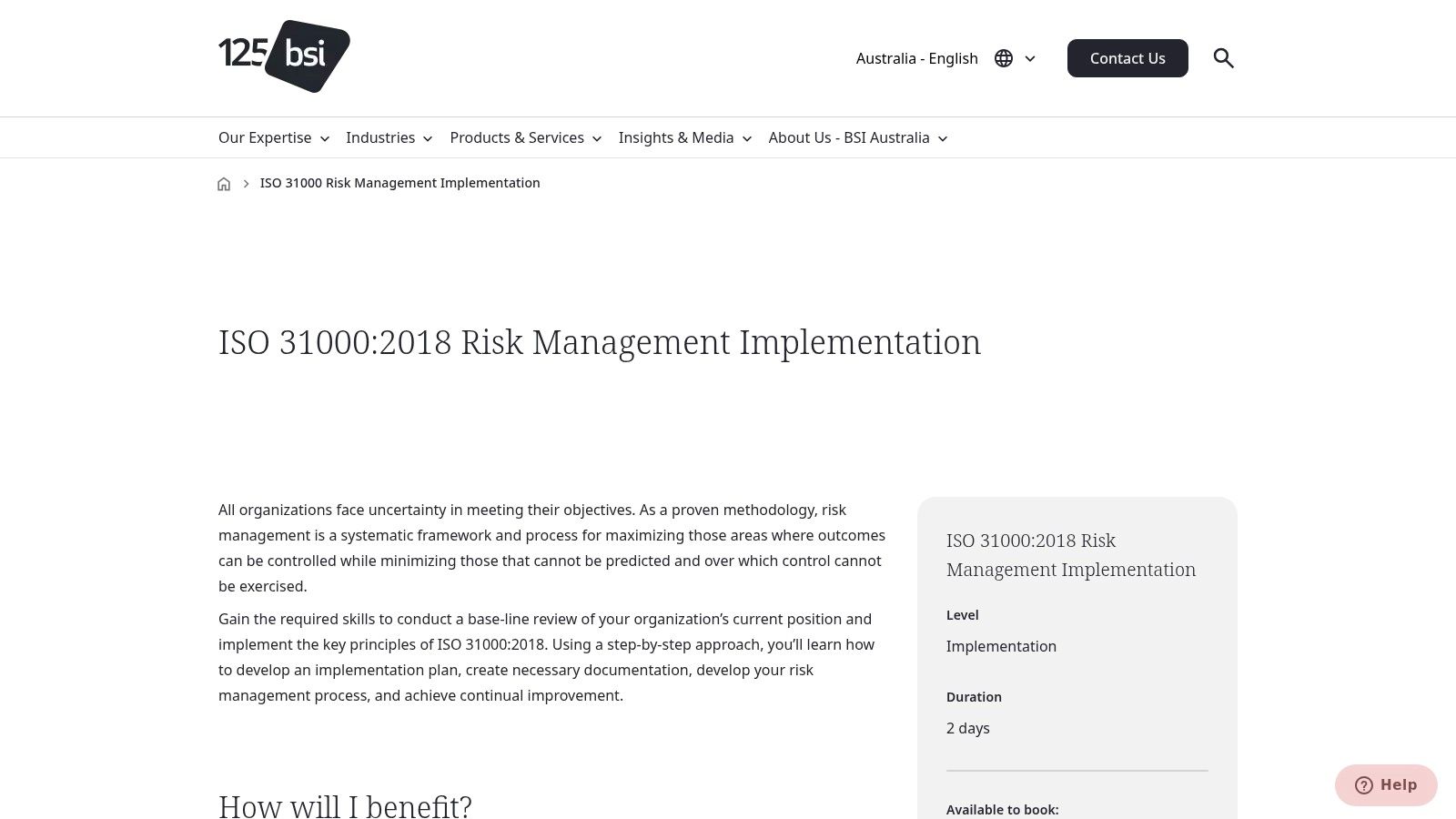
The primary strength of BSI's offering is its direct alignment with the source standard, providing credibility and authenticity. The two-day implementation course is especially practical, guiding participants through building an ISO 31000-aligned risk management plan step-by-step. For a data scientist or ML engineer, this provides a structured methodology to ensure their risk models and controls are not just statistically sound but also fit within a proven, auditable governance framework. This is vital when deploying AI systems in high-stakes environments like finance or healthcare, where demonstrating adherence to a global standard can be a regulatory or client requirement.
Key Information:
Best For: Technical teams and managers needing to implement or audit against the ISO 31000 standard within a corporate setting.
Cost: Courses range from approx. $1,000 to $2,000 AUD depending on the format and duration.
Delivery: Live online (virtual classroom), in-person classroom, and self-paced eLearning options are available.
Pros: High global brand credibility; clear, structured learning pathways; frequent Australian schedules.
Cons: Implementation course requires foundational ISO 31000 knowledge; pricing is at the premium end for short courses.
Website: BSI Training Academy - ISO 31000
3. Intertek SAI Global (Australia) — Risk Management ISO 31000 Foundation (1 day)
For teams or individuals needing a rapid, foundational understanding of the ISO 31000 standard, Intertek SAI Global's one-day course is an excellent option. It's designed as a high-level introduction, ideal for technical professionals like data scientists or ML engineers who need to grasp the core principles of risk management frameworks without committing to a lengthy certification. The course provides a solid overview of the ISO 31000 vocabulary, principles, and framework, ensuring participants can speak the same language as their risk and compliance colleagues.
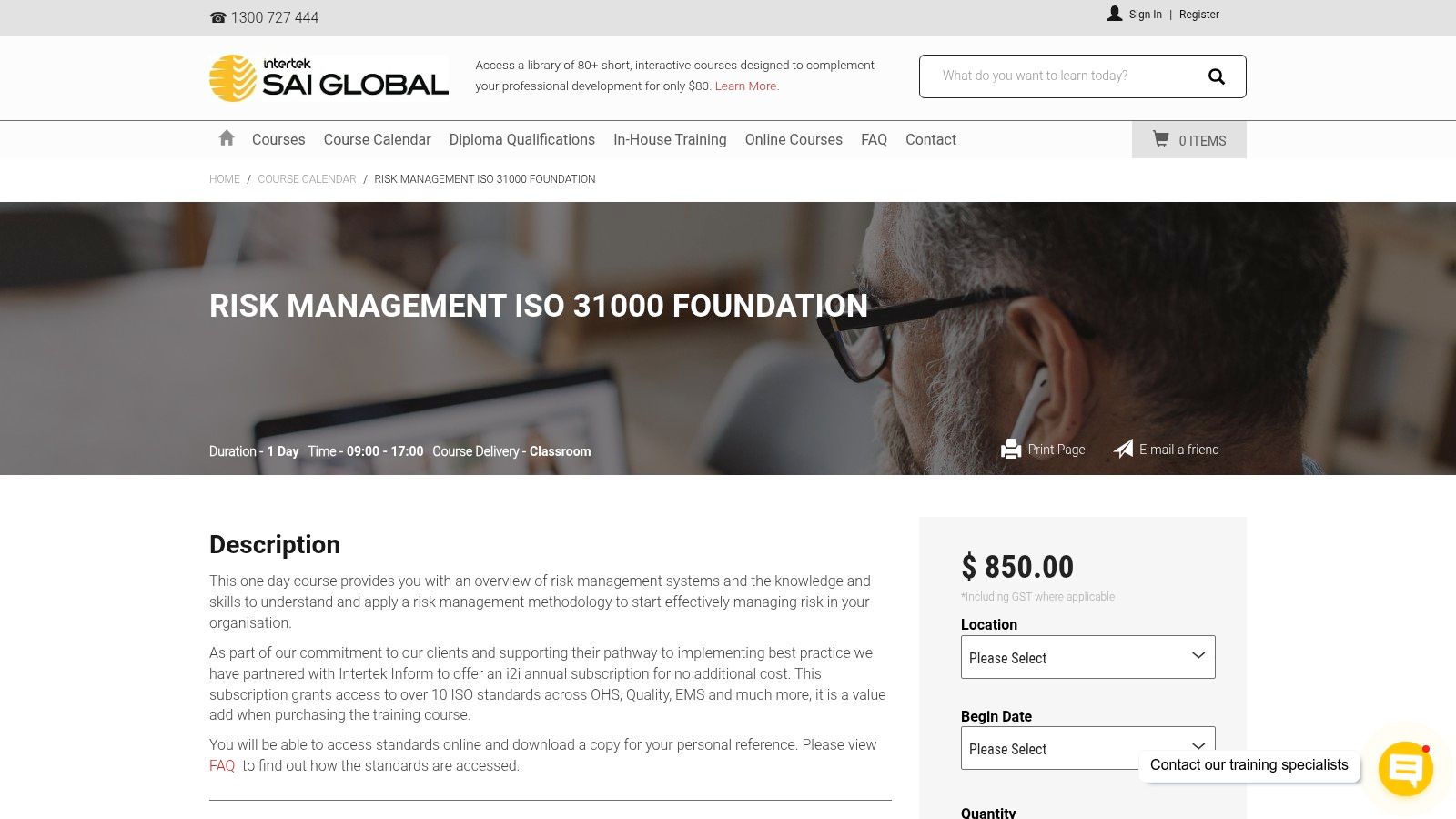
The key appeal of this offering is its efficiency and value. Delivered in a single day either virtually or in person, it minimises disruption to busy project schedules. A significant bonus is that enrolment often includes access to relevant standards documents via the Intertek Inform platform, which can be a costly purchase on its own. For a data professional whose main job isn't risk management but who contributes to risk-related projects (like building credit scoring models or fraud detection systems), this course provides essential context. It bridges the gap between technical model development and the overarching enterprise risk strategy, ensuring that AI-driven solutions are built with a standards-aligned risk perspective from the start.
Key Information:
Best For: Technical teams, data analysts, and ML engineers who need a quick, practical introduction to ISO 31000.
Cost: Varies by format and location, but generally a competitive price point for a branded provider.
Delivery: Virtual classroom and in-person sessions offered in major Australian cities.
Pros: Very efficient one-day format; excellent value with included access to standards; strong brand recognition.
Cons: Foundation level only, not a deep-dive course; limited seats often available for specific dates and locations.
Website: Intertek SAI Global - Risk Management ISO 31000 Foundation
4. Governance Institute of Australia — Certificate in Risk and Compliance (bundle)
For data and AI professionals whose work intersects with corporate strategy and board-level decision-making, the Governance Institute of Australia offers a unique credential. Its Certificate in Risk and Compliance is not a granular technical course but a high-level bundle designed for senior managers and directors. It packages six short courses covering risk frameworks, compliance, cyber security governance, and sustainability reporting, delivering a governance-centric perspective on risk that is crucial for anyone involved in deploying high-stakes AI systems or influencing organisational policy. This makes it an excellent choice for experienced practitioners aiming for leadership roles where technical expertise must be translated into business and legal assurance.
The certificate’s strength lies in its holistic view, connecting risk management directly to governance, legal obligations, and accountability. This is particularly relevant for those working in AI governance roles, as it provides the language and frameworks needed to communicate model risk and ethical considerations to a non-technical board. As an on-demand program from a respected Australian peak body, it offers flexibility and credibility, complete with digital badges and 36 CPD hours. While it lacks the deep quantitative focus of certifications like the FRM, it provides the essential strategic context, making it a powerful complement to technical risk management courses for aspiring leaders in the data science field.
Key Information:
Best For: Senior data scientists, ML leaders, and consultants needing to align risk practices with board-level governance and compliance.
Cost: Approx. $2,860 AUD for non-members (member discounts available).
Delivery: Fully online, on-demand with 180-day access.
Pros: Broad governance-risk-compliance coverage in one package; recognised by a professional peak body; strong focus on senior management duties.
Cons: Higher price point than single courses; assessment is quiz-based, not a proctored exam; less focused on quantitative risk modelling.
Website: Certificate in Risk and Compliance
5. Governance Institute of Australia — Risk Governance (short course)
For data scientists and AI leaders whose work directly informs board-level decisions, understanding the governance context is critical. The Governance Institute of Australia's Risk Governance short course is specifically designed for this purpose. Unlike broader enterprise risk management (ERM) programs, its focus is narrower and more strategic, centred on how risk information is communicated to, and acted upon by, the board and executive leadership. This makes it an excellent choice for senior practitioners wanting to bridge the gap between technical risk modelling and strategic oversight.
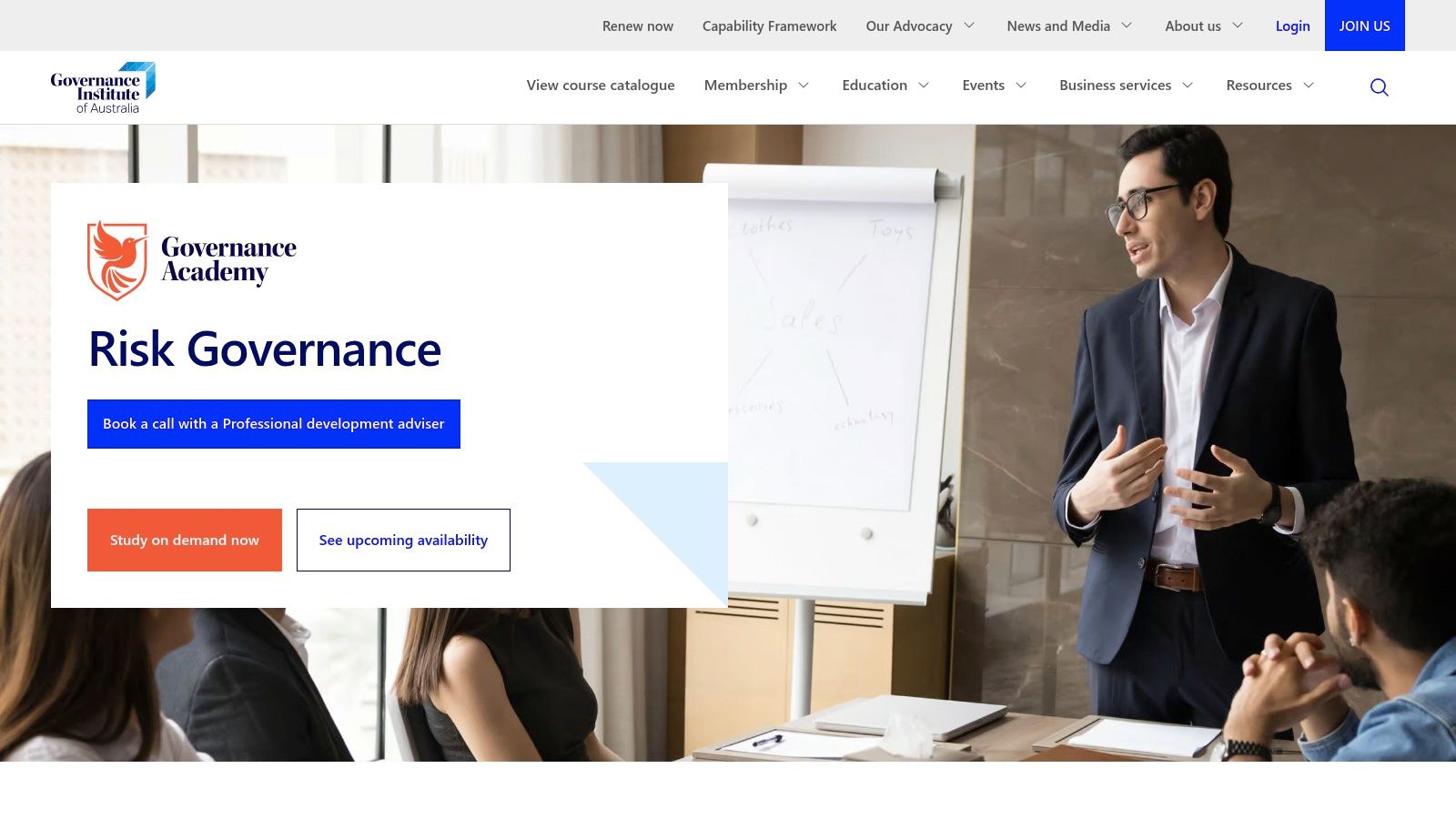
The course's main strength lies in its practical, board-oriented outputs. Participants learn how to frame risk appetites, improve risk culture, and structure board papers effectively, ensuring that complex data-driven insights are presented in a way that facilitates decisive action. For an ML engineer developing fraud detection models, for example, this course provides the skills to articulate the model's residual risk and operational implications in a language that resonates with directors. The on-demand online delivery offers flexibility, while scheduled runs provide a more structured learning experience. It is one of the best specialist risk management courses for those aspiring to influence high-level strategy.
Key Information:
Best For: Senior data professionals, team leads, and consultants who need to communicate risk insights to executive and board members.
Cost: Varies by intake and membership status. Member discounts are available.
Delivery: On-demand online or via scheduled virtual workshops.
Pros: Strong focus on board-level governance; highly practical content for executive reporting; flexible delivery options.
Cons: Narrower scope than a full ERM certification; not an entry-level course for junior analysts.
Website: Governance Institute Risk Governance Course
6. University of Sydney — Centre for Continuing Education (CCE) Risk Management & Corporate Governance
For professionals needing a rapid, university-backed primer on risk management principles, the University of Sydney’s Centre for Continuing Education (CCE) offers a highly practical workshop. This single-day, facilitator-led session is designed for immediate impact, covering core ISO 31000 concepts, the three lines model, and essential risk processes. Its distinct advantage is the integration of Australian corporate governance frameworks, including the Corporations Act and ASX principles, making it exceptionally relevant for those operating within local publicly listed companies or regulated sectors.
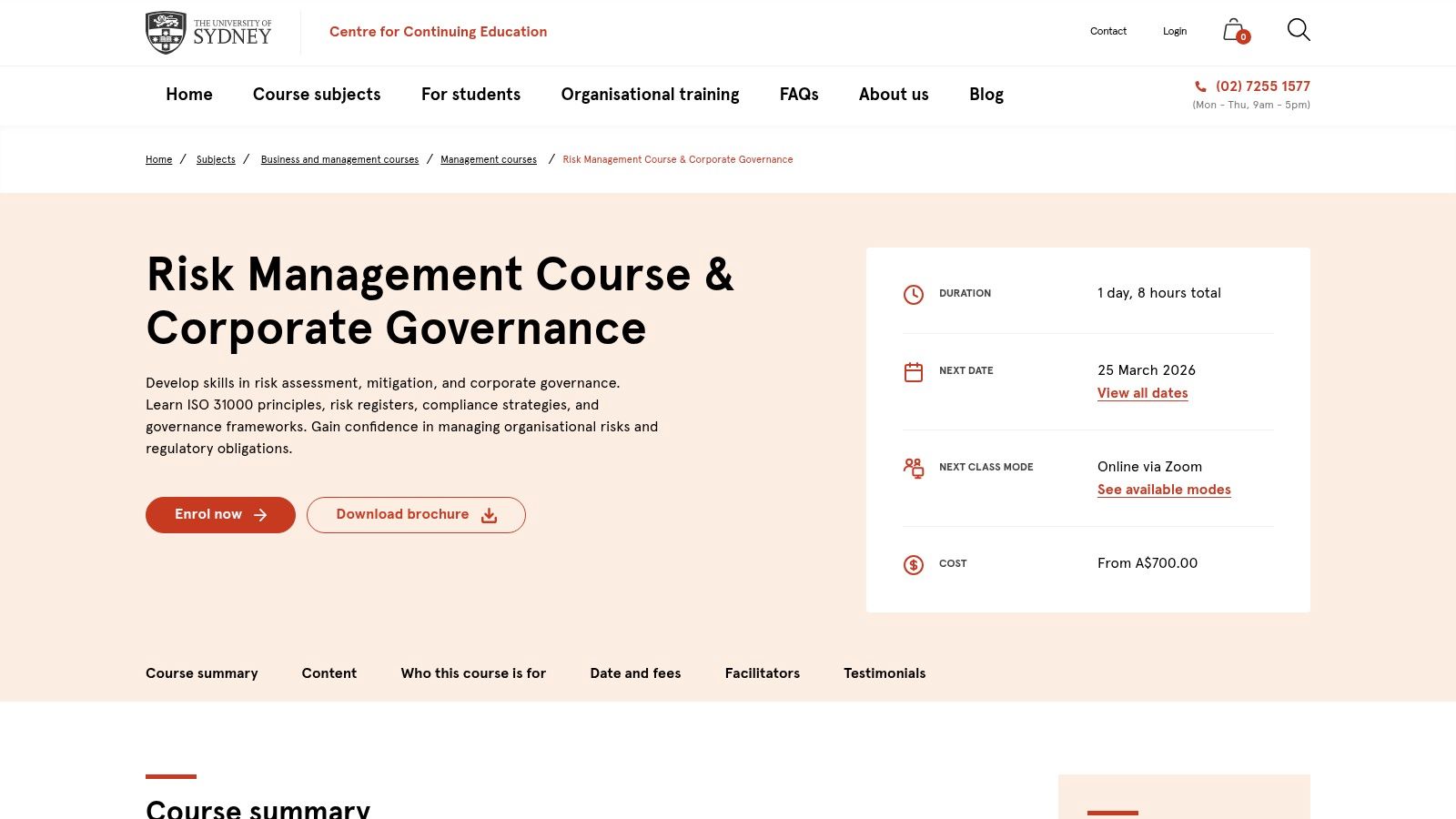
The workshop's format is its key differentiator. Delivered as an intensive 8-hour session either online or face-to-face, it is ideal for time-poor professionals who cannot commit to a multi-week course. Data scientists and ML engineers will find this course useful for gaining the foundational vocabulary and structural understanding needed to communicate risk insights to non-technical stakeholders and management. It provides the essential context to ensure that a model’s outputs and limitations are understood within the broader business governance structure, even though it doesn't lead to a formal credential.
Key Information:
Best For: Professionals needing a fast-paced, practical introduction to risk management and governance from a reputable Australian university.
Cost: Approximately $995 AUD.
Delivery: One-day (8-hour) workshop, available online via Zoom or face-to-face in Sydney.
Pros: Accessible pricing with a respected university brand; practical, facilitator-led format for immediate application.
Cons: Not a formal credential, providing a certificate of completion only; the single-day format limits depth for advanced topics.
Website: University of Sydney CCE Risk Management
7. UTS Open — Risk Management (portfolio of short courses)
For professionals whose work intersects with physical, environmental, and regulatory risk, particularly within the built environment, the University of Technology Sydney (UTS) Open platform provides a highly specialised portfolio of risk management courses. Unlike broad enterprise risk programs, these short courses are designed in collaboration with NSW government bodies and industry experts to address specific, practical challenges. This makes them ideal for engineers, planners, and data scientists working on projects related to infrastructure, environmental impact, and public safety. The curriculum focuses on applied methodologies for assessing and managing risks like flooding, bushfires, and land contamination.
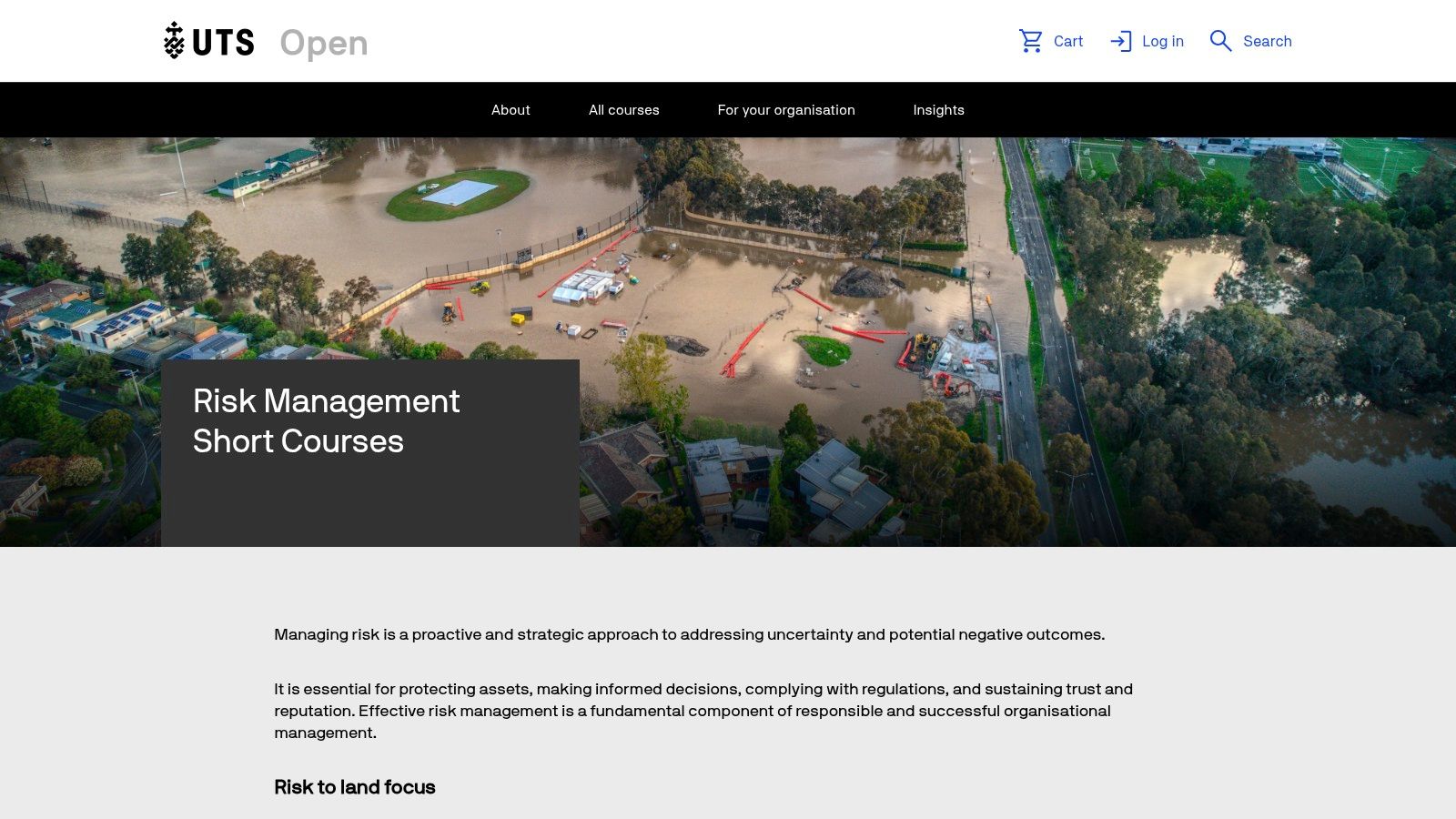
The distinct advantage of UTS Open is its modular, topic-specific design. You can select a one-to-five-day course on a precise subject, such as the Contaminated Site Assessment, Remediation and Management (CSARM) modules, without committing to a lengthy, generalised program. This targeted approach allows for immediate upskilling in an area directly relevant to your current role or a desired career pivot. For a data professional analysing geospatial data for urban planning or environmental modelling, understanding the regulatory frameworks and practical assessment techniques taught in these courses provides crucial context. This knowledge ensures analytical models are not only technically sound but also aligned with Australian industry standards and government compliance requirements.
Key Information:
Best For: Engineers, environmental scientists, and data analysts in sectors like construction, urban planning, and government who need applied skills for physical and regulatory risk.
Cost: Varies by course, typically ranging from $900 to $4,500 AUD.
Delivery: A mix of online, in-person, and blended formats, primarily based in Sydney.
Pros: Strong practical and regulatory alignment for built-environment risk; clear, topic-specific offerings allow targeted upskilling.
Cons: Not a single ERM or corporate risk course as topics are specialised; less applicable for corporate, IT, or cyber risk audiences.
Website: UTS Open Risk Management Courses
8. RMIT Online — Graduate Certificate in Cyber Security Governance and Risk Management
For technical professionals aiming to transition into leadership or governance roles, RMIT Online's Graduate Certificate in Cyber Security Governance and Risk Management offers a substantial academic qualification. This programme is designed for those who need to manage the complex interplay between technology, security, and business objectives. It moves beyond single-course training to provide a university-level credential focused on the managerial aspects of cyber risk, making it ideal for data scientists or ML engineers responsible for securing AI platforms and ensuring compliance.
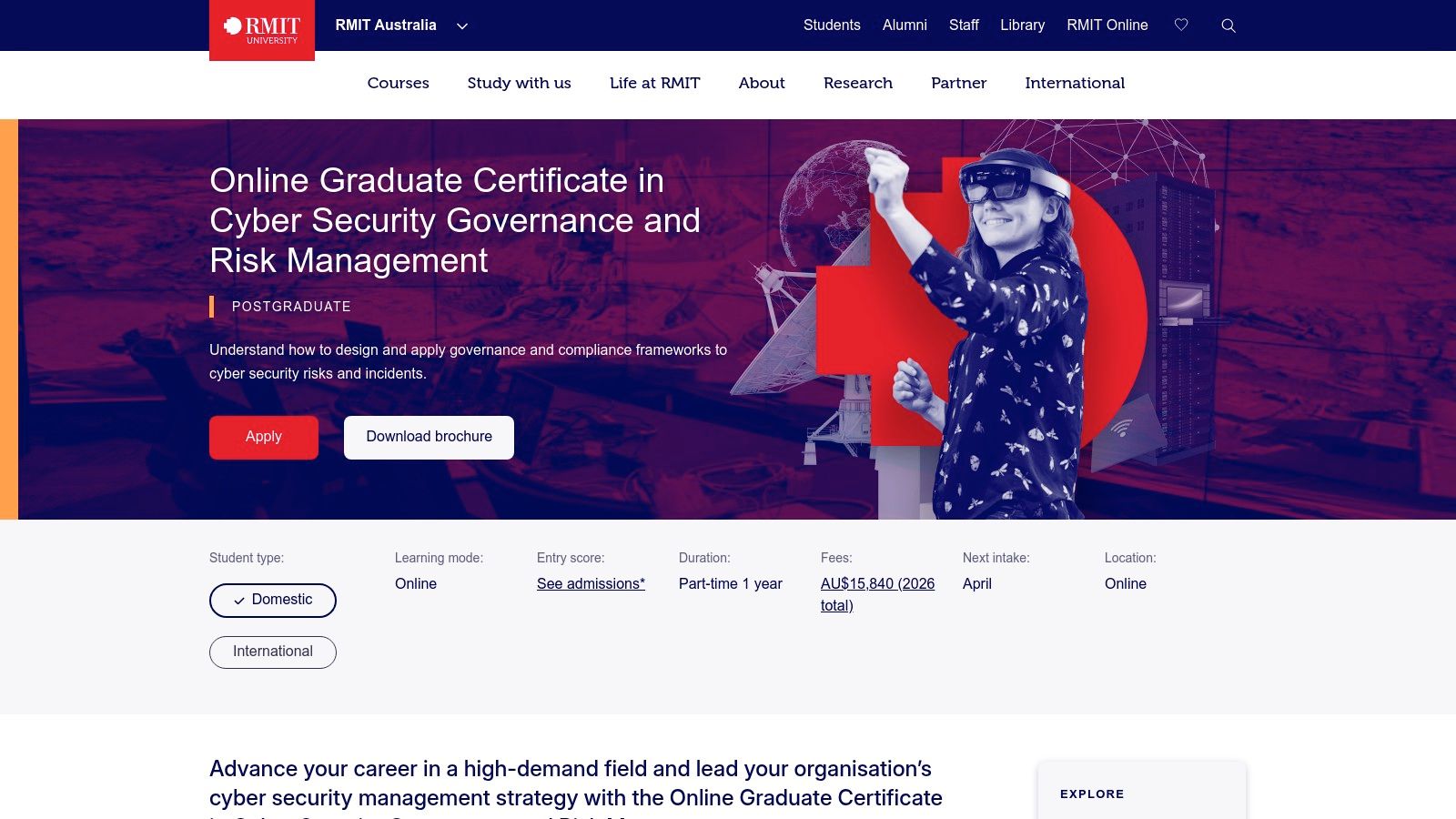
The key distinction of this graduate certificate is its academic depth and direct pathway to further study. Comprising four distinct courses, it provides a structured education in governance, risk, and compliance (GRC) within a cybersecurity context. Graduates earn credits that can be applied towards an RMIT Online MBA, offering a clear progression for those with long-term leadership ambitions. This makes it one of the more strategic risk management courses for individuals looking to build a career in cybersecurity roles where a formal qualification can be a significant advantage. The fully online delivery model provides the flexibility needed for working professionals to balance study with their existing commitments.
Key Information:
Best For: Technical leaders, data scientists, and ML engineers needing a formal qualification to move into cyber risk governance and compliance roles.
Cost: Fees are charged per course, with the full graduate certificate costing approximately $16,320 AUD. FEE-HELP is available for eligible students.
Delivery: Fully online, with multiple intake periods throughout the year.
Pros: University-level credential; provides credits towards an RMIT Online MBA; focused on high-demand GRC skills.
Cons: Significant time and financial commitment; subject to university admission criteria and academic calendars.
Website: RMIT Online Graduate Certificate in Cyber Security Governance and Risk Management
9. QUTeX (QUT Executive Education) — Resilience/Risk short courses (delivered with RMIA partners)
For senior data professionals and AI team leads stepping into leadership roles, QUT Executive Education (QUTeX) provides a crucial bridge between technical risk assessment and strategic enterprise resilience. Often delivered in partnership with RMIA, these executive-level short courses move beyond standard risk management frameworks to address modern challenges like systemic risk, organisational resilience, and managing through volatility. The content is research-informed and taught through interactive, case-based sessions designed for experienced decision-makers. This academic-practice blend makes it distinct from purely certification-focused training.
The primary value for a data or ML leader is learning to frame quantitative risk insights within a broader C-suite conversation. Instead of just presenting model accuracy, you learn to articulate how that model contributes to the organisation's ability to withstand systemic shocks. The focus is less on the mechanics of a specific standard and more on developing the strategic mindset required to lead risk conversations. Because these courses are designed for an executive audience, they provide an excellent opportunity to network with senior leaders from diverse industries, offering a different kind of peer group than technical training programs.
Key Information:
Best For: Senior AI/ML leaders and data strategists needing to translate technical risk into executive-level business resilience strategy.
Cost: Varies significantly by course; pricing and schedules depend on the specific intake and duration.
Delivery: Primarily in-person executive workshops and seminars in Brisbane, with some online options.
Pros: Strong academic-practice blend suited to executive decision-makers; highly topical content focused on resilience and disruption.
Cons: Offerings vary by term and can be niche; premium pricing aimed at a corporate/executive audience.
Website: QUT Executive Education
10. Australian Institute of Management (AIM) — Risk Management (Online)
For professionals who need practical, job-ready skills without the commitment of a formal accreditation pathway, the Australian Institute of Management (AIM) offers a highly flexible online Risk Management course. Designed for busy managers and specialists, this course focuses on immediate workplace application. It provides the tools and frameworks to identify, assess, and treat risks within an organisational context, making it an excellent choice for data professionals moving into a team lead or project management role where risk oversight becomes a key responsibility.
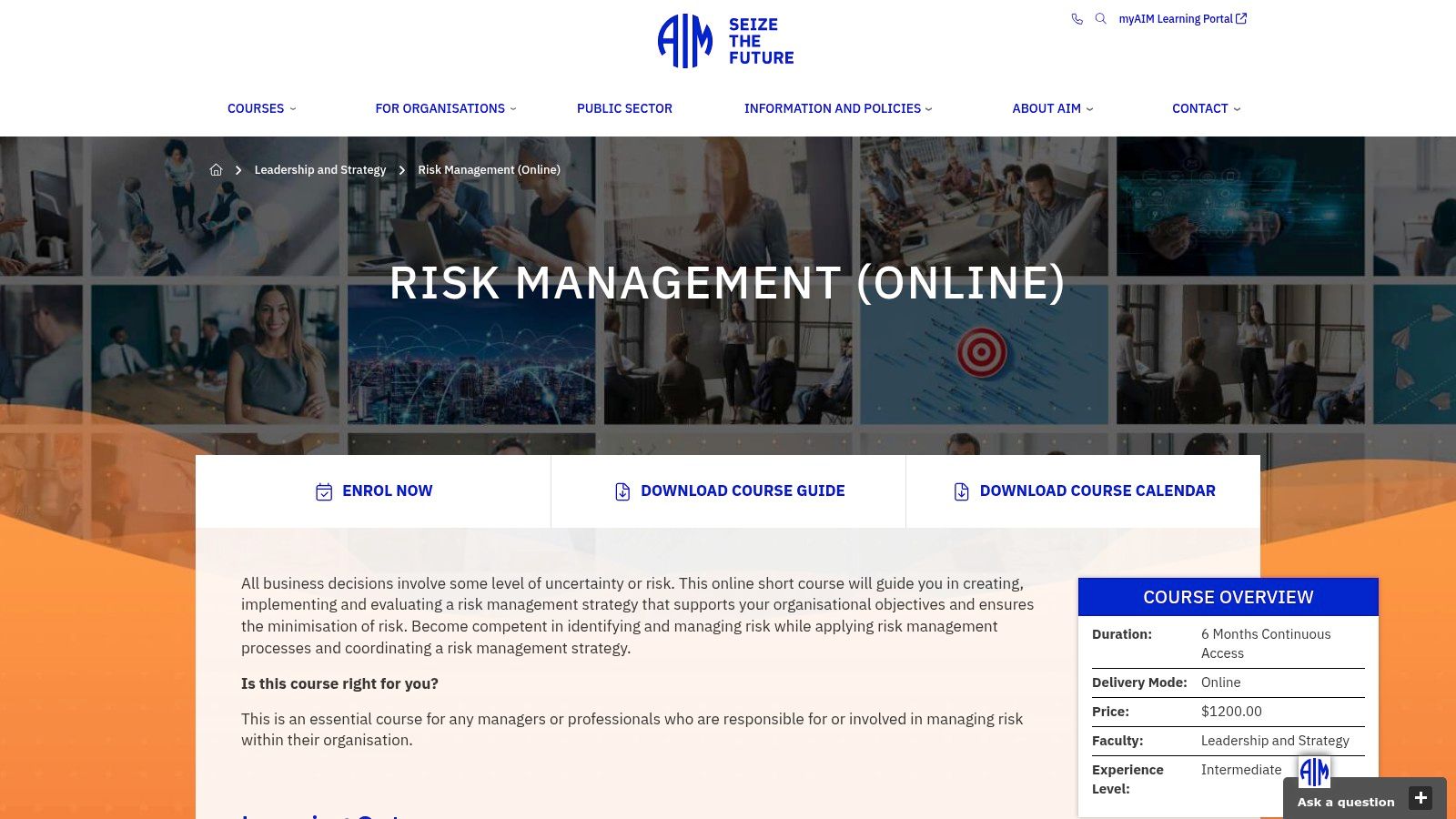
The standout feature of AIM's offering is its practicality and accessibility. The self-paced format, combined with six months of access, allows you to learn and apply concepts directly to your current projects. For an ML engineer, this could mean using the supplied templates to build a risk register for a new model deployment, addressing potential operational or ethical risks. While it doesn't lead to a specialised credential like the FRM, its recognition as a leading national Registered Training Organisation (RTO) ensures the content is high-quality and respected by employers for its focus on applied management skills. This makes it a strong contender among foundational risk management courses.
Key Information:
Best For: Busy professionals, team leads, and managers needing a practical, self-paced introduction to operational risk.
Cost: Contact AIM for current pricing. Often priced competitively for professional development budgets.
Delivery: Fully online and self-paced over six months.
Pros: Highly flexible schedule; strong focus on practical tools and workplace application; reputable provider.
Cons: Not tied to a formal external risk credential; less depth than specialised certifications.
Website: AIM Risk Management (Online)
11. ISACA (Sydney Chapter and accredited partners) — CRISC Exam Preparation (IT Risk)
For data and AI professionals whose roles intersect with technology infrastructure, cybersecurity, and information systems, the Certified in Risk and Information Systems Control (CRISC) certification from ISACA is a gold-standard credential. ISACA's global network, including its active Sydney Chapter and accredited partners, provides instructor-led bootcamps and training courses specifically designed to prepare candidates for the rigorous CRISC exam. These risk management courses are essential for anyone responsible for identifying and managing IT risk, a critical function in organisations that rely on data-intensive platforms and AI models.
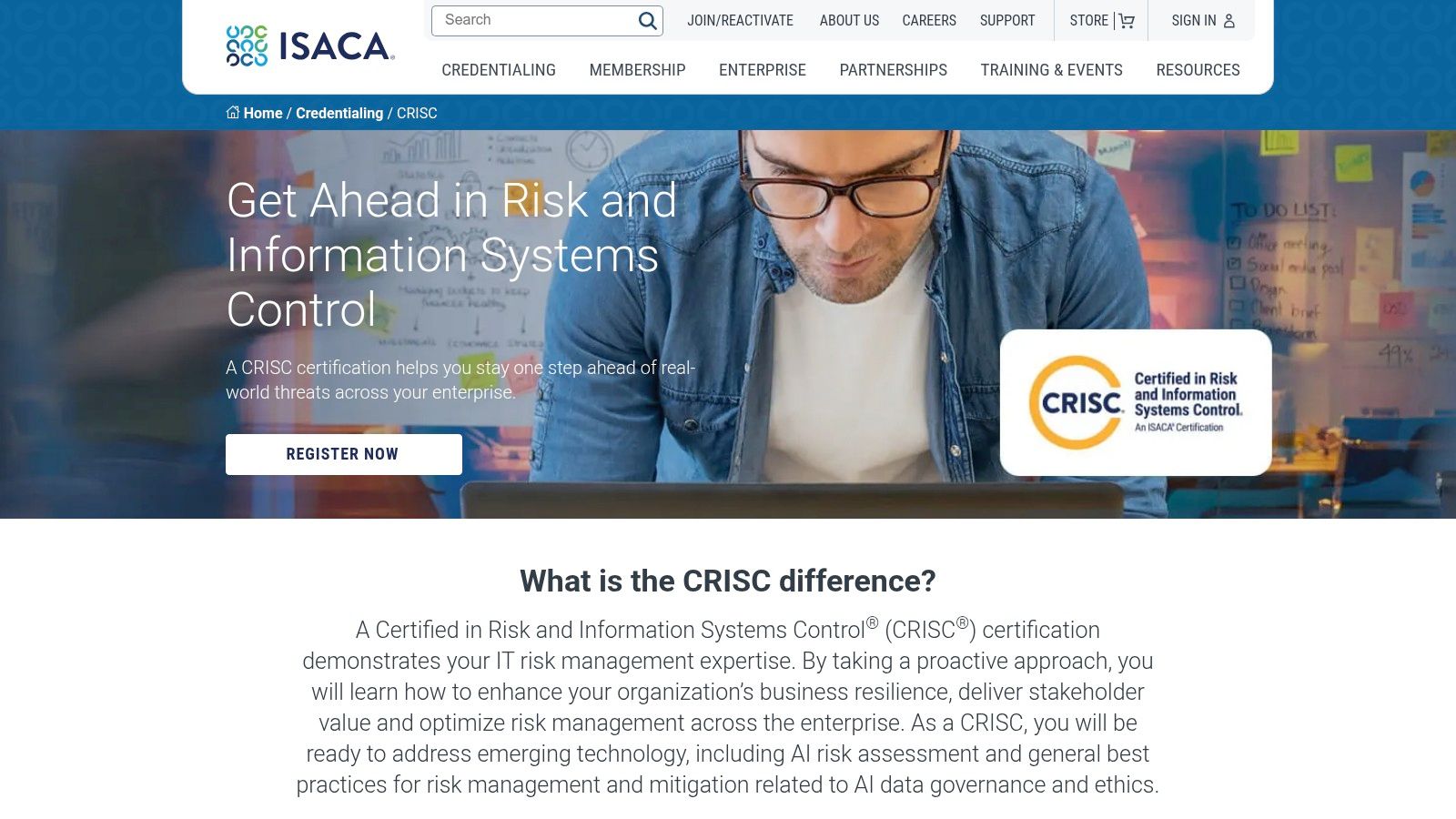
The key strength of ISACA's training is its direct alignment with the CRISC domains and its strong employer recognition within IT governance, risk, and compliance (GRC) roles. By undertaking an official preparation course, you gain access to the most current ISACA materials and exam-focused instruction, often delivered in AU-friendly time zones. For an ML engineer or data platform manager, this certification demonstrates a capacity to not only build systems but also to secure them and manage their associated operational risks according to globally recognised frameworks. It bridges the gap between technical implementation and business-level risk appetite, a skill set highly sought after in regulated industries like finance and healthcare.
Key Information:
Best For: Technical professionals (ML engineers, platform managers, data architects) moving into IT risk, audit, or GRC roles.
Cost: Varies by provider; bootcamp fees are typically separate from the exam and certification application fees.
Delivery: Virtual instructor-led training, chapter-run events (e.g., in Sydney), and self-paced materials available.
Pros: Strong employer recognition for IT risk roles; multiple delivery formats; direct exam preparation with local chapter support.
Cons: Certification requires professional experience; intensive preparation best for those with some IT risk exposure; exam and certification fees are separate.
Website: ISACA CRISC Certification
12. PM-Partners (Australia) — Managing Project Risk (and project management courses)
For data scientists and ML engineers working within project-based teams, understanding risk at the delivery level is essential. PM-Partners, a well-known Australian project management training provider, offers a dedicated "Managing Project Risk" course that frames risk within the context of project timelines, budgets, and deliverables. This practitioner-led training is less about formal risk credentials and more about equipping technical professionals with the practical skills to identify, analyse, and treat risks that could derail a data science or platform engineering project.
The key strength of PM-Partners' approach is its practicality. The courses supply attendees with applied templates and casework, moving beyond theory to hands-on planning. This is particularly useful for AI project teams where risks can be unique, such as model drift, data quality degradation, or unexpected stakeholder resistance. While the focus is on project risk, not enterprise or financial risk, the skills are directly transferable to managing the lifecycle of an AI model from development to deployment. The availability of virtual and in-person sessions across major Australian cities makes this training accessible for teams nationwide. It's an excellent choice for those who need immediately applicable tools for de-risking their specific workstreams.
Key Information:
Best For: Technical leads, data scientists, and ML engineers who need to manage risk within project delivery frameworks.
Cost: Varies by course and format; contact PM-Partners for specific pricing.
Delivery: Virtual classroom and in-person workshops in Sydney, Melbourne, Brisbane, and Perth.
Pros: Established Australian provider with a practical project management focus; useful templates and casework; multiple formats and courses can be combined for broader skills.
Cons: Not a formal risk management credential; focus is specific to project risk, not broader enterprise or cyber risk.
Website: PM-Partners
12-Provider Risk Management Course Comparison
| Provider / Program | Core focus & delivery ✨ | Target audience 👥 | Recognition & quality ★🏆 | Price & value 💰 |
|---|---|---|---|---|
| RMIA — ERM + CPRA/CPRM pathway | ISO 31000 ERM curriculum; online + city chapters; direct accreditation pathway ✨ | Practising risk professionals seeking local credentials 👥 | ★★★★; RMIA professional body & network 🏆 | 💰 Moderate + separate exam fees |
| BSI Training Academy — ISO 31000 tracks | Intro (1 day), implementation (2 day), eLearning; ISO‑aligned implementation plans ✨ | Teams wanting ISO‑aligned, internationally recognised training 👥 | ★★★★; global brand credibility | 💰 Premium for short courses |
| Intertek SAI Global — ISO 31000 Foundation (1 day) | One‑day fundamentals; classroom & virtual; Intertek Inform standards access ✨ | Entry‑level teams new to ISO 31000 👥 | ★★★; branded provider; good value | 💰 Budget‑friendly for a branded course |
| Governance Institute — Certificate in Risk & Compliance (bundle) | Six short courses; 36 CPD hrs; digital badges; on‑demand ✨ | Boards, senior managers, governance professionals 👥 | ★★★★; peak governance body recognition 🏆 | 💰 Higher upfront cost but broad bundle value |
| Governance Institute — Risk Governance (short) | Board‑oriented governance focus; practical outputs (board papers) ✨ | Executives, directors, company secretaries 👥 | ★★★; applied, governance‑centric | 💰 Moderate; member discounts |
| University of Sydney CCE — Risk Mgmt & Corporate Governance | One‑day (8 hr) facilitator‑led workshop; ASX/Corporations Act context ✨ | Professionals seeking practical, university‑led upskill 👥 | ★★★★; reputable uni delivery | 💰 Accessible single‑day pricing |
| UTS Open — Risk Management (short courses) | Specialist topics (flood, bushfire, contaminated land); practitioner instructors ✨ | Built‑environment, regulatory and NSW govt practitioners 👥 | ★★★; topic‑specific practical focus | 💰 Varies by course; transparent pricing |
| RMIT Online — Grad Cert Cyber Security Governance & Risk | 4‑course online graduate certificate; MBA credit pathway ✨ | Tech leaders, cyber/GRC professionals working on AI platforms 👥 | ★★★★; academic credential & career progression 🏆 | 💰 High cost & time commitment |
| QUTeX — Resilience / Risk short courses | Executive, case‑based sessions; research‑informed; RMIA partnerships ✨ | Senior leaders focused on resilience and systemic risk 👥 | ★★★★; academic‑practice blend | 💰 Premium / varies by intake |
| AIM — Risk Management (Online) | Self‑paced 6 modules; 6 months access; workplace tools & templates ✨ | Busy professionals needing flexible, practical learning 👥 | ★★★; national RTO delivery | 💰 Mid‑range; good workplace value |
| ISACA — CRISC Exam Preparation (Sydney & partners) | Exam‑focused bootcamps; updated ISACA materials; chapter events ✨ | IT, data, AI platform risk practitioners preparing for CRISC 👥 | ★★★★★; globally recognised cert & employer value 🏆 | 💰 Moderate prep cost + exam & membership fees |
| PM‑Partners — Managing Project Risk | Practitioner‑led project risk course; templates & PDUs; national delivery ✨ | Project managers, delivery teams, engineering/data projects 👥 | ★★★; practical PM orientation | 💰 Varies; practical templates add value |
Integrating Your New Skills and Advancing Your AI Career
You've explored the diverse landscape of risk management courses available in Australia, from university microcredentials to globally recognised professional certifications. Choosing the right program is the foundational first step, but the true measure of its value lies in how you apply your newfound knowledge. This concluding section is about turning theoretical understanding into practical capability, ensuring your investment in education translates directly into career momentum and tangible impact within your organisation.
The journey doesn't end with a certificate. It begins when you start to see your data science projects, ML models, and IT systems through a risk-aware lens. The real work is in embedding these principles into your daily workflow, influencing team decisions, and articulating your unique value proposition to current and future employers.
From Certificate to Capability: Putting Your Knowledge into Practice
Completing one of the courses we've detailed, whether it's an ISO 31000 foundation course from BSI or a specialised CRISC preparation program, equips you with a powerful new vocabulary and framework. The next step is to actively use it.
Start by reframing your role. You are no longer just a data scientist or an ML engineer; you are a professional who builds robust, reliable, and responsible AI systems. This shift in perspective is crucial.
Actionable Steps for Immediate Integration:
Conduct a Mini-Risk Assessment: Select a small, current project. Using the frameworks you learned (like the ISO 31000 process), informally map out potential risks. Consider data privacy breaches, model bias, operational failures, or reputational damage. This exercise solidifies your learning and demonstrates initiative.
Update Your Professional Profile: Go beyond simply listing the certification on your CV and LinkedIn. In your job descriptions or professional summary, articulate how this training informs your work. For example, instead of "Completed Certificate in Risk and Compliance," try "Applies formal risk and compliance frameworks to ensure robust and ethical ML model deployment."
Lead the Conversation: In team meetings or project planning sessions, start asking risk-oriented questions. "Have we considered the reputational risk if this model produces biased outcomes?" or "What's our contingency plan if this data pipeline fails?" You don't need to have all the answers, but by asking the right questions, you position yourself as a strategic thinker.
Articulating Your Value in the Australian AI Job Market
For data scientists, ML engineers, and recent graduates, a formal qualification in risk management is a significant differentiator. It signals to employers that you understand the bigger picture beyond just code and algorithms. You recognise that technical excellence must be balanced with organisational resilience and ethical responsibility.
When preparing for interviews, be ready to move beyond just mentioning your certification. Develop specific examples of how you have applied or would apply risk management principles.
Mapping Your Skills to Employer Needs:
| Your New Skill | How to Frame It in an Interview |
|---|---|
| Enterprise Risk Management (ERM) | "My training in ERM helps me connect the technical risks in my ML projects, like model drift, directly to the broader business objectives and strategic risks the company faces." |
| IT/Cyber Risk (CRISC, RMIT Cert) | "I can now better assess and communicate the specific IT risks associated with deploying new AI tools, ensuring our security posture keeps pace with our innovation." |
| Project Risk Management (PM-Partners) | "I apply formal project risk methodologies to anticipate potential blockers in our development sprints, from resource constraints to unexpected technical hurdles, leading to more predictable delivery timelines." |
By translating course content into the language of business impact, you demonstrate a maturity and commercial awareness that is highly sought after. You show that you are not just a technician but a potential leader who can safeguard the organisation’s assets and reputation. The selection of risk management courses is broad, but by aligning your choice with a specific career goal-be it operational, financial, or enterprise risk-you create a clear and compelling narrative for your professional development.
The future of AI is not just about building more powerful models; it's about building trustworthy and sustainable ones. By investing in your risk management expertise, you are not just upskilling; you are positioning yourself at the forefront of this critical evolution, ready to lead the charge in developing responsible AI in Australia.
Ready to find a role where your new risk management skills will be recognised and rewarded? AI Jobs Australia is the nation's premier platform for connecting specialised AI talent with forward-thinking employers. Explore curated opportunities where expertise in model risk, operational resilience, and ethical AI is in high demand by visiting AI Jobs Australia today.