
What Is Supervised Learning? An Essential Guide to Modern AI

At its core, supervised learning is a type of machine learning where the algorithm learns from data that already has the answers included. It’s a lot like a student learning from flashcards. Each card has a question (the input data) and the correct answer (the label), which helps the student—or in this case, the algorithm—figure out the relationship between them.
Learning with an Answer Key
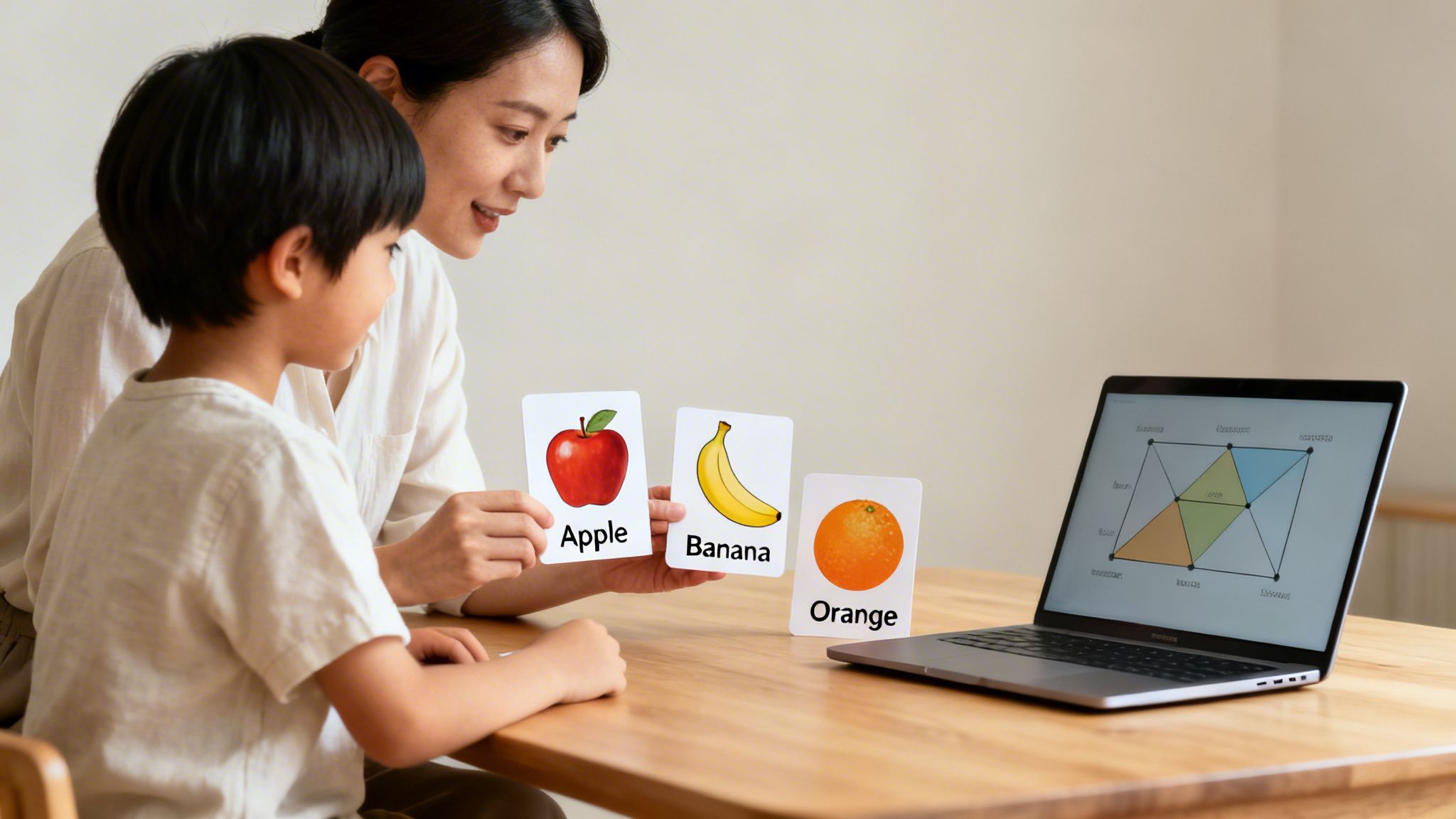
Ultimately, supervised learning mirrors how we learn with a teacher. Think about teaching a toddler to recognise different fruits. You wouldn’t just hand them a fruit bowl and walk away. You’d pick one up, say "This is an apple," and then point to another and say, "That's a banana."
This hands-on approach provides immediate feedback. The child starts to connect the visual cues—colour, shape, texture—with the label you’ve given them. After seeing enough of these labelled examples, they can confidently spot an apple they’ve never encountered before. Supervised learning algorithms operate on this exact same principle, just with data points instead of fruit.
So, Who is the "Supervisor"?
The "supervision" part of the name comes from the human-provided labels in the training data. This carefully prepared dataset acts as a guide, or a teacher, showing the model how to connect specific inputs to the correct outputs.
During the training phase, the model takes a guess based on the input data and then checks its answer against the true label. If it's wrong, it tweaks its internal logic to get closer to the right answer next time. This cycle of predicting, checking, and correcting repeats over and over until the model gets good enough at the task.
The whole point of a supervised model is to build a reliable map from inputs to outputs, so it can accurately predict outcomes for new, unseen data based on what it learned from the labelled examples.
This simple but powerful idea is the engine behind many AI applications we interact with every day. For anyone building a career in data science or AI in Australia, understanding this is non-negotiable, as it’s the foundation for countless business solutions. From forecasting customer churn at a major bank to diagnosing diseases from medical scans, learning from labelled data is what makes it all possible.
The Building Blocks of Supervised Learning
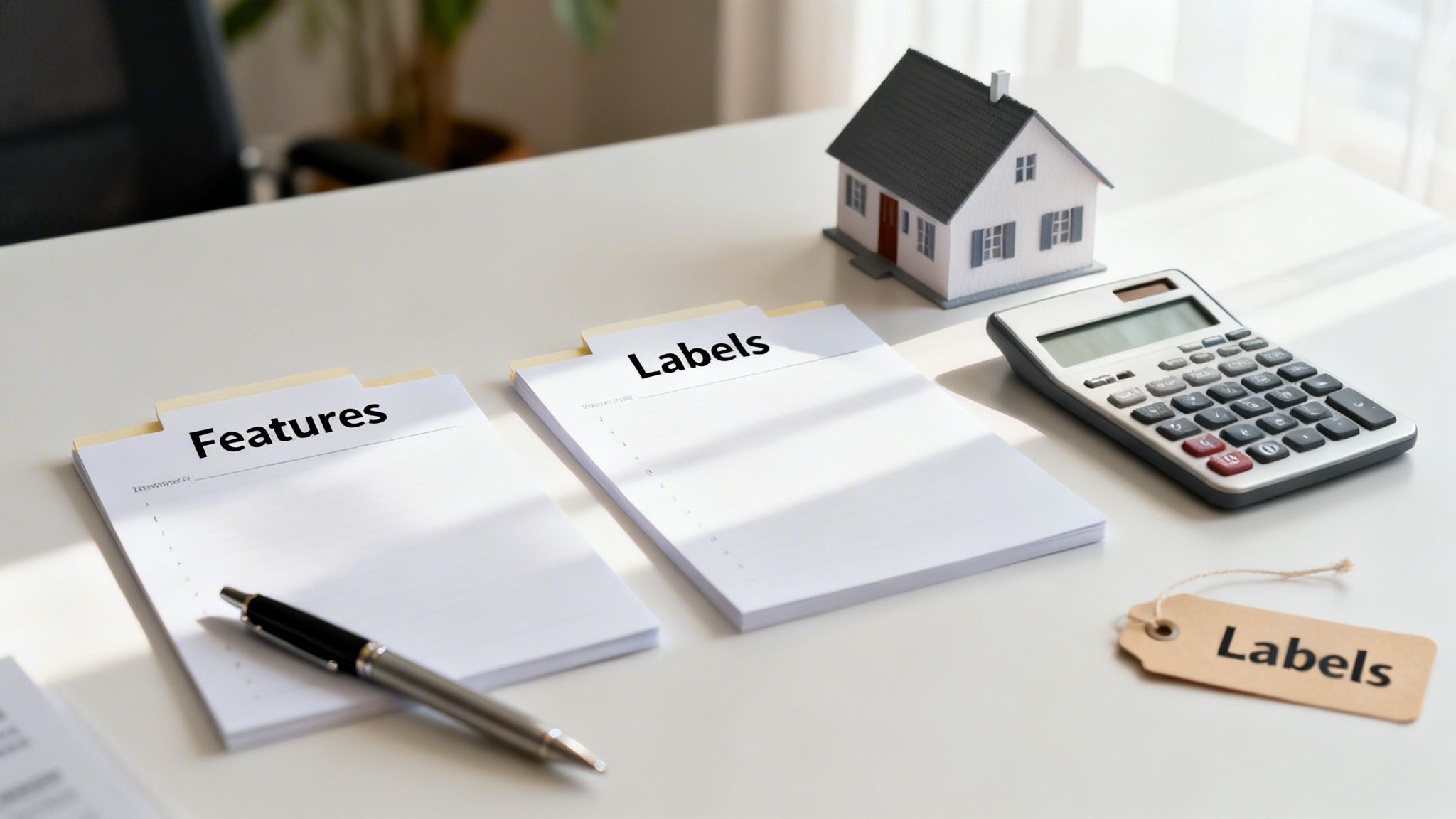
To really get your head around supervised learning, you need to know its three core ingredients. No matter how complex the task, every single supervised learning model is built from the same fundamental parts, all working together to turn raw data into smart predictions.
Think of it like teaching a toddler to identify animals. You show them a picture (the input), you say the name of the animal (the correct answer), and over time, their brain (the model) learns to connect the two.
Let's break down the machine learning equivalents.
Features: The Inputs
First up, we have features. These are just the individual, measurable bits of information you feed into the model. They are the clues, the raw data points, the characteristics of whatever you’re trying to analyse.
Let’s stick with a classic Australian example: predicting the sale price of a house in Sydney. The features are all the descriptive details you have about the property.
- Number of bedrooms (e.g., 3, 4, 5)
- Square metre size of the land and the house itself
- Suburb or postcode (e.g., Bondi, Parramatta)
- Proximity to the nearest train station in kilometres
- Age of the property in years
These features are the evidence the model uses to make its decision. The more relevant and high-quality your features are, the better the final prediction will be. Getting this right is a huge part of the job, and it’s often done using popular tools you can explore in our guide on Python for machine learning.
Labels: The Target Outcome
Next, we have the label. This is simply the "answer" you want the model to predict—the correct outcome or target. Going back to our flashcard analogy, the label is the name of the fruit on the back of the card. It's the known truth that the model learns from.
For our Sydney house price example, the label is straightforward: the final sale price of the house in Australian dollars.
In supervised learning, every single data point (a house) has its features (bedrooms, size, location) paired with a corresponding label (the price it sold for). The model's entire job is to figure out the hidden relationship between the features and that label.
This pre-labelled dataset is precisely what makes the whole process "supervised." Without those correct answers to guide it, the algorithm would just be guessing in the dark.
The Model: The Learning Algorithm
Finally, there’s the model. This is the algorithm that crunches the numbers. It’s the engine that takes in all those property features and learns how to spit out an estimated sale price.
During the training phase, the model sifts through thousands of historical property listings (the features) alongside their known sale prices (the labels). It constantly adjusts its internal logic, trying to close the gap between its own predicted price and the actual sale price.
Once this training is done, you have a powerful tool. You can show it a brand new property listing it’s never seen before, and it will produce a remarkably accurate price prediction.
Classification vs Regression Explained
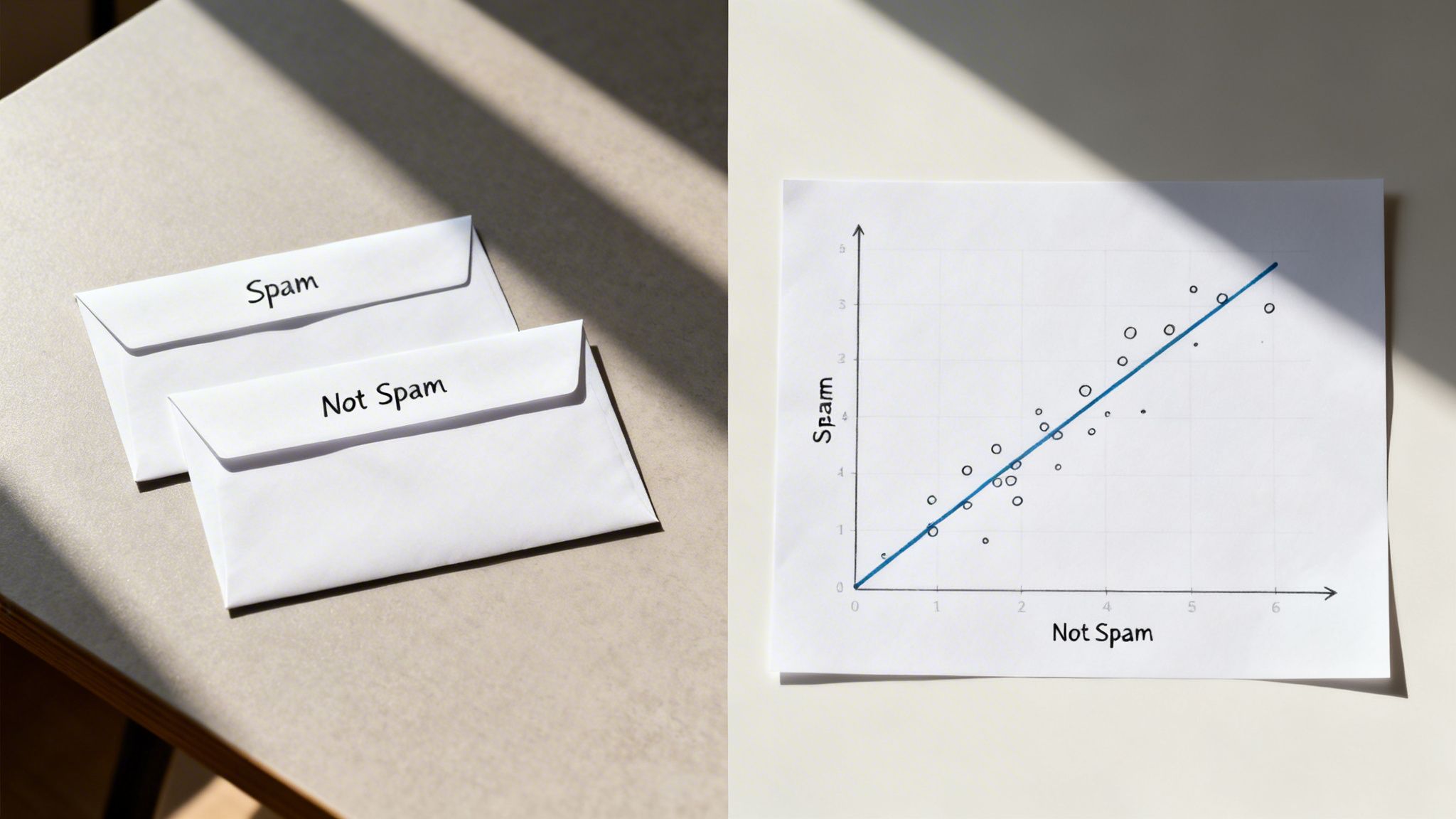
Once you get into supervised learning, you'll quickly find that most problems fall into one of two buckets: classification or regression. Getting your head around the difference is absolutely fundamental because it shapes which algorithms you’ll use and how you’ll measure whether your model is actually any good.
The easiest way to think about it is this: classification is like sorting mail into different pigeonholes, while regression is like using a set of scales to find an exact weight. One task is about assigning a label, the other is about predicting a number.
Classification: Predicting a Category
A classification task is all about assigning a label. The model takes a look at the data you give it and decides which predefined category it belongs to. The output is a distinct, qualitative choice.
The perfect, everyday example is your email spam filter. It scans an incoming message—looking at the sender, subject line, words used, and so on—and makes a call: is this "Spam" or "Not Spam"? It’s a clear-cut decision with no middle ground.
Here are a few other places you’ll see classification at work:
- Medical Diagnosis: Analysing a medical image to classify a tumour as either "Malignant" or "Benign."
- Customer Churn: A telco predicting if a customer will "Churn" (leave) or "Stay" based on their account activity.
- Image Recognition: An algorithm identifying an animal in a photo as a "Dog," "Cat," or "Bird."
In every one of these scenarios, the goal is to pin a specific label on something. This is a crucial function in Australian industries from fintech to healthcare, where making accurate categorical judgements drives business decisions.
Regression: Predicting a Number
On the flip side, regression is all about predicting a continuous, numerical value. Instead of sorting things into categories, the model's job is to forecast a specific quantity on a sliding scale. The answer isn't "yes" or "no," but "how much?"
Picture a real estate agency in Melbourne trying to price homes. A regression model would take in features like the property’s square metres, location, and number of bedrooms to predict its sale price. The output wouldn't be a vague label like "Expensive," but a concrete figure like $850,000.
A handy mental shortcut: if you're asking "Which one?" or "What kind?", it’s probably a classification problem. If you're asking "How much?" or "How many?", you're almost certainly dealing with regression.
Other common regression tasks include:
- Weather Forecasting: Predicting tomorrow's temperature in degrees Celsius.
- Demand Forecasting: An Australian supermarket chain like Coles predicting how many cartons of milk it will sell next week.
- Financial Modelling: Estimating a company's projected revenue for the next financial quarter.
Both classification and regression are powerful techniques, and knowing which one to use comes down to the question you need to answer. Are you sorting data into neat piles, or are you trying to pinpoint a specific number?
Comparing Classification and Regression Tasks
To make the distinction even clearer, here's a simple side-by-side comparison.
| Aspect | Classification | Regression |
|---|---|---|
| Output Type | Discrete category or label (e.g., "Yes," "No," "Spam") | Continuous numerical value (e.g., 25.4, $150,000) |
| Core Question | "What kind is this?" or "Which group does it belong to?" | "How much is it?" or "How many will there be?" |
| Evaluation | Accuracy, Precision, Recall, F1-Score | Mean Absolute Error (MAE), Root Mean Squared Error (RMSE) |
| Example | Is this email spam or not spam? | What will the house price be? |
Ultimately, choosing the right approach is the first step towards building a successful supervised learning model.
A Tour of Popular Supervised Learning Algorithms
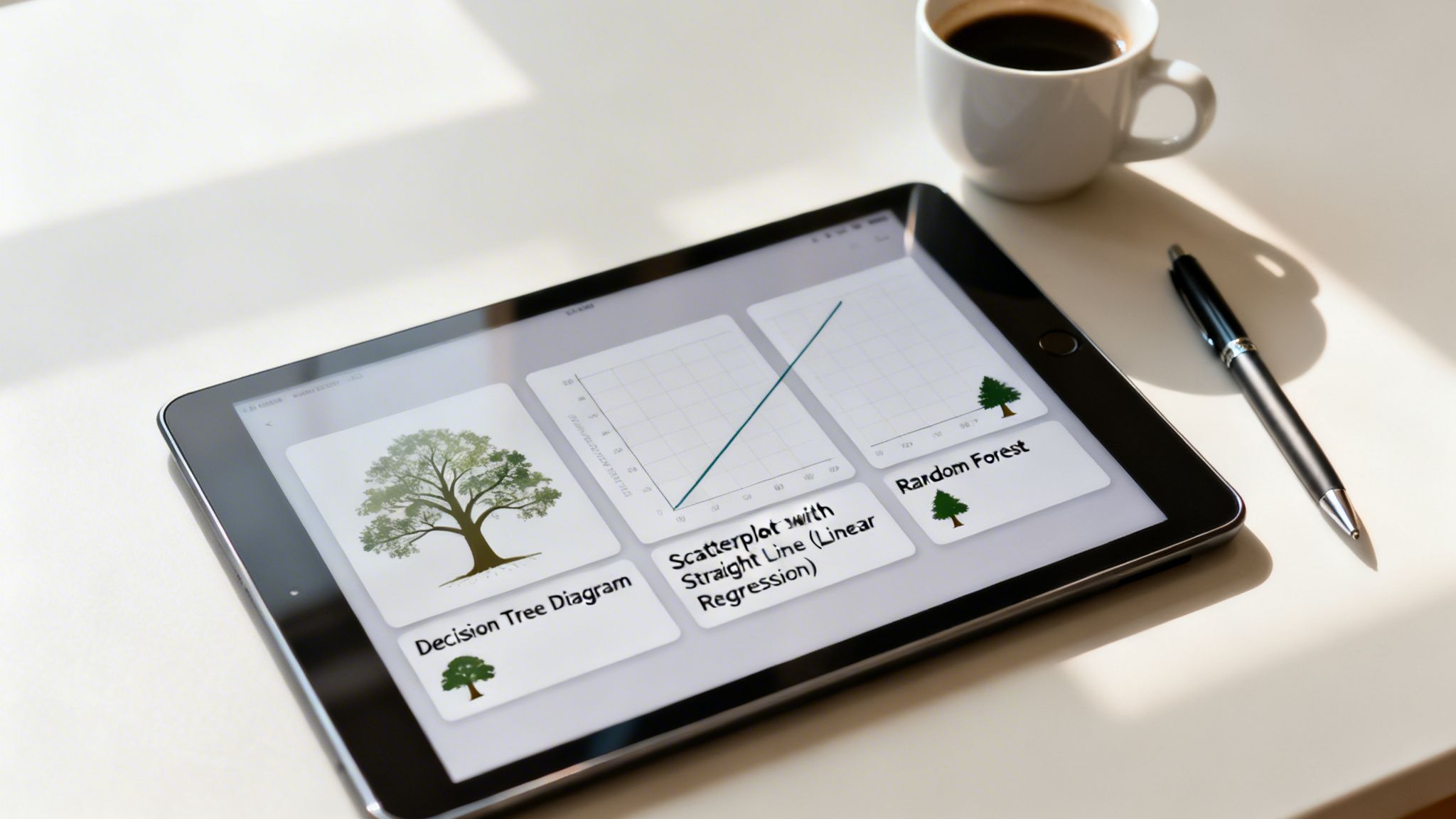
Knowing whether you're dealing with a classification or regression problem is the first big hurdle. The next is picking the right tool for the job. While there are hundreds of algorithms out there, a handful of trusted workhorses handle most of the tasks you'll come across in the Australian tech scene.
Let's skip the dry, academic definitions. Instead, we'll use simple analogies to get a real feel for how these algorithms "think" and where they shine. Getting your head around these core models is a must for any data professional trying to solve actual business problems.
Linear and Logistic Regression
These two are the bread and butter of supervised learning—often the first you'll learn, and for good reason. They're fast, straightforward, and you can easily explain how they work.
Think of Linear Regression as someone trying to draw the best possible straight line through a scatter plot. Its whole job is to find the simplest linear relationship between your inputs and a continuous output. It's the perfect choice for regression tasks.
For example, you could use it for:
- Predicting a graduate's starting salary based on their years of experience.
- Estimating a property's value based on its square metre size.
Logistic Regression, despite its name, is your go-to for classification. Picture it as a simple "yes/no" switch. It takes in data, calculates the probability of an outcome, and slots it into one of two categories. It’s ideal for binary classification tasks where you need a clear, decisive answer.
Decision Trees
If you’ve ever played a game of "20 Questions," you instinctively understand how a Decision Tree works. The algorithm asks a series of simple "if-then" questions to split the data, creating a flowchart that leads to a final conclusion.
Imagine a bank using one to decide on a loan application. The logic might look like this:
- First Question: Is the applicant's income over $70,000?
- If yes, next question: Have they been employed for more than two years?
- If no, next question: Do they have any prior defaults?
This branching continues until it hits a final decision, or a "leaf node," like "Approve Loan" or "Reject Loan." The beauty of Decision Trees is that they’re incredibly easy to visualise. You can literally show a stakeholder the exact path the model took to arrive at its decision.
But there's a catch. A single Decision Tree can easily overfit—it learns the training data too well, like a student who memorises the textbook but can't apply the concepts to a new problem. This is where its more powerful cousin comes in.
Random Forests
To get around the overfitting problem, we can use a Random Forest. The name is a perfect description: instead of relying on one Decision Tree, this algorithm builds an entire forest of them. Each tree is trained on a slightly different, random sample of the data.
When you need a prediction, every tree in the forest gets a vote. For a classification task, the model's final answer is the category with the most votes. For a regression task, it's the average of all the individual predictions.
This "wisdom of the crowd" method makes Random Forests remarkably accurate and stable. By averaging out the quirks and errors of many different trees, the final result is far more reliable. It’s a go-to choice for complex problems across finance, healthcare, and e-commerce right here in Australia.
How Supervised Learning Powers Australian Industries
The theory behind supervised learning is one thing, but its real power comes to life when you see it in action. Across Australia, this technology has left the research labs and is now a core part of how major industries operate, quietly shaping business decisions and customer experiences every single day.
From the big banks in Sydney to hospitals in Melbourne, Australian organisations are using supervised models to solve complex, practical problems and get a real competitive edge. This isn't some far-off trend—it’s happening right now, creating thousands of high-demand roles for professionals who know how to turn labelled data into valuable insights.
The investment reflects this reality. Australian organisations are projected to spend over AUD 6 billion on AI and machine learning by 2026. This spending spree isn't just for show; it's driven by the clear, bottom-line value that supervised learning delivers, from stopping fraud to creating personalised customer journeys. You can find more detail on Australia's investment in AI and machine learning.
Banking and Finance
In the financial world, supervised learning is the bedrock of modern risk management and security. Take the major Australian banks like CommBank and NAB; they rely on classification models to shield their customers from fraud in real-time.
These systems are incredibly sophisticated. They analyse thousands of features for every single transaction—things like the time, location, amount, and merchant—to classify it as either "Legitimate" or "Potentially Fraudulent." If a transaction gets flagged, an alert is triggered, often stopping a fraudulent payment before it even goes through. At the same time, regression models are busy assessing credit risk, predicting the likelihood that a loan applicant will default based on their financial history.
Healthcare and Medical Research
The impact on healthcare, especially in states like NSW and Victoria, has been profound. Here, supervised learning models—particularly those built for image classification—are being trained to spot diseases in medical scans with remarkable accuracy.
Think about it like this: an algorithm is fed thousands of labelled MRI scans. Some show signs of a specific condition, others are perfectly healthy. The model learns to identify the subtle patterns, sometimes patterns a human radiologist might overlook. This can lead to earlier, more accurate diagnoses, which ultimately improves patient outcomes. It’s not about replacing doctors, but about giving them a powerful new tool to work with.
By learning from vast libraries of labelled medical data, supervised models can act as a second pair of eyes for radiologists and clinicians, helping them make faster and more informed decisions.
E-commerce and Retail
Online retail is another fantastic example. Australian e-commerce giants like The Iconic use supervised learning to craft personalised shopping experiences. Every time you click around their site, a regression model is humming away in the background.
It’s constantly making predictions about which products you’re most likely to be interested in, based on signals like:
- Your past browsing history
- Items you've previously purchased
- What similar customers have bought
This allows them to dynamically change the product recommendations you see, making the whole experience feel more relevant and intuitive. It's a classic supervised learning application that has a direct, measurable impact on sales and customer loyalty. This ability to forecast what a customer will do next is a huge field, which you can read more about in our guide on what is predictive analytics.
Building Your Career in Machine Learning in Australia
Getting your head around the theory is a great first step, but the real goal is to turn that knowledge into a fulfilling career. Australia’s artificial intelligence scene isn't just growing; it's absolutely exploding with opportunities for people who can build, deploy, and manage supervised learning models.
The local market is red hot. Valued at around AUD 2.61 billion in 2025, Australia's machine learning sector is forecast to grow at a staggering 47.40% each year through to 2035. This isn't just a number on a page; this incredible expansion, detailed in recent market analysis from Expert Market Research, means a huge demand for skilled talent in every major city.
We're talking about real-world roles opening up everywhere—from finance and healthcare to retail. If you're looking to break into the field, now is the time to build the skills and create a portfolio that will make you stand out.
Essential Skills for Aspiring Professionals
To catch a hiring manager's eye in the Australian job market, you need more than just technical chops; you need a knack for practical problem-solving. Companies are looking for people who can show they can deliver real value from day one.
Start by focusing on these core areas:
- Programming Proficiency: Being fluent in Python is a must. You'll also need to be comfortable with its key data science libraries like Pandas, NumPy, and Scikit-learn.
- Algorithm Intuition: You don't have to memorise every last formula, but you do need to genuinely understand how different supervised learning algorithms work—what they're good at, and where they fall short.
- Data Wrangling and Feature Engineering: Let's be honest, real-world data is a mess. Showing you can take raw, messy data and transform it into clean, useful features is a skill that’s seriously in demand.
- Model Evaluation: Knowing how to properly test a model and make sense of metrics like accuracy, precision, and RMSE is what separates the beginners from the pros.
A strong portfolio is your best resume. It’s tangible proof that you can not only talk about supervised learning but also apply it to solve real problems.
Create projects that put these skills on display. For example, you could build a regression model to predict property prices in your city using real estate data, or a classification model to spot fraudulent transactions from a public dataset. The key is to document your entire process on a platform like GitHub so recruiters can see how you think. For more detailed steps, check out our guide on how to become an AI engineer in Australia.
Advice for Hiring Managers
If you're on the other side of the desk, finding the right person is your biggest challenge. In a market this competitive, you need a smart strategy to spot candidates with genuine potential and design roles that the best people actually want.
When you're interviewing, try to move past the textbook questions. Ask a candidate to walk you through a project they're proud of, focusing on the hurdles they hit and the choices they made to overcome them. Give them a hypothetical business problem and ask for their approach—which model would they start with, and why? This tells you a lot more about their practical skills than any pop quiz.
To bring in the best talent, create roles that offer a real sense of growth and impact. Top candidates aren't just looking for a paycheque; they want to work on interesting problems, have some autonomy, and see the results of their hard work.
Ready to find your next role or hire top talent in the AI space? At AI Jobs Australia, we connect the brightest minds with the best opportunities in the country. Explore AI jobs today.