Your Guide to Mastering MLOps in Australia

Ever had that frustrating experience of building a brilliant, high-performance machine learning model, only to see it gather dust in a digital garage? That's a common story in AI. A model might perform beautifully in a lab, but getting it into the real world—and keeping it running reliably—is a whole different ball game. This is where MLOps comes in; it's the bridge that turns promising AI experiments into tangible business value.
What Is MLOps and Why Is It Booming in Australia?
So, what exactly is MLOps (Machine Learning Operations)? Think of it as the pit crew and race-day logistics for your AI. While data scientists are busy building the powerful engine (the model itself), MLOps engineers are the ones designing and maintaining the entire system that gets that engine onto the racetrack, monitors its performance, and allows for rapid, seamless part swaps when needed.
This specialised discipline is crucial because machine learning systems aren't like traditional software. A standard application is relatively static once deployed, but an ML model's performance can degrade over time. It starts making less accurate predictions as it encounters new data that looks different from what it was trained on. This is a well-known problem called model drift, and MLOps provides the automated framework to detect it, trigger retraining, and redeploy updated models without missing a beat.

From the Garage to the Racetrack: The MLOps Difference
The need for a dedicated MLOps approach becomes crystal clear when you compare the machine learning lifecycle to traditional software development. While both rely on automation and continuous delivery, machine learning introduces unique complexities that are all tied to the unpredictable nature of data and model behaviour.
MLOps isn't just "DevOps for machine learning." It's an expanded philosophy that treats data, models, and code as first-class citizens in an automated, iterative, and reproducible system.
This distinction is what makes all the difference. Without these practices, many organisations get their models stuck in "pilot purgatory"—they work great as a proof-of-concept but are too fragile or complex to deploy and maintain at scale. A proper MLOps strategy is the cure, bringing discipline and automation to every stage. As you build out your systems, you might find our guide on the top 12 generative AI tools for Aussie professionals a handy resource for expanding your personal toolkit.
Australia's MLOps Gold Rush
Here in Australia, the demand for MLOps expertise is skyrocketing. As more local companies move beyond simply experimenting with AI, the need for robust, production-grade systems has become a critical business priority. The numbers tell the story: Australia's machine learning market, valued at AUD 2.61 billion in 2026, is projected to hit a staggering AUD 126.36 billion by 2035.
This incredible growth is fuelled by the fact that 68% of Australian businesses have already started moving their AI initiatives from pilot projects into full production. This shift creates a massive demand for professionals who can build and manage these complex systems. You can discover more insights about Australia's AI market growth on expertmarketresearch.com.au.
To really drive home why MLOps is so different from standard DevOps, let's break down the key distinctions.
ML Lifecycle vs Traditional Software Lifecycle
| Lifecycle Aspect | Traditional Software (DevOps) | Machine Learning (MLOps) |
|---|---|---|
| Core Components | Code is the primary asset. | Code, models, and data are all core assets. |
| Testing Focus | Unit tests, integration tests, UI tests. | Includes data validation, model validation, and A/B testing. |
| Deployment Trigger | New code commit or feature release. | Can be triggered by new code, new data, or model decay. |
| Key Challenge | Ensuring code works as expected. | Ensuring the model performs well on unseen, live data. |
| Monitoring | System health, uptime, CPU/memory usage. | Includes data drift, concept drift, and model performance metrics. |
As you can see, MLOps adds several layers of complexity, focusing not just on the application's health but on the performance and integrity of the data and the model itself. This is what makes it such a specialised and valuable skill set in today's AI-driven market.
The Core Pillars of an MLOps Framework
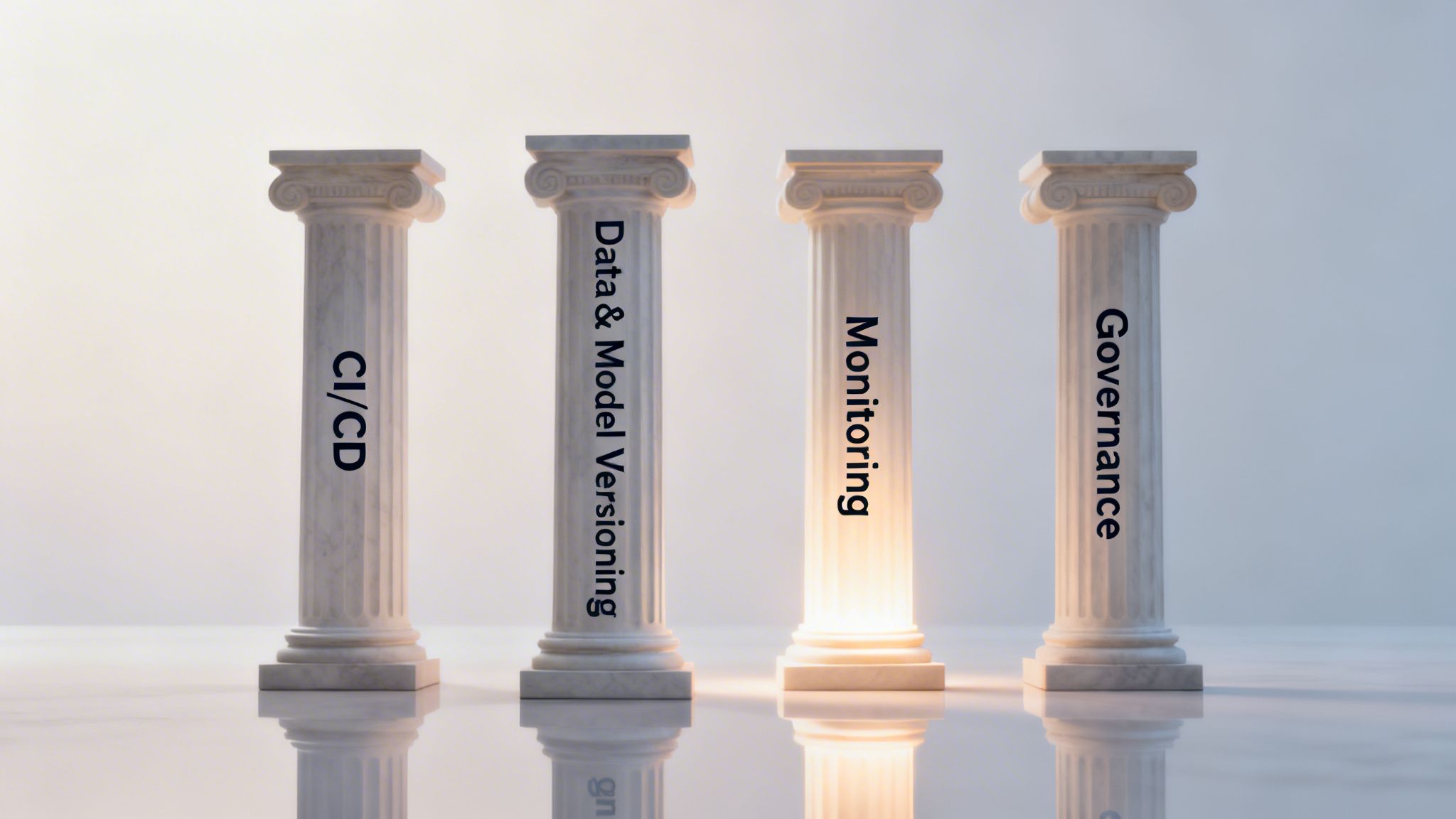
A solid MLOps framework isn't just one piece of software. It’s a culture and a set of practices that bring discipline and velocity to the machine learning lifecycle. To really get MLOps, you need to understand the four foundational pillars that hold it all together. Each one solves a critical problem that arises when you try to move a model from a data scientist’s laptop into the real world.
Think of it like a high-performance racing team. You have the engine builders, the chassis experts, the pit crew, and the strategists. They all have their own jobs, but they need to work in perfect sync to win. If one part of the team fails, the whole effort falls apart.
This integrated mindset is exactly what Australian companies are looking for. They need professionals who see the big picture—how CI/CD, versioning, monitoring, and governance all connect to drive real business outcomes.
CI/CD for Machine Learning
Most of us have heard of Continuous Integration and Continuous Delivery (CI/CD) from the world of software development. But in MLOps, it’s a whole different beast. The automation here goes way beyond just compiling and testing code; it has to wrangle data, models, and experiments.
A traditional software pipeline kicks off when a developer commits new code. An MLOps pipeline is far more dynamic. A new run might be triggered by a code change, sure, but it could also be triggered by a fresh batch of data or, even more interestingly, a dip in the live model's performance.
Imagine an Australian e-commerce site with a product recommendation engine. A proper CI/CD pipeline for this model would automatically:
Trigger when the week's customer interaction data is ready.
Validate that new data, checking for anomalies or quality issues before it pollutes the model.
Retrain the model on the combined old and new datasets.
Evaluate the challenger model against the current champion, ensuring it's genuinely an improvement.
Deploy the winning model into production, often without a human touching a thing.
This hands-off process ensures the recommendations stay sharp and relevant, which is the entire point of a good MLOps strategy.
Data and Model Versioning
In software, you version your code with tools like Git. Simple enough. In machine learning, that’s only one-third of the story. You absolutely must version your data and your models as well. This pillar is all about one thing: complete reproducibility. It's the ability to travel back in time and perfectly recreate any model you've ever built.
Think of versioning as the 'black box recorder' for your machine learning projects. It tracks not just the code that trained the model, but also the exact dataset used and the resulting model artifact itself.
This level of traceability is non-negotiable for debugging, auditing, or compliance. If a model at a fintech company starts making biased loan approvals, version control lets the team instantly identify the exact cocktail of code, data, and configuration that caused the issue. Without it, you’re just guessing.
Continuous Monitoring
Getting a model into production isn't the finish line; it's the starting line. Continuous Monitoring is your 24/7 watchtower, keeping an eye on your model's health and performance out in the wild. This isn’t the same as standard software monitoring that tracks CPU usage and server errors. MLOps monitoring looks at metrics unique to machine learning.
Here’s what you should be tracking:
Model Drift: Is the model's accuracy slowly degrading as the world changes around it?
Data Drift: Is the live data the model sees today fundamentally different from the data it was trained on?
Performance Metrics: Are you still achieving the business goal? This could be click-through rates, fraud detection accuracy, or customer churn reduction.
Bias and Fairness: Is the model treating all user groups equitably?
This proactive watch gives you an early warning system. It tells you when your model is going stale and it’s time to kick off that CI/CD pipeline for a retrain.
Governance and Compliance
The final pillar, Governance, is what makes your AI responsible, explainable, and trustworthy. This is especially crucial in highly regulated Australian industries like finance, insurance, and healthcare. It’s about having clear rules for documentation, managing who can access or change models, and being able to explain why a model made a certain decision.
As Australia's adoption of AI grows, this pillar is becoming a deal-breaker for serious organisations. By 2026, the Australian government's AI Action Plan aims to make the nation a global leader in trusted, ethical AI. MLOps provides the technical backbone for this ambition, directly tackling major adoption hurdles like the 63% of integration challenges and 59% of compliance barriers companies report facing. You can learn more about the AI landscape in Australia and its market drivers on appinventiv.com.
Ultimately, good governance is what allows you to build AI that people and regulators can trust, paving the way for scaling your efforts responsibly.
How MLOps Workflows Actually Operate
To really get a feel for MLOps, let's move beyond the theory and walk through how it works in practice. Think about the journey a model takes: it starts as a spark of an idea, a few lines of code in a data scientist's notebook. The goal is to turn that fragile experiment into a robust, automated system that can serve live predictions to thousands, or even millions, of users without falling over.
This is exactly what an MLOps pipeline does. It forges a reliable path from development to production, creating a continuous loop where the two sides work together.
The whole process is built around automation and consistency. A good workflow isn't a straight line; it's a cycle that learns and improves itself with every piece of new data and performance feedback. Each stage acts as a quality gate, ensuring everything is solid before the model moves on to the next step. It’s this structure that brings proper engineering discipline to the often-chaotic, experimental world of data science.
Visualising the MLOps Lifecycle
A diagram is often the best way to see how this all connects. While the exact tools and steps can differ between companies, the core stages of the journey from raw data to a production-ready model are surprisingly consistent.
The image below lays out a simplified but powerful view of these connected stages.
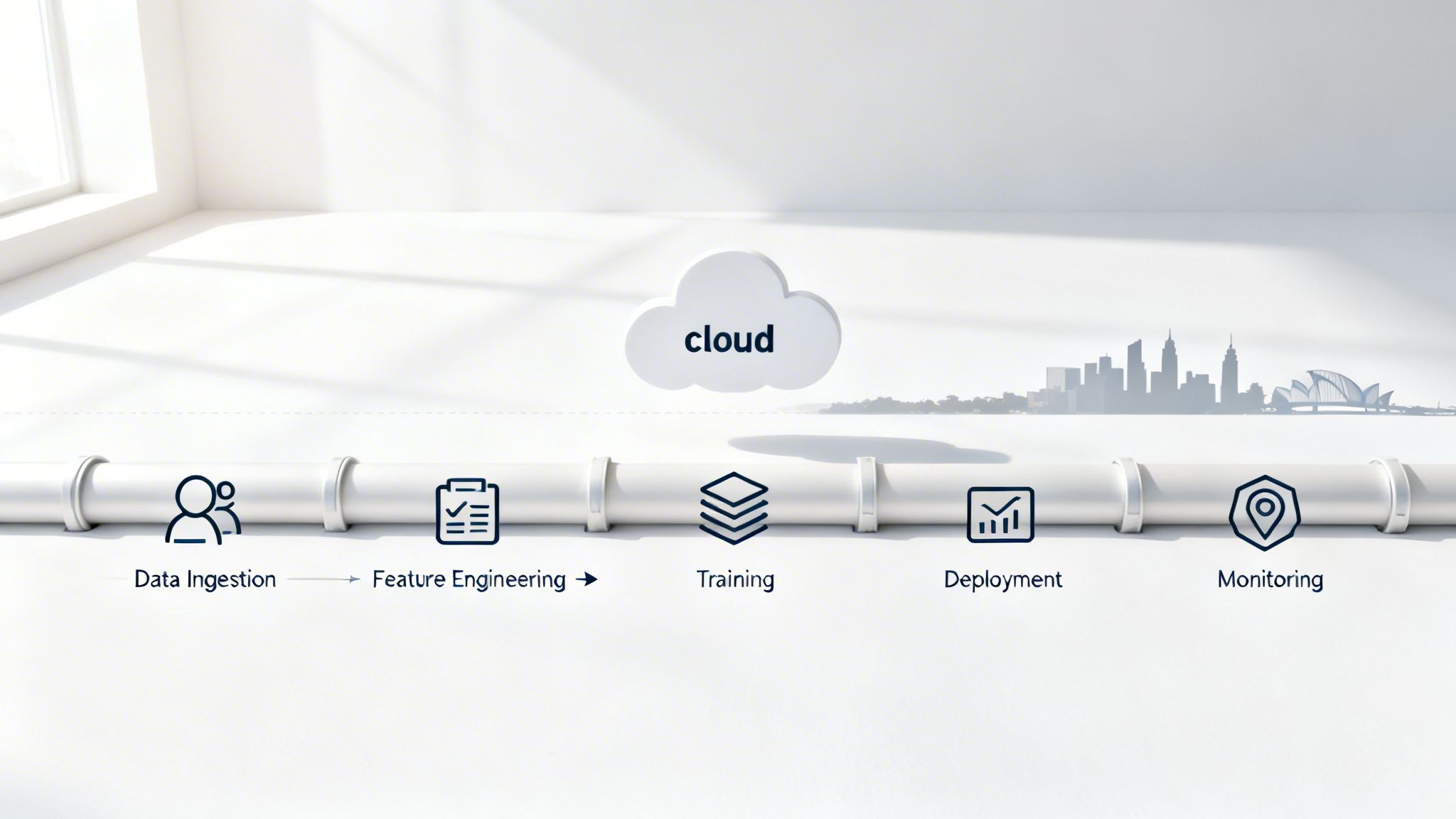
As you can see, this isn't a one-and-done process. It’s a closed-loop system where insights from monitoring live models feed right back into the beginning of the pipeline, triggering retraining and driving constant improvement.
The Stages of an Automated Pipeline
So, what actually happens at each point in the workflow? Let's break it down. This entire sequence is typically orchestrated by tools like Kubeflow, MLflow, or the native services within AWS, Azure, or GCP.
Data Ingestion and Validation: The process kicks off when new data arrives. The very first job is to check that data. The pipeline automatically validates it against a predefined schema, looking for corruption, quality issues, or any unexpected shifts that could poison the model down the line.
Feature Engineering: Raw data is rarely in a state that a model can learn from. Here, an automated script transforms, cleans, and engineers the validated data into meaningful features—the crucial signals the model will use to make predictions. This logic is version-controlled, just like any other piece of code.
Model Training: With clean data and well-defined features, the pipeline automatically kicks off the training process for a new model. This stage often involves experimenting with different algorithms or tuning hyperparameters to squeeze out the best possible performance.
Model Validation and Registration: Before a new model gets anywhere near production, it has to prove its worth. The "challenger" model is rigorously tested against a reserved dataset and its performance is compared to the current "champion" model. Only if it’s demonstrably better does it get registered in a central model registry, complete with its version number and performance metrics.
A model registry is essentially a catalogue for your machine learning models. It’s a central, versioned library where all vetted and approved models are stored, documented, and ready to be deployed.
This gated approach is fundamental. It prevents underperforming or un-tested models from ever making it out into the wild.
Deployment and Monitoring in the Real World
Once a model is validated and officially registered, it’s finally ready for prime time. But deployment isn't just about flicking a switch. It’s a carefully managed rollout. Smart teams use strategies like canary releases (exposing the new model to a tiny fraction of users) or A/B testing to monitor its performance in a controlled way before going all-in.
After deployment, the job is far from over. This is where continuous monitoring takes centre stage. The system keeps a close watch on the model’s real-world accuracy, looking for signs of performance decay, concept drift, or potential bias. If accuracy dips below a set threshold, it can automatically fire an alert or, even better, kick off a brand new retraining pipeline. And just like that, the MLOps loop is complete.
This kind of operational rigour is no longer a nice-to-have in Australia; it's becoming essential. With 68% of businesses reportedly having AI models in production, the demand for MLOps specialists who can build and manage these automated workflows is soaring. The action is happening on cloud platforms, with 60% of new rollouts favouring them to meet Australia's sovereign cloud requirements. You can read the full research about these market trends and their impact on skills demand.
Charting Your MLOps Career Path in Australia
As Australian companies dive headfirst into AI, they’re quickly realising that building a model is only the beginning. The real challenge is getting it into production and keeping it there, which is why professionals who can connect the worlds of data science and operations are in such high demand.
MLOps has moved from a 'nice-to-have' skill to a fundamental part of any serious AI team. If you're looking to build a career in this exciting field, this is your guide to understanding the roles, the required skills, and how to nail the interview.
The Different Faces of MLOps Roles
The term "MLOps" covers a few different but related roles. While job titles can vary from a tech startup in Sydney to a large bank in Melbourne, the core responsibilities usually fit into one of these key profiles. Think of it less as a single job and more as a spectrum of skills.
MLOps Engineer: This is the role at the heart of it all. An MLOps Engineer is the person who designs, builds, and manages the entire assembly line for machine learning. They're obsessed with automation, using tools like Docker, Kubernetes, and CI/CD platforms to make sure models can travel from a data scientist's laptop to a production environment smoothly and reliably.
Machine Learning Engineer: The line between an ML Engineer and an MLOps Engineer can be blurry. Generally, an ML Engineer is more involved in the model development itself, focusing on writing production-grade code and optimising algorithms for speed and efficiency. They bridge the gap between pure data science and software engineering. We cover this role in more detail in our machine learning engineer career in Australia guide.
Data Scientist (with MLOps skills): These days, a data scientist who only knows their way around a Jupyter notebook has a ceiling on their career. Companies are now looking for data scientists who understand how their models will actually be used. This means writing cleaner code and having a practical appreciation for things like model versioning and monitoring in the real world.
The Skills That Will Get You Hired
To land a great MLOps job, you need a specific blend of technical know-how and the right mindset. Hiring managers aren't just looking for someone who can code; they want someone who can think about the entire system.
A common mistake I see candidates make is talking only about model accuracy. Australian employers need to know you can think end-to-end—from the moment data comes in, to automated deployment, monitoring, and figuring out what to do when things inevitably break.
Based on what we see in job descriptions across the country, here are the skills that really matter:
Your Core Technical Toolkit:
Programming: You absolutely must be fluent in Python.
Containerisation: You need solid experience with Docker to package your applications and Kubernetes to manage them at scale.
CI/CD Automation: You should be able to show you’ve used tools like Jenkins, GitLab CI, or GitHub Actions to build automated ML workflows.
Cloud Platforms: You'll need deep knowledge of at least one of the big three: AWS (SageMaker), Google Cloud (Vertex AI), or Azure ML.
ML Frameworks & Tools: Experience with a tool like MLflow for tracking experiments and managing models is often a key requirement.
The Mindset That Sets You Apart:
Systems Thinking: It’s about seeing the whole picture—how data pipelines, training, deployment, and monitoring all connect—rather than just focusing on one piece of the puzzle.
Collaboration: You’ll be working side-by-side with data scientists, developers, and business leaders, so being able to speak their language is crucial.
Communication: Can you explain a complex idea like model drift or a deployment strategy to someone who isn't a tech expert? This skill is gold.
How to Ace Your MLOps Interview
When you sit down for an MLOps interview, expect the conversation to move quickly past model building and into the nitty-gritty of operations. The key is to frame your experience in a way that shows you understand the entire lifecycle.
For example, instead of just saying, "I built a churn prediction model," try something like this:
"I developed a churn prediction model, but the main project was building the CI/CD pipeline around it. This pipeline automatically retrained the model on new customer data every week. We used MLflow to track all our experiments and version the models, and I set up a dashboard in Grafana to send alerts if the model's accuracy dropped by more than 5%."
See the difference? That answer proves you're not just a model builder. You're a systems builder who creates real, lasting business value.
Finding Your Next MLOps Role on AI Jobs Australia
Knowing the theory of MLOps is a great start, but the real challenge is turning that knowledge into your next role. Let’s get practical and look at how to find a top-tier MLOps position using AI Jobs Australia, a platform built specifically for Australia’s AI community.
The problem with general job boards is that they often lump MLOps roles in with broad DevOps or software engineering positions. You end up wasting time sifting through listings that aren't quite right. AI Jobs Australia is different because it only features verified, AI-focused roles. Every job you see is guaranteed to involve building with AI, using AI tools, or working in an AI team, so your search is relevant from the get-go.
Optimising Your Search for MLOps
To make the platform work for you, you need to think like a hiring manager. It all comes down to using the right keywords and skills in your profile that recruiters in Australia are actually searching for. This is how the platform's algorithms connect you with the best opportunities.
Start by building out a profile that truly showcases your expertise. Don't just list "MLOps." Break it down into the specific tools, platforms, and concepts you've actually worked with.
Your keyword toolkit should include:
Core Concepts: "CI/CD for ML," "model monitoring," "data versioning," and "model governance."
Cloud Platforms: "AWS SageMaker," "Azure ML," or "Google Vertex AI."
Key Tools: "MLflow," "Kubernetes," "Docker," and "Jenkins" or "GitLab CI."
Architectural Patterns: "Hybrid cloud setups" and "pipeline orchestration."
When you weave these terms into your profile summary and work experience, you dramatically boost your visibility.
Think of a well-optimised profile as your personal agent. It works around the clock to match your unique skills—like experience with canary deployments or model drift detection—with companies that desperately need them.
This level of detail shows employers you’re not just repeating buzzwords; you have genuine, hands-on experience building and maintaining production-level machine learning systems.
Setting Up Targeted Job Alerts
Once your profile is polished, it’s time to let the opportunities find you. The platform’s job alerts are powerful because you can filter by role, location, and specific keywords. This is where you can get really strategic.
Here’s how to set up alerts that deliver:
Define Your Role: Use search terms like "MLOps Engineer," "Machine Learning Engineer," or even "Data Scientist MLOps" to cover all bases.
Select Your Location: Zero in on tech hubs like Sydney and Melbourne, or choose "Remote" to see roles from anywhere in the country.
Add Skill-Based Keywords: Create alerts for specific technologies like "Kubeflow" or "MLflow" to find jobs that fit your exact tech stack.
This approach means you'll be one of the first to see a new role that matches your MLOps skills. Instead of endlessly scrolling, you get a curated list of verified jobs delivered straight to your inbox.
Ready to see what’s out there? You can browse all the latest AI jobs in Australia right now. A focused search helps you move faster and land that next great opportunity with confidence.
Answering Your Key MLOps Questions
As you explore MLOps, you’ll naturally have questions. It’s a field that sits right at the intersection of data science, software engineering, and IT operations, so it’s common to wonder where roles begin and end, what skills are truly essential, and how it all delivers actual results.
This section tackles the most common questions we hear from aspiring professionals and hiring managers across Australia. We’ll give you clear, direct answers to demystify the core ideas and connect the technical work to real-world business value.
How Is MLOps Different from DevOps?
This is easily the most frequent question, and the distinction is crucial. While MLOps borrows heavily from DevOps—think automation and continuous delivery—it's built to handle the unique headaches that come with machine learning.
The simplest way to think about it is this: DevOps manages code. MLOps manages code, models, and data.
This creates a few key differences:
What Kicks Off a Pipeline: A standard DevOps pipeline is usually triggered by a change in the source code. An MLOps pipeline, on the other hand, can be triggered by a code change, the arrival of new data, or—most importantly—a drop in the live model's performance, a phenomenon known as model drift.
The Versioning Headache: DevOps is focused on versioning code. In MLOps, you have to version everything: the code, the exact dataset used for training, and the final model file. This complete traceability is the only way to reliably reproduce results and debug issues later on.
A New Level of Testing: Software testing checks if code works as intended. MLOps testing does that too, but it also adds data validation, model performance checks against a baseline, and evaluations for fairness and bias.
Monitoring Beyond the Basics: DevOps monitors application health like CPU usage and uptime. MLOps monitors all that, plus model-specific metrics like prediction accuracy, data drift, and concept drift to make sure the model is still making sense of the world.
In short, MLOps is an extension of DevOps, specifically adapted for the experimental and data-driven nature of machine learning.
What Is the Real Business Impact of MLOps?
Beyond all the technical talk, what does MLOps actually do for a business? The impact is direct, measurable, and profound. It’s what separates an AI science project from a reliable engine for business growth.
Good MLOps turns machine learning from a high-cost, high-risk research activity into a predictable, scalable, and value-generating factory.
The main business benefits are clear:
Faster Time-to-Value: Automation slashes the time it takes to get a model from a data scientist's laptop into a live product. This means quicker delivery of AI-powered features and a much faster return on investment.
Greater Reliability and Performance: With continuous monitoring and automated retraining, models in production never go "stale." A recommendation engine stays relevant and a fraud detection system remains accurate, protecting both revenue and the customer experience.
Stronger Governance and Compliance: For regulated industries in Australia like finance and healthcare, MLOps is non-negotiable. It provides the clear, auditable trail needed to prove that models are fair, explainable, and secure. It answers: who built what model, with what data, and how is it performing right now?
Smarter Resource Allocation: By automating the repetitive grunt work, MLOps frees up your highly-skilled (and highly-paid) data scientists and engineers. They can then focus on genuine innovation instead of getting bogged down in manual deployments and maintenance.
Do I Need a Data Science Background to Work in MLOps?
Not necessarily, but you absolutely need to speak the language and understand the data science lifecycle. An MLOps Engineer doesn't need to be an expert in designing neural networks, but you must know what a model is, how it's trained, how it's evaluated, and the many ways it can fail in the wild.
Many of the best MLOps professionals come from a DevOps, software engineering, or cloud infrastructure background. They bring that critical systems-thinking and automation mindset, then learn the specifics of the machine learning world on top.
Your role is to be the bridge. You need to have an intelligent conversation with a data scientist about their model's requirements and then translate that vision into a robust, automated, and scalable system. Your value is in operationalising their work, not doing it for them.
Is MLOps Just for Big Companies?
Definitely not. While big tech companies with massive AI teams were the early pioneers, the principles of MLOps are just as valuable—if not more so—for startups and small-to-medium businesses in Australia. For a smaller team, automation is even more critical because you simply don’t have the staff to handle everything manually.
Cloud platforms like AWS, GCP, and Azure have made MLOps far more accessible by offering managed services that handle much of the underlying complexity. A small team can use tools like SageMaker Pipelines or Vertex AI Pipelines to build sophisticated workflows without needing to manage a huge Kubernetes cluster from day one.
For a startup, establishing good MLOps practices early on builds a solid foundation for growth. It ensures that as the company scales, its AI capabilities can scale reliably with it, preventing a mountain of technical debt and operational chaos down the road. It’s all about building it right from the start.
Ready to turn your MLOps knowledge into your next career move? At AI Jobs Australia, we connect top AI talent with verified MLOps, Machine Learning, and Data Science roles across the country. Start your search and find your next opportunity on AI Jobs Australia.