
Your Guide to Data Scientist Jobs in Australia
The demand for Data Scientist jobs in Australia is absolutely exploding. From the big banks in Sydney to the mining giants in Perth, everyone is scrambling to find professionals who can turn raw data into a genuine competitive advantage. For those with the right skills, this boom is a golden opportunity.
Why Data Science Is Booming Across Australia

Think of a good data scientist as a modern-day business navigator. Companies today are swimming in an ocean of information, and it's easy to get lost. These experts don't just gather data; they use it as a compass to chart a course through complex markets, spotting hidden opportunities and steering the company towards growth and efficiency.
This shift is happening in every major Australian industry. It's no longer a 'nice-to-have'—it's become a core part of business strategy. In retail, data science is fine-tuning supply chains. In mining, it's predicting when multi-million dollar equipment might fail. The simple truth is that companies that use their data well are leaving their competitors behind, making skilled data professionals essential.
The Driving Forces Behind the Demand
So, what's fuelling this incredible growth? A few key factors have come together to create a perfect storm for anyone looking to build a career in data science. This isn't just a passing trend; it’s a deep, fundamental change in how Australian businesses operate.
The demand has shot up over the last few years, particularly in sectors like finance, mining, and healthcare where data-driven decisions are critical. In banking, data scientists are the front line for managing customer insights, spotting fraud, and automating risk assessments. In the resources sector, they're the ones building predictive models to make mining operations safer and more efficient.
This heavy reliance on data tells us one thing: the career opportunities are only going to keep growing. You can see this demand for yourself by looking through the data science jobs listed on major boards like Hays.
Data scientists don't just analyse the past; they build models that forecast the future. This predictive power allows organisations to move from reactive decision-making to proactive strategy, creating immense value and a powerful competitive edge.
This guide is your map to navigating this exciting field. We'll break down everything you need to know, including:
- Decoding Core Roles: What's the real difference between a Data Analyst, a Data Scientist, and a Machine Learning Engineer?
- Mapping Salaries and Locations: A look at what you can expect to earn in major hubs like Sydney and Melbourne.
- Mastering In-Demand Skills: The specific technical and soft skills that Aussie employers are desperate for.
- Securing Your Position: Proven strategies for landing one of the top-tier data science jobs in Australia.
Decoding the Key Data Science Roles
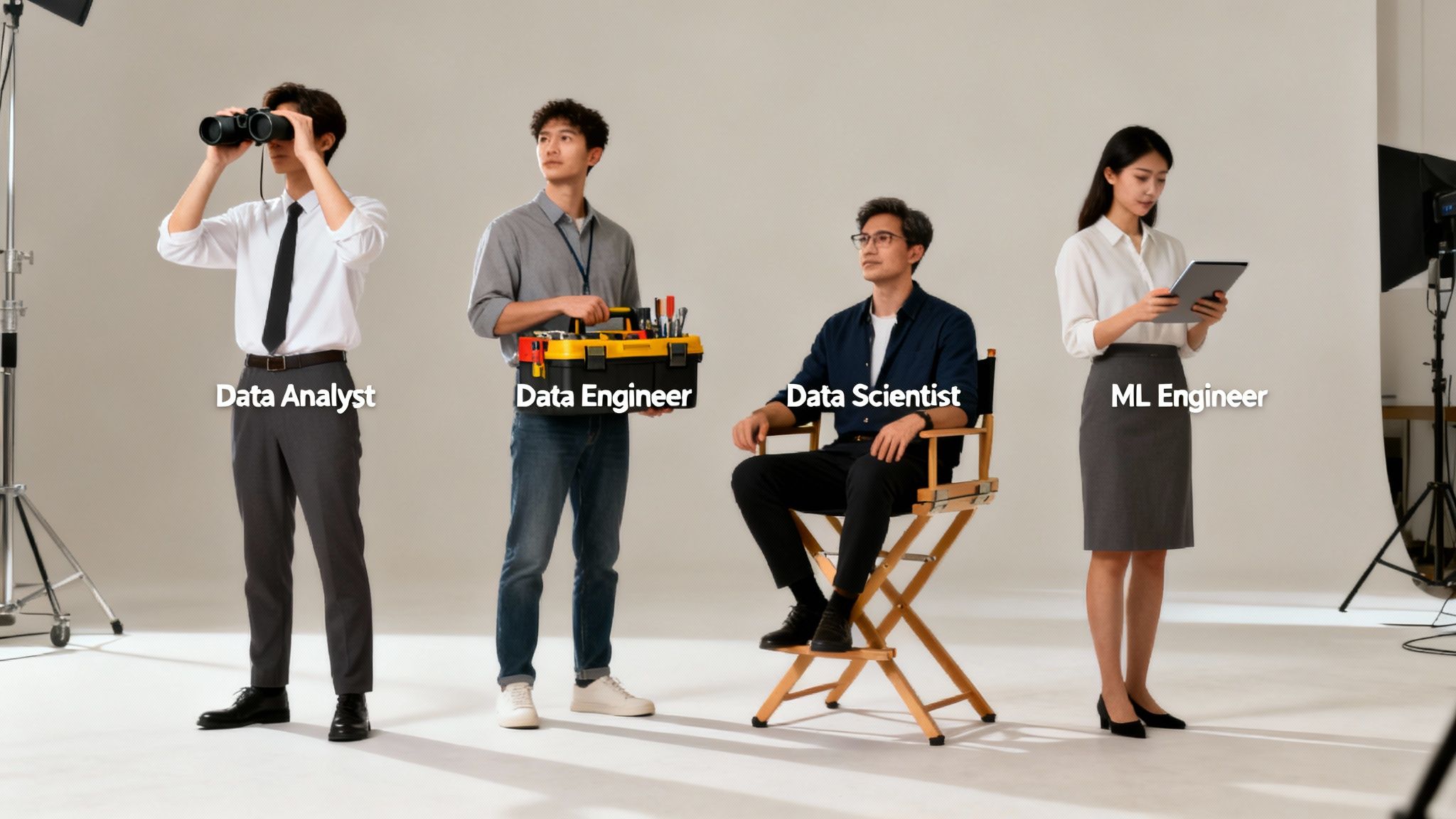
The term 'data scientist' gets thrown around a lot, but it's not a one-size-fits-all job title. Think of it more like an umbrella term for a team of specialists, each playing a crucial part in turning raw data into something genuinely valuable for a business. Knowing the difference between these roles is the first real step to figuring out where you fit in Australia's booming data scene.
Let’s try a simple analogy: making a film. A film crew isn't just one person; it's a collection of experts working in sync. A data team functions in much the same way, with each role building on the work of the others to create the final product.
The Data Analyst: The Location Scout
First up is the Data Analyst. They are the 'location scout' of the data world. Their mission is to get out there, explore the existing landscape of data, pinpoint interesting trends, and report back on what they've found. They're the masters of answering the questions: "what happened?" and "why?".
An analyst's day is often spent querying databases with SQL, wrestling data into shape, and building clear, compelling dashboards with tools like Tableau or Power BI. These visualisations aren't just pretty charts; they are vital tools that help business leaders make sharp, day-to-day decisions. You’ll find them everywhere, from retail giants like Woolworths to government agencies.
The Data Engineer: The Set Builder
Before the cameras can roll, someone has to build the entire set. In our world, that’s the Data Engineer. These are the architects and builders who construct the robust infrastructure—the data pipelines, warehouses, and platforms—that allows information to be gathered, stored, and accessed reliably.
Without a solid data engineer, everything falls apart. The data would be a chaotic, untrustworthy mess. They are the ones who ensure data is clean, secure, and ready for analysts and scientists to work their magic. Their toolkit is packed with cloud platforms like AWS or Azure, database tech, and languages like Python. Tech companies, Australia's big banks, and any large enterprise with huge data streams are always on the lookout for them.
The Data Scientist: The Director
The Data Scientist is the 'director' of the whole production. They take the solid, reliable data from the engineers and the initial insights from the analysts to build the main story. Their focus shifts from the past to the future, constantly asking, "what could happen?".
They do this by designing experiments, building predictive models with advanced statistical methods, and hunting for the deeper patterns that aren't immediately obvious. A data scientist's ultimate goal is to solve complex business puzzles and help steer the company’s strategic direction.
“A data scientist's true value lies in their ability to connect complex statistical models to real-world business outcomes. They don’t just find patterns; they translate those patterns into a strategic story that executives can act on.”
This role is in high demand, especially in sectors that live and breathe prediction and optimisation, like e-commerce, finance, and healthcare. To find the best opportunities, you'll want to look at companies that are serious about their data strategy. You can browse a curated list of top roles by checking out the latest Data Scientist jobs across Australia.
The Machine Learning Engineer: The VFX Artist
Finally, we have the Machine Learning (ML) Engineer. This is the 'VFX artist' who takes the director's most ambitious concepts and brings them to life for the audience. They are the ones who take the clever models built by data scientists and deploy them into live, production environments so they can work at massive scale.
An ML Engineer makes sure a brilliant algorithm doesn't just die on a laptop. They turn it into a feature in a live application, serving up predictions to thousands of users in real time. This is a deeply technical role that demands sharp software engineering chops, a firm grasp of MLOps, and serious cloud skills. You’ll find this specialisation is red-hot at tech scale-ups and established players like Canva or Atlassian, who embed AI directly into their products.
A Snapshot of Key Data Science Roles in Australia
To bring it all together, here’s a quick comparison of how these roles stack up against each other in the Australian market.
| Role Title | Primary Responsibilities | Essential Skills | Common Employers in Australia |
|---|---|---|---|
| Data Analyst | Analyses historical data to answer business questions ("what happened?"). Creates reports and dashboards for stakeholders. | SQL, Excel, BI Tools (Tableau, Power BI), communication | Retail, Government, Banking, Consulting |
| Data Engineer | Builds and maintains the data infrastructure. Creates reliable data pipelines for collection, storage, and access. | Python, SQL, Cloud Platforms (AWS, Azure, GCP), ETL tools | Tech Companies, Financial Services, Large Enterprises |
| Data Scientist | Uses advanced statistical methods and machine learning to make predictions ("what could happen?"). Guides strategy. | Python/R, Machine Learning, Statistics, Experiment Design | E-commerce, Finance, Healthcare, Tech Start-ups |
| Machine Learning Engineer | Deploys and scales machine learning models into production systems. Focuses on performance, reliability, and automation. | Software Engineering, MLOps, Cloud Infrastructure, Python | Tech Product Companies (e.g., Atlassian), AI Start-ups |
Understanding these distinctions is key. It helps you focus your learning, tailor your CV, and target the right companies for the career you actually want.
Where the Money Is: Mapping Data Science Salaries and Locations

Let's talk about the bottom line: your paycheque. It’s one of the most important factors when you’re planning your next career move. For data science jobs in Australia, what you earn isn't just a flat figure; it’s a mix of your experience, the city you call home, and the industry you work in.
Think of it like different climates across the country. The hot, high-demand "climates" of Sydney and Melbourne generally pay the most. But other cities offer their own unique appeal, often with a better balance of opportunity, lifestyle, and cost of living. Knowing these regional nuances is key to finding a role that ticks all your boxes—both professional and personal.
How Experience Shapes Your Salary
Without a doubt, your experience level is the biggest lever on your earning potential. As you climb the ladder from an entry-level role to a strategic leader, your salary grows to match your increasing value. Australian companies know that seasoned professionals who can deliver real business results are worth investing in.
Here’s a realistic breakdown of what you can expect to see on your offer letter at different career stages:
- Junior Data Scientist (0-2 years’ experience): You’ll likely start somewhere between $80,000 and $110,000. At this stage, it’s all about learning the ropes, supporting the senior team, and getting your hands dirty with data cleaning, analysis, and basic modelling.
- Mid-Level Data Scientist (2-5 years’ experience): The salary band here typically sits between $115,000 to $150,000. You’re now working more autonomously, leading smaller projects, and maybe starting to specialise in something like machine learning or data visualisation.
- Senior/Lead Data Scientist (5+ years’ experience): Now we’re talking $160,000 to $220,000+. Senior roles are about leading complex projects, mentoring junior talent, and turning raw data insights into top-level business strategy.
Your salary really reflects the scale of the problems you solve. A junior might be fine-tuning a marketing campaign, but a senior data scientist could be building a fraud detection system that saves the company millions. The bigger the impact, the bigger the paycheque.
Australia’s Tech Hubs and How Salaries Differ
While your experience sets the baseline, your location adds another layer to the salary equation. The major capital cities are the epicentres for data science jobs in Australia, but each has its own distinct market and pay scale. Keep in mind that the higher salaries in places like Sydney are often offset by a higher cost of living.
Sydney is the undisputed heavyweight champion of Australia's tech and finance scene. It has the highest number of data science roles and, as a result, the highest average salaries. A data scientist here can expect to earn around $145,000 on average, thanks to massive demand from banking, insurance, and big tech.
Melbourne isn't far behind, with a booming start-up culture and a strong footing in e-commerce, healthcare, and research. The average salary hovers around $135,000. For many, the slightly lower cost of living compared to Sydney makes it a very appealing alternative.
Brisbane and Perth are emerging as serious contenders. Their average salaries might be a touch lower—think $120,000 to $130,000—but they offer fantastic opportunities. You'll find great roles in logistics and resources in Brisbane, and in mining technology in Perth. Plus, these cities often come with a more relaxed lifestyle and an easier path to getting on the property ladder.
To get a feel for what’s happening in the market right now, you can explore current openings and find data science jobs across Australia, from roles in the CBD to fully remote positions. This gives you a real-world benchmark for salaries and might even uncover great opportunities in places you hadn't considered.
The Skills Australian Employers Actually Want

Knowing the different data science roles is one thing, but actually getting hired is another challenge altogether. To succeed in the competitive Aussie market, you need the right tools in your toolkit. But this isn't about just listing buzzwords on your resume; it's about mastering the specific blend of technical and soft skills that local employers genuinely value.
Think of your technical skills as the engine of a car—they provide the raw power to get the work done. Your soft skills, on the other hand, are the steering wheel and the driver's intuition. They let you navigate tricky business problems and actually get to your destination. Australian companies are on the hunt for people who have both a powerful engine and the finesse to handle it.
The Technical Foundations
Some technical skills are simply non-negotiable if you're serious about landing a data science job in Australia. These are the foundations you’ll see in almost every job description, forming the absolute core of your day-to-day work. Mastering them is your ticket to getting past the initial screening and into an interview.
Let's break down the must-haves:
- Python and R: These are the undisputed workhorses of statistical programming. While R has strong roots in academia, Python has become the industry favourite thanks to its versatility and incredible libraries.
- SQL (Structured Query Language): Data rarely arrives in a neat, tidy package. You need to know how to speak the language of databases, and SQL is it. It’s how you’ll pull, filter, and wrestle with the raw information before any analysis can even begin.
On top of these, you’ll need real, hands-on experience with key libraries. Employers will be looking for projects where you’ve used Scikit-learn for machine learning tasks, and either TensorFlow or PyTorch for more advanced deep learning applications.
Cloud and Visualisation Differentiators
Once you've got the programming basics down, expertise in cloud platforms is what will really make you stand out. As more companies shift their data infrastructure online, they need people who can work comfortably in these environments.
It's a bit like this: knowing Python is like having your driver's licence, but knowing your way around cloud services is like having your heavy vehicle licence. It opens up a whole new class of jobs working with data at a massive scale.
A data scientist who is comfortable working within a cloud environment like AWS, Azure, or GCP can add value from day one. They don't just build models on their local machine; they can access, process, and deploy solutions within the company’s actual infrastructure, which is a massive advantage.
Just as crucial is your ability to communicate what you've found. This is where data visualisation tools are essential. Being skilled in platforms like Tableau or Power BI lets you transform complex spreadsheets and model outputs into clear, compelling stories that even non-technical stakeholders can understand.
The Soft Skills That Seal the Deal
Technical chops will get your foot in the door, but it’s the soft skills that land you the job and, eventually, the promotion. Australian employers place a huge premium on candidates who can connect the dots between complex data and real-world business strategy.
These are the abilities that separate a good data scientist from a truly great one:
- Business Acumen: This is all about understanding what actually matters to the business. It’s the ability to ask the right questions and link your data work directly to goals like boosting revenue, cutting costs, or making customers happier.
- Compelling Communication: You have to be a translator. Your job is to take complicated statistical ideas and explain them in simple terms to managers, marketers, and executives, helping them understand the "so what?" behind your analysis.
- Problem-Solving Mindset: At its heart, data science is about solving puzzles. Employers want to see that you're naturally curious, can think critically, and can creatively use data to find a solution—especially when the path isn't obvious.
Ultimately, Australian companies aren't just hiring a coder. They're hiring a strategic partner who can use data to help them make smarter decisions. Build a strong combination of technical depth and sharp communication skills, and you'll be the ideal candidate they're looking for.
A Practical Guide to Landing Your Next Role
Knowing your stuff is one thing, but navigating the job market requires a clear, actionable strategy. Landing one of the top data science jobs in Australia isn’t just about having the right skills; it’s about positioning yourself as the best possible solution to a company’s problems. This starts long before you even think about clicking "apply".
Think of your job hunt as a data science project. The goal? To land a great role. Your skills, experience, and projects are your data points. Your strategy is the model you build to predict—and achieve—a successful outcome. Let's walk through how to build that winning model.
Crafting Your Professional Brand
Before a recruiter even glances at your resume, they've probably already looked you up on LinkedIn. In the Australian market, a polished, professional online presence is your digital handshake, and it's absolutely non-negotiable. It needs to tell a compelling story about who you are and what you can do for a business.
Your resume needs to be just as sharp. Forget the generic, one-size-fits-all approach. Every single application deserves a resume tailored specifically to that job description. Use the company’s language, highlight the skills they’re asking for, and connect your past achievements to their future goals.
- Customise for Impact: For every role, rewrite your summary to mirror what the job ad is asking for. If they’re focused on "customer churn prediction," your experience in that exact area needs to be front and centre.
- Quantify Everything: Don't just say you "improved a model." Get specific. Say you "developed a logistic regression model that improved customer churn prediction accuracy by 15%." Numbers speak volumes and prove your impact.
- Focus on Australian Norms: Keep it concise. Two pages is the sweet spot for most experienced professionals here. Local recruiters appreciate clarity and getting straight to the point.
Building a Portfolio That Solves Problems
Your portfolio is easily your most powerful asset. It’s where you stop telling an employer what you can do and start showing them how you solve real-world problems. A strong portfolio is your proof of concept, demonstrating not just your technical chops but, crucially, your commercial mindset.
Don't just populate your GitHub with half-finished tutorial projects. The real magic is in creating end-to-end projects that tackle an interesting business problem. A single project that scrapes, cleans, models, and presents findings in a clear dashboard is far more impressive than a dozen disconnected code snippets.
The best portfolios tell a story. They don't just showcase code; they explain the 'why' behind the project, the challenges you overcame, and the business value your solution delivered. This narrative is what truly captures a hiring manager's attention.
For instance, you could analyse real estate data to predict property prices in a specific Sydney suburb or use public transport data to model commuter patterns in Melbourne. These locally relevant projects show initiative and an understanding of the Australian context, which makes you a much more compelling candidate.
Finding the Right Opportunities
It’s easy to get lost in the sea of listings on huge, generic job boards. Sites like LinkedIn and Seek are certainly part of the picture, but they often have hundreds of applicants vying for a single role. To get a real edge, you need to look where others aren't.
This is where specialised job boards come in. They cut through the noise by focusing only on high-quality, relevant roles in a specific niche.
By curating roles, these platforms save you an enormous amount of time and connect you directly with companies that are serious about hiring top data talent.
Exploring these niche platforms can uncover "hidden" jobs that aren't advertised anywhere else. For a focused look at verified AI and data science positions, you can browse the latest data science jobs in Australia and find openings that genuinely match your skills and career goals. A targeted approach like this dramatically increases your chances of finding the perfect fit.
Acing the Interview Process
The data science interview process in Australia is usually a multi-stage affair designed to test you from every angle. It tends to follow a predictable pattern, and knowing what to expect is half the battle.
- The Recruiter Screen: This is a quick chat to see if your experience lines up with the role and to get a feel for your personality. Be ready with a clear, compelling summary of your background.
- The Technical Challenge: This could be a take-home assignment or a live coding session. They want to see how you approach a problem, how you write clean code, and how you justify your decisions.
- The Case Study or Portfolio Review: Here's your chance to shine. You'll present a project or walk through a business case. This is all about testing your business acumen and communication skills.
- The Final Interview: This is often with senior leadership. It's the last check for strategic thinking and team fit. Be prepared to talk about your long-term career goals and how you see yourself contributing to the company's vision.
Ultimately, success in these interviews comes down to preparation. Brush up on your technical skills, rehearse your project presentations, and research the company inside and out. If you can show genuine curiosity and enthusiasm, you're bound to leave a great impression.
Answering Your Big Questions About Data Science Careers in Australia
Jumping into a new career path always brings up a tonne of questions. When it comes to data science jobs in Australia, I see the same queries pop up again and again. So, let’s get those burning questions answered with some clear, straightforward advice to help you figure out your next move.
We'll cover everything from whether you need a PhD to what the go is with visa sponsorships and what a typical career ladder actually looks like here. Think of this as filling in the final, practical details on your map so you can push forward with confidence.
Do I Really Need a PhD to Get a Data Science Job in Australia?
This is easily the most common myth out there, and the short answer is a definite no. A PhD is certainly a huge asset for highly specialised R&D roles—think deep learning research or complex pharmaceutical modelling—but it's absolutely not a prerequisite for the vast majority of data science jobs in Australia.
Most companies, especially in sectors like finance, e-commerce, and consulting, care a lot more about your practical skills and real-world experience. They're looking for people who can build models that solve their business problems, not just write academic papers.
For most Australian employers, a solid project portfolio that shows off your problem-solving chops is far more powerful than an advanced degree. They’re hiring for impact, not just credentials.
A Master’s degree in a quantitative field like statistics, computer science, or economics is extremely competitive. Combine that with real proficiency in Python, SQL, and the core machine learning libraries, and you’re in a fantastic position to build a successful career.
What’s the Demand Like for International Candidates?
The demand for skilled data professionals in Australia is strong, and plenty of companies are willing to sponsor international talent. This is particularly true for mid-level and senior roles where a specific, hard-to-find skill set is needed. The main pathway for this is the Temporary Skill Shortage (TSS) visa (subclass 482).
That said, you have to be realistic. It’s a competitive process, and employers will often look at local candidates first to avoid the paperwork and costs that come with sponsorship.
To really stand out as an international applicant, you need to bring something special to the table. This could be:
- A sought-after specialisation: If you have deep expertise in a high-demand niche like MLOps, natural language processing (NLP), or fintech, you'll immediately look more attractive.
- A compelling portfolio: Show them projects that solve complex, relevant business problems. Make it impossible for them to ignore you.
- Significant commercial experience: A few years of proven success in a similar role will always get a hiring manager’s attention.
How Important Is Industry-Specific Experience?
This is a great question, and the answer really depends on the seniority of the role. For a senior position, domain knowledge can be a deal-breaker. A bank hiring a Senior Data Scientist for its credit risk team is going to want someone who already speaks the language of financial modelling.
For junior and mid-level roles, though, it's much less of a barrier. At this stage, employers are far more interested in your core technical toolkit. Strong skills in statistics, programming, and machine learning are like a universal passport—they're highly transferable across industries.
If you can show a genuine curiosity for a new industry and prove you're a fast learner, you can easily bridge that experience gap. The trick is to frame your past projects in a way that highlights the transferable problem-solving skills you’ve already mastered.
What Does a Typical Data Science Career Path Look Like?
The career ladder for data science jobs in Australia is becoming much clearer these days. While everyone's journey is a bit different, there’s a common progression you can generally expect as you gain more experience.
A typical career path tends to move through these stages:
- Junior Data Scientist: This is your entry point. You'll focus on tasks like data cleaning, exploratory analysis, and helping senior team members on bigger projects.
- Mid-Level Data Scientist: After two to four years, you’ll be running smaller projects on your own, building more sophisticated models, and presenting your insights to business stakeholders.
- Senior Data Scientist: At this level, you’re in the driver's seat. You'll lead major projects, mentor junior colleagues, and have a real say in the company's data strategy.
From the senior level, the path often splits. You can either head down the management track (think Data Science Manager or Head of Data), where your focus shifts to leading teams and strategy. Or, you can pursue the technical leadership track (becoming a Principal Data Scientist), where you stay hands-on, tackling the gnarliest technical challenges without the people-management duties.
Ready to find a role that matches your skills and ambitions? AI Jobs Australia researches thousands of company sites to uncover verified, AI-focused roles you won't find on generic boards. Create a smart profile and browse the best data science opportunities across the country.