
What Is an Aptitude Test for AI Roles?
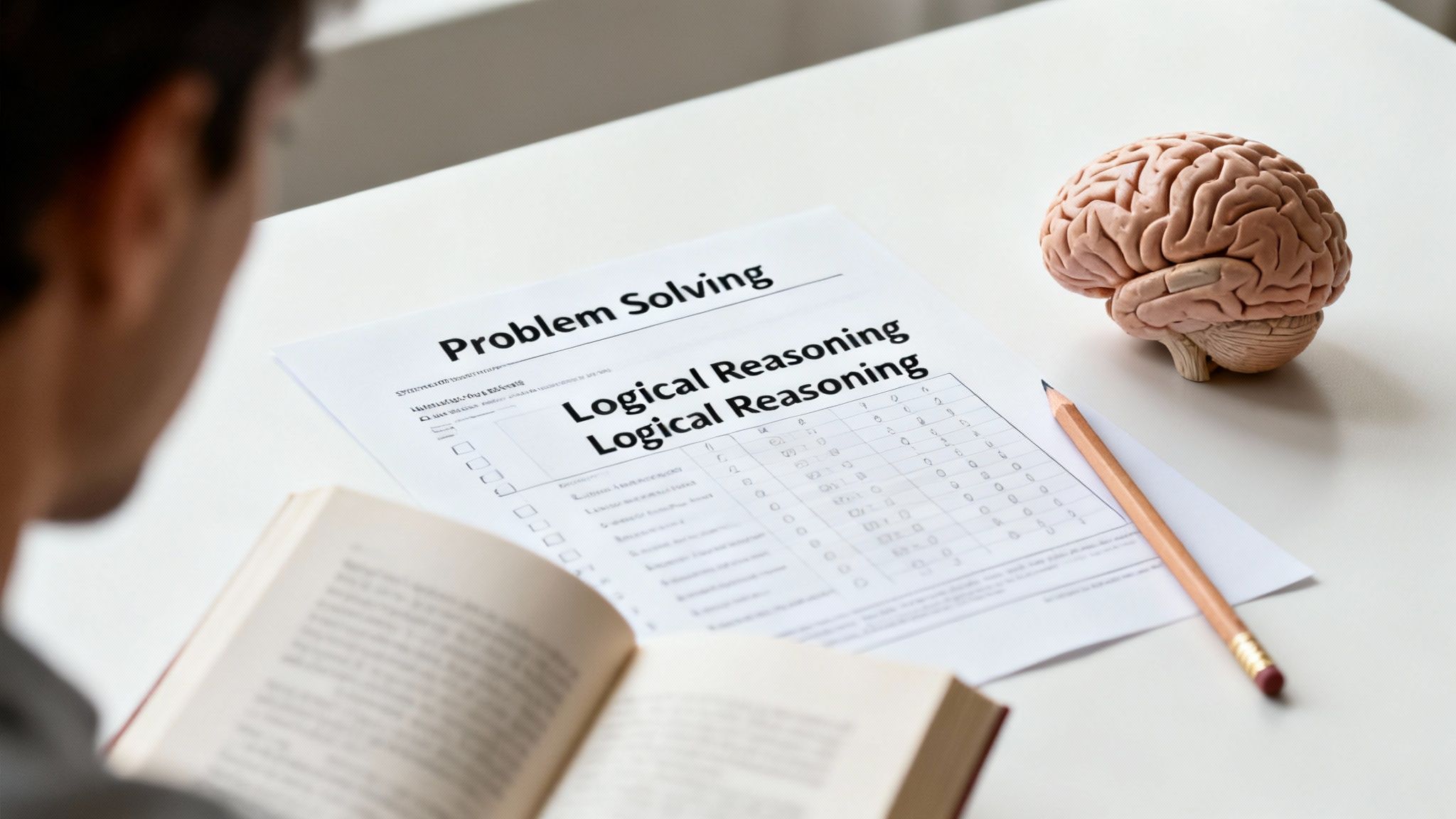
An aptitude test is a standardised assessment that gets to the heart of a person’s potential to succeed in a particular job or pick up a new skill. It’s not a knowledge-based exam that checks what you’ve already learned. Instead, it evaluates your natural cognitive abilities—things like reasoning, problem-solving, and spotting patterns.
Think of it less like a final exam and more like a fitness test for your brain’s core functions.
Decoding the Purpose of an Aptitude Test
Let's imagine a company hiring a junior software engineer. They could give every applicant a complex coding challenge in Python. The problem? That only shows who already knows Python well. An aptitude test asks a much more powerful question: who has the underlying logical thinking to become a great programmer, regardless of the language?
This is the central idea behind aptitude testing. It’s not about your CV or memorised facts; it’s all about your future potential. For employers, especially in fast-moving fields like AI and data science in Australia, this is gold. They need to find people who can learn quickly, adapt to new tools, and solve problems they’ve never encountered before.
An aptitude test gives them objective data on these core abilities, helping to predict who will truly excel in the role with far greater accuracy.
What Aptitude Tests Really Measure
At its core, an aptitude assessment is designed to gauge your inherent strengths in a few key areas. It provides a baseline read on your raw cognitive horsepower, separate from your formal education or work history.
Key abilities often put to the test include:
Logical Reasoning: Your knack for identifying patterns, following a set of rules, and drawing sound conclusions from abstract information.
Numerical Reasoning: How well you can interpret data from charts, graphs, and tables to make calculations and spot trends.
Verbal Reasoning: Your ability to understand written passages, evaluate arguments, and make accurate inferences from what you’ve read.
Problem-Solving: The speed and accuracy with which you can dissect a problem, pinpoint the main issue, and figure out a smart solution.
By focusing on these foundational skills, employers can create a more level playing field. A candidate from a non-traditional background might lack specific technical experience but possess exceptional logical reasoning, making them a high-potential hire.
Aptitude Tests vs Technical Skills Tests
It’s easy to mix these two up, but it's crucial to understand the difference. Simply put, an aptitude test predicts your capacity to learn, while a technical test confirms what you already know.
Here’s a quick breakdown of how they compare.
| Attribute | Aptitude Test | Technical Skills Test |
|---|---|---|
| Focus | Measures potential and innate cognitive abilities. | Assesses current knowledge and learned skills. |
| Example Task | Identifying the next shape in a logical sequence. | Writing a function in a specific programming language. |
| Purpose | Predicts future job performance and trainability. | Verifies existing proficiency and technical competency. |
| Preparation | Involves practising question types to build speed. | Requires studying specific subjects or technologies. |
Both are valuable tools for hiring, but they serve completely different purposes. One looks at your raw talent, the other at your trained expertise.
Why Australian Tech Companies Actually Use Aptitude Tests
In Australia's buzzing tech scene, companies aren't just trying to fill a role for today—they're hunting for people who can solve tomorrow's problems. This is exactly why aptitude tests have become such a common first step. They cut through the noise of a polished resume to get a real look at your raw potential for handling complex, ever-changing work.
Think about it. For a job like a Machine Learning Engineer or Data Scientist, knowing today's popular tools is great, but the ability to learn and adapt is what really counts. The frameworks everyone loves now might be old news in two years. An aptitude test helps employers spot the people with the fundamental cognitive skills—like solid logical reasoning and sharp data interpretation—that are needed to keep up.
At its core, an aptitude test is a great equaliser. It offers a standardised, objective way to weigh up candidates from all sorts of backgrounds. Someone with an unconventional career path might have incredible problem-solving skills that a CV just can't show. These tests give them a chance to prove it.
Predicting Who Will Thrive in Fast-Paced Roles
In the AI world, you're constantly up against new problems where the answer isn't in a textbook. Employers need to know if you can think on your feet, connect abstract dots, and navigate ambiguity without a clear roadmap. An aptitude test is basically a dry run of that mental workout.
It's also a powerful predictor of trainability, which is a huge deal for tech companies that invest a lot in their people. A good score suggests you can pick up new, complex ideas quickly—an essential trait when you're working with constantly evolving algorithms and datasets. This focus on future potential, not just past experience, is why these tests are so popular.
A candidate's ability to learn is often a much better sign of long-term success than their current knowledge of a specific programming language. Aptitude tests give us a glimpse into that learning capacity.
This is especially true with the skills shortages we see today. Instead of holding out for a unicorn candidate with five years of experience in a technology that's only three years old, smart employers use these tests to find bright, capable people they can invest in and develop themselves.
Building a Fairer, More Objective Hiring Process
Let's be honest: unconscious bias is a real and persistent problem in hiring. A well-designed aptitude test helps strip that away by offering a standardised, impartial measure of what someone can do. Everyone gets the same test under the same conditions, and the results are all about performance.
This objectivity is crucial for creating diverse teams that perform at a high level. It makes sure every applicant is judged on their cognitive strengths, not on which uni they went to or how prestigious their last company was. For you as a candidate, this means your ability to think and solve problems is what gets your foot in the door.
Standardised Evaluation: Every candidate is measured against the same yardstick, taking subjective interviewer feelings out of the initial screening.
Focus on Merit: The spotlight shifts from pedigree to pure potential, opening up opportunities for talented people from all walks of life.
Improved Diversity: By cutting down on bias, companies build more inclusive teams that bring a much richer set of perspectives to the table.
How AI is Changing the Game
Funnily enough, AI itself is now influencing how companies use these tests. Many Australian tech firms are using automated hiring platforms to handle the massive number of applications they get for popular roles. These systems can screen thousands of candidates efficiently, using aptitude test scores as a primary filter.
This automation means a strong score is more critical than ever. It's often the very first data point that decides whether you get to the technical interview. For anyone trying to break into the tech industry, getting a handle on what is an aptitude test and how to do well is a non-negotiable first step. You can see these requirements firsthand by browsing the latest AI jobs in Australia. A high score could be the very thing that makes you stand out from the crowd.
The Most Common Aptitude Tests You'll Face

While the term "aptitude test" sounds pretty broad, the ones you’ll actually encounter are usually designed to measure very specific cognitive skills. Think of them as different lenses, each one focused on a particular part of your problem-solving toolkit. Knowing what each test looks for is the first step to feeling confident and prepared.
Companies don't just pick these tests at random. They choose a mix of assessments that directly mirror the kind of mental heavy lifting the job demands. For a Data Analyst, that means being able to make sense of complex charts. For an AI Engineer, it's about spotting abstract patterns and building logical solutions.
Let's break down the most common types you’ll see for AI and data roles in Australia so you know exactly what’s coming.
Numerical Reasoning Tests
First things first: numerical reasoning tests aren’t about complex calculus or high-level algebra. They’re all about how well you can interpret the stories that data tells through graphs, charts, and tables. Can you quickly spot a trend, calculate a percentage change, or draw a sound conclusion from a set of figures?
Imagine you’re a Data Scientist looking at a dashboard of monthly user engagement. This test is built to see how efficiently you can tackle questions like:
"Which quarter saw the biggest percentage growth in active users?"
"If this trend holds, what’s the projected revenue for next month?"
"What's the ratio of new subscribers to cancelled subscriptions?"
These tests are timed, so it’s a game of both accuracy and speed. They’re really assessing your practical numeracy—how comfortable you are making sense of numbers in a real-world business context.
The point isn't to test your memory of mathematical formulas. It’s to see if you can think critically with quantitative information, a core skill for any data-driven role.
These abilities are highly sought after. For example, national assessments show a clear link between numeracy skills and the ability to handle complex workplace tasks. The Programme for the International Assessment of Adult Competencies found that 49.0% of males and 38.4% of females aged 15-74 reached a numeracy level considered essential for roles like data analysis. It’s no wonder employers use these tests to verify such crucial skills. You can read the full insights from the Australian Bureau of Statistics to learn more.
Verbal Reasoning Tests
Verbal reasoning tests are all about how well you comprehend and analyse written information. You'll usually get a passage of text followed by a series of statements. Your job is to decide if each statement is 'True', 'False', or if you 'Cannot Say' based only on the text provided.
This isn't a test of your general knowledge or personal opinions. It's a very precise measure of your ability to:
Pull out key information from dense text.
Understand logical arguments and spot any underlying assumptions.
Tell the difference between a fact and an inference.
For anyone in AI and data, this skill is absolutely vital. You’ll be reading technical documents, trying to understand project briefs from non-technical colleagues, and communicating complex findings clearly. A verbal reasoning test shows an employer you can handle the nuances of language with precision and logic.
Logical and Abstract Reasoning Tests
This is where things get visual. Logical reasoning tests, often called abstract or diagrammatic reasoning tests, use shapes and patterns to assess your problem-solving skills without words or numbers. You’ll be shown a sequence of figures and asked to figure out the next one in the series or find the missing piece.
Think of it as a pattern-detection mission. You’re on the hunt for the hidden rules that govern the sequence, such as:
Rotation: Are the shapes turning clockwise or anti-clockwise?
Alternation: Does a specific feature pop up in every second or third box?
Progression: Is something consistently growing or shrinking, like the number of sides on a shape?
These tests are a pure measure of your fluid intelligence—your ability to tackle completely new problems you've never encountered before. For roles in machine learning and software engineering, this is a fantastic indicator of your potential to grasp complex algorithms and design elegant, logical solutions from scratch. Doing well here suggests you can think systematically and find order in chaos.
Coding Logic and Algorithmic Thinking Tests
This isn’t a full-blown coding challenge. A coding logic test zeroes in on your foundational problem-solving structure. It often uses pseudocode or simple logic puzzles to see how you’d build a solution, completely independent of a specific language like Python or C++.
The test might give you a problem and ask you to arrange a series of steps into the most efficient order. Or, it could show you a small block of pseudocode and ask you to predict what it will output with a certain input.
This assessment gets right to the heart of your algorithmic thinking. It’s about your ability to:
Break down a big problem into smaller, manageable chunks.
Identify the most efficient path to a solution.
Anticipate edge cases and potential flaws in your logic.
For hiring managers in technical roles, this is incredibly valuable. It proves you get the fundamental principles of programming logic, which makes you a more adaptable and trainable developer. Knowing these skills are in high demand can help shape your career path; you can see what’s out there by checking current artificial intelligence jobs available now.
Spatial Reasoning Tests
While less common, spatial reasoning tests are still relevant for certain tech roles. They measure your ability to mentally manipulate 2D and 3D objects. You might be asked to imagine folding a flat shape into a cube or to identify the mirror image of a complex figure.
This might sound a bit abstract, but it has very practical applications in fields like robotics, computer vision, and even data visualisation. An AI engineer working on a self-driving car's navigation system, for instance, needs strong spatial awareness to model the real world. This test gauges your knack for thinking about objects, their positions, and how they relate to each other in space—a key cognitive skill for anyone building technology that interacts with the physical world.
Making Sense of Your Aptitude Test Score
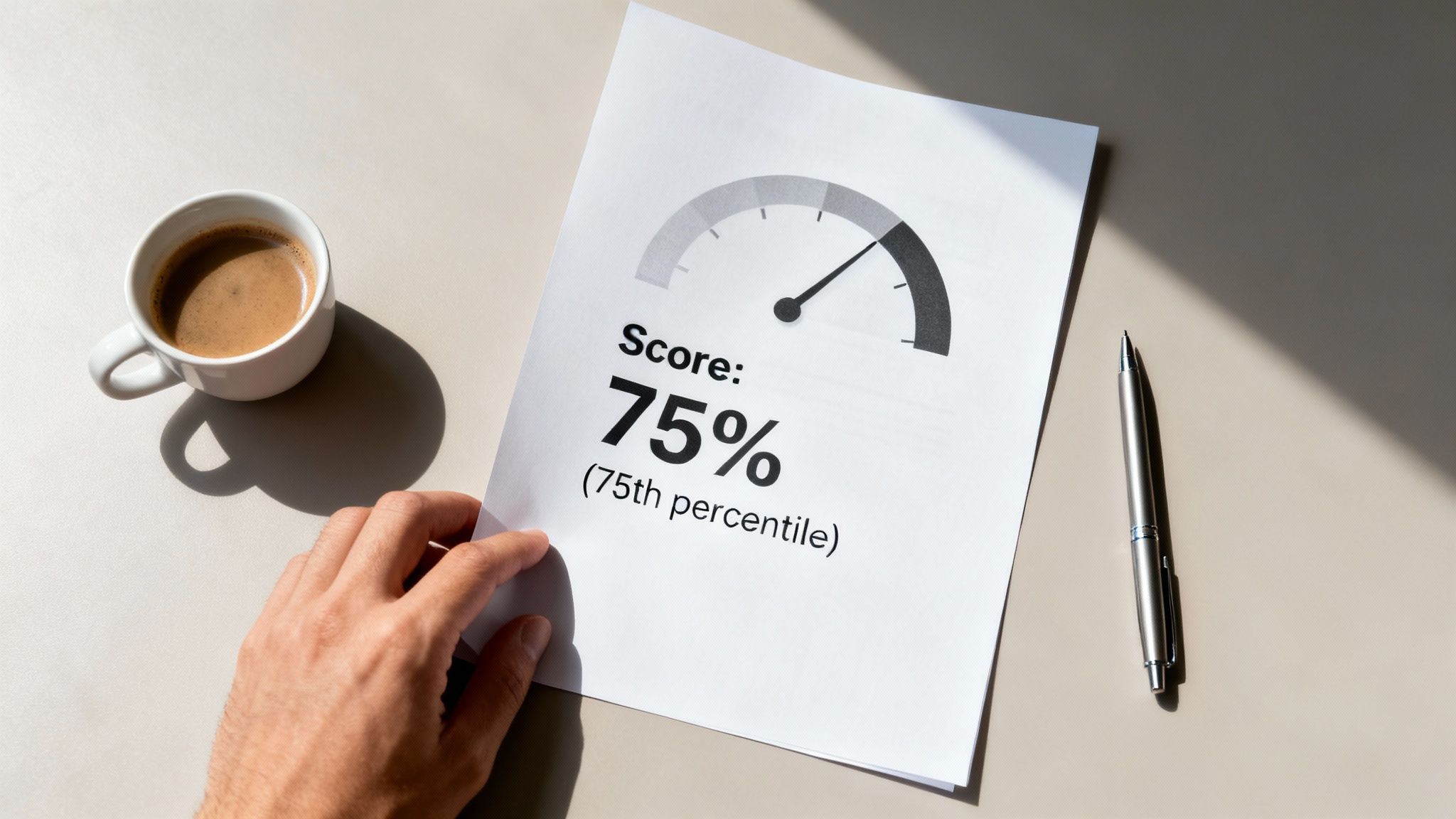
So, you’ve finished the test, and the result is in. Let's say it's 75%. Your first thought is probably, "Is that good enough?" It’s a natural question, but the answer isn't a simple yes or no, because aptitude test scores aren't like your old school report cards.
Think of it less like a test you pass or fail and more like a race. That 75% doesn't just mean you got three-quarters of the questions right; it tells an employer where you placed against everyone else who ran the same race. This is the magic of percentile rankings.
Understanding Your Percentile Rank
Your score is almost always measured against a norm group—a specific pool of people who have also taken that exact test. This group could be other graduates gunning for similar AI roles, existing employees at the company, or even a national average of professionals in your field.
So, a score in the 80th percentile means you performed better than 80% of the people in that specific group. This context changes everything.
Raw Score: This is simply the number of questions you got right.
Percentile Score: This shows how you performed relative to the comparison group.
This comparative approach gives employers a far more useful piece of information. It doesn't just show them what you can do; it shows how your abilities stack up against a relevant talent pool, which helps level the playing field for all applicants.
What Employers Actually See
Recruiters don’t look at your score as the final word. It's just one piece of a much larger puzzle they’re piecing together to get a full picture of you as a candidate. A great score can definitely make your application jump to the top of the pile, but an average one won't automatically get you rejected.
An aptitude test score is a data point, not a decision. It signals potential and how quickly you might learn, which is then explored in interviews, technical tasks, and portfolio reviews. Your result helps guide the conversation; it doesn't end it.
Take high-stakes fields like medicine. The UCAT ANZ, a key aptitude test for health sciences, shows that in one cycle, the mean score among 37,913 candidates was 1870. The top 10% scored above 2220. This is a classic example of how these tests filter for elite potential—a practice mirrored in competitive AI roles where sharp reasoning is non-negotiable. You can discover more insights about these test statistics and how they’re used.
The Strategic Value of Your Score
So, what does that number really mean for your application? Here’s a practical way to think about it:
A Top-Tier Score (90th percentile and above): This is a massive plus. It sends a strong signal to employers that you have exceptional cognitive abilities and are likely a very fast learner. This can easily make you a priority for an interview.
A Strong Score (70th-89th percentile): You've clearly demonstrated above-average aptitude. Your score is solid and will get you past most automated screening stages, letting your experience and other skills take centre stage.
An Average Score (40th-69th percentile): This is not a deal-breaker. It might not make you stand out on its own, but it shows you meet a baseline level of competency. From here, your success will lean more heavily on the strength of your CV, portfolio, and how you perform in the interview.
At the end of the day, your aptitude test score gives an employer valuable context about your potential to solve problems. Knowing how they interpret it helps you understand its true weight in the hiring process and where to focus your energy next.
How to Prepare for Your Aptitude Test
Here's the good news: while you can’t exactly ‘study’ for innate abilities, you can absolutely train to get better at aptitude tests. Think of it like a sport. Natural talent is a great starting point, but it's consistent practice, understanding the rules, and developing a solid game plan that truly makes a difference.
Proper preparation isn’t about memorising answers. It's about getting comfortable with the format, learning to work quickly under pressure, and spotting the common traps designed to throw you off. This roadmap will give you a clear plan to turn that prep time into a genuine edge.
Familiarise Yourself with the Test Format
The biggest mistake you can make is going in blind. Every test has its own unique style, question types, and strict time limits. Knowing the layout beforehand eliminates nasty surprises, calms the nerves, and lets you pour all your energy into solving the problems, not figuring out the instructions.
First things first, find out exactly what kind of test you’ll be facing. Will it be numerical, logical, verbal, or a mix? A lot of companies will even tell you which provider they use (like SHL, Saville, or Revelian), which is gold because you can then find practice materials that are an exact match.
Your goal here is to completely demystify the experience. By the time the real test starts, the format should feel so familiar that it's second nature, letting you jump straight into the questions.
This sort of preparedness is just as vital in higher education. An Australian pilot study on the Student Aptitude Test for Tertiary Admission (SATTA) found a strong connection between uniTEST scores and how well students performed in their first year of university. It shows that aptitude is a powerful predictor of success, especially in demanding fields. You can learn more about the findings on aptitude measurement in education.
Build Speed and Accuracy Through Timed Practice
Aptitude tests are a sprint, not a marathon. It’s not just about getting the right answer; it’s about getting it fast. This is where timed practice becomes absolutely essential. There's simply no substitute for simulating real test conditions to build the speed and mental stamina you'll need.
Try this simple, three-step approach:
Start Without the Clock: First, work through sample questions without any time pressure. The goal is just to understand the logic behind each problem and get the method right.
Add a Timer: Once you're comfortable with the questions, start timing yourself. Use the real test’s time-per-question average as your benchmark. This is where you learn to find that sweet spot between speed and accuracy.
Run Full-Length Mock Tests: Finally, sit down and complete full-length practice exams in one go. This builds the endurance you need to stay focused and helps you perfect your pacing for the whole assessment.
This step-by-step training develops a rhythm, turning quick, accurate answers into a habit instead of a panicked scramble.
Analyse Your Mistakes and Learn from Them
Just churning through practice tests won't get you very far. The real improvement comes from looking back at your performance—especially your mistakes. Every wrong answer is a clue telling you exactly where you need to get better.
After each practice run, ask yourself these questions:
Why did I get this wrong? Was it a simple calculation mistake, a misread of the question, or a gap in my reasoning?
Was I tricked? Learn to spot the "distractor" answers that are cleverly designed to look right. Recognising these is a crucial skill.
Could I have solved it faster? See if there were any shortcuts or more efficient ways to get to the answer.
This kind of active review is what separates mindless repetition from smart preparation. By carefully analysing your errors, you train your brain to see the patterns, avoid the common pitfalls, and tackle every new problem with a sharper strategy.
Guidance for Employers on Fair Aptitude Testing
For hiring managers, aptitude tests are much more than just another step in the hiring process. When used correctly, they become the foundation for a fair, effective, and legally sound way to find great talent. A thoughtful approach doesn’t just help you spot high-potential candidates; it creates a positive and inclusive experience for everyone who applies.
The absolute cornerstone of a fair test is job relevance. The skills you assess have to directly map to what the person will actually be doing day-to-day. For example, testing an AI Engineer on abstract logical reasoning makes perfect sense. But asking them to analyse complex literary passages? That’s probably not a relevant measure of their ability to succeed in the role.
Designing a Defensible Assessment Process
To make sure your aptitude testing is both effective and fair, you need a structured game plan. A well-designed process helps you pinpoint the best candidates and also protects your organisation by showing a clear commitment to objective, merit-based hiring.
It all starts with defining what "success" truly looks like for the role. Once you know that, you can pick assessments that genuinely measure the cognitive skills needed to achieve it.
Here are a few key principles to stick to:
Validate Your Tests: Always partner with reputable providers whose assessments are validated to predict on-the-job performance. This step is crucial—it confirms the test is a reliable indicator of a candidate’s potential, not just a random quiz.
Monitor for Bias: You need to regularly analyse your test data to check for adverse impact. This happens when one demographic group passes at a significantly lower rate than another. Catching this early allows you to refine your process and maintain fairness.
Ensure Accessibility: Be prepared to offer reasonable accommodations for candidates with disabilities, like extra time or alternative formats. The goal is to measure aptitude, not someone’s ability to navigate a system that wasn’t built for them.
Remember, an aptitude test score is just one piece of the puzzle, not the whole picture. The best hiring decisions come from looking at everything together—test results, interviews, work samples, and reference checks.
Integrating Results into a Holistic Review
You should never use an aptitude test score as the single reason to hire or reject someone. The real value of these tests is unlocked when you fold them into a bigger evaluation strategy. A low score doesn't automatically mean a candidate is out, just as a high score isn't a golden ticket.
Instead, let the results guide your next steps. A candidate with a moderate score but an absolutely brilliant portfolio might deserve a deeper technical interview to see their practical skills in action. This balanced approach helps you make well-rounded decisions and, ultimately, build stronger, more diverse teams.
For more insights on attracting top-tier talent, explore our guide on how to hire AI professionals in Australia.
Frequently Asked Questions
Got questions about aptitude tests? You're not alone. Let's tackle some of the most common queries we see from candidates in Australia's AI and tech scene to help you know exactly what you're walking into.
How Long Do Aptitude Tests Usually Take?
There's really no one-size-fits-all answer here. A quick test focusing on a single skill might be over in just 20 minutes. On the other hand, many companies bundle several tests together—maybe a mix of numerical, logical, and verbal reasoning—and that can take up to 90 minutes.
Your best bet is to check the instructions the employer sends you. They’ll almost always tell you the format and duration ahead of time, so you can block out enough quiet time to focus and do your best work.
Can I Use a Calculator on a Numerical Test?
This is a big one, and it completely depends on the test provider. Some modern platforms have a calculator built right into the screen for you to use. Others strictly forbid any outside help, including your own calculator.
Pay close attention to the rules. Accidentally using a calculator when it's not allowed can get you disqualified. Before you begin, double-check the instructions to see if one is provided, permitted, or banned. It’s a simple step that can save you a lot of grief.
Are Aptitude Tests Good Predictors of Job Success?
They can be, but they’re just one piece of the puzzle. An aptitude test is great at measuring your raw problem-solving ability and how quickly you can pick up new skills—both critical for thriving in a fast-paced AI role.
That said, they work best when they're part of a bigger picture. Smart employers combine aptitude test scores with other assessments to get a well-rounded view of a candidate. This usually includes:
Technical interviews to dive deep into your coding and system design skills.
Portfolio reviews to see real-world examples of what you've built.
Behavioural chats to see how you collaborate and if you’ll be a good fit for the team.
Think of it this way: an aptitude test is a valuable data point, not the final word on your potential.
Ready to find your next role in the Australian tech scene? AI Jobs Australia connects top talent with verified opportunities in AI, machine learning, and data science. Create your profile and start browsing roles at https://www.aijobsaustralia.com.au.