
A Guide to AI Engineering Salaries in Australia
If you're an AI Engineer in Australia, you're in a fantastic position. Salaries in this field typically fall between $110,000 to well over $200,000 per year, but this can shift quite a bit based on your experience, where you're based, and the specific skills you bring to the table. These aren't just your standard tech salaries; they come with a premium because the demand for people who can build intelligent systems is through the roof.
AI Engineer Salary Australia: What Can You Really Earn?
Artificial Intelligence has moved far beyond being a tech buzzword. It's now a fundamental part of how businesses innovate, whether it's a logistics company in Perth fine-tuning its supply chain or a Sydney-based fintech developing smarter financial products. This nationwide investment in AI talent has fired up the job market, pushing salaries for AI engineers significantly higher than for many traditional software development roles.
So, what’s the takeaway for you? If you have skills in AI, you hold some serious bargaining power. Getting a clear picture of the salary landscape is your first step to making the most of this demand.

Breaking Down the Pay Packet
Your total compensation is built on several key things. Your base salary is the starting point, but your years of experience, the city you work in, and any niche skills you have will all add to it. It makes sense, right? An entry-level engineer fresh out of uni won't be on the same package as a senior engineer leading a complex project. Likewise, a job in a major tech hub like Melbourne or Sydney will often pay more than one in a smaller city.
AI Engineer Salary Australia At a Glance
To give you a clearer idea, here's a quick summary of what you can expect for a base salary at different stages of your career. Keep in mind, this doesn't include super or potential bonuses.
| Experience Level | Typical Annual Salary Range (AUD) |
|---|---|
| Junior / Entry-Level (0-2 years) | $80,000 – $120,000 |
| Mid-Level (3-5 years) | $120,000 – $170,000 |
| Senior / Lead (5+ years) | $170,000 – $250,000+ |
These figures give you a solid baseline for what to expect as you progress.
More Than Just the Base Salary
It’s crucial to remember that the numbers in the table are often just the beginning. The entire pay structure for AI and data roles is being reshaped. Across Australia, professionals in Data and AI are pulling in an average of AUD 157,000 a year, which also includes related roles like Machine Learning Engineers and Data Scientists.
And the ceiling is high. Get into a top-tier role like a Director of AI, and you could be looking at an average salary of AUD 236,000. It just goes to show how much earning potential there is as you climb the ladder.
The real value of an AI Engineer isn't just about coding. It's about using that technical expertise to solve genuine business problems. That ability to create commercial impact is what justifies the six-figure salary and makes this one of the most rewarding careers in tech right now.
The best way to know your worth is to see what’s out there. A great starting point is to check out current AI Engineer jobs in Australia to see what companies are offering and how your skills line up with real-world pay.
Mapping Your Career and Salary Progression
Your journey as an AI Engineer is a story of continuous growth, and your salary should reflect every milestone you hit. It's not a static role. Think of it as a dynamic path where mastering new skills and taking on more responsibility directly boosts your earning potential. You start with the fundamentals and move toward strategic leadership, with significant pay bumps marking each major step.
It’s a lot like building a complex AI model. You begin with a solid base, slowly add layers of complexity and new capabilities, and fine-tune it until it delivers powerful, reliable results. Your career works the same way, and Australian employers are ready to pay a premium for that hard-won expertise.

The Entry-Level Foundation
As a junior or entry-level AI Engineer, your world revolves around learning and execution. You’ll be in the trenches, cleaning data, prototyping models, and implementing algorithms under the watch of more senior team members. This is where you cut your teeth, build practical skills, and prove your technical chops.
In Australia, an entry-level AI gig typically starts somewhere between $80,000 and $100,000 a year. This phase is less about calling the shots and more about becoming a rock-solid engineer who contributes effectively to the team’s goals.
Advancing to a Mid-Level Professional
With a few years under your belt, you’ll step into a mid-level role. This is where your pay packet really starts to grow. You’re no longer just ticking off tasks; you’re taking ownership of entire features or model pipelines. You’re the one translating a business problem into a technical solution and making sure your models hold up in testing.
Mid-level AI Engineers can expect their salaries to jump into the $120,000 to $170,000 range. This pay rise reflects your growing autonomy and your knack for solving tougher challenges without needing constant oversight.
Reaching the Senior Tiers
Making the leap to Senior AI Engineer means you've shifted from a builder to a strategist. Your responsibilities now include designing system architectures, optimising model performance for production, and mentoring junior engineers. You’re not just fixing technical problems anymore—you're aligning the company's AI strategy with its core business objectives.
At this level, your value is measured by your impact. Leading a major project that lifts revenue or mastering a production-level system are the kinds of milestones that open the door to serious salary negotiations and push your earnings well past the average.
This strategic responsibility comes with top-tier rewards. A senior AI engineer salary in Australia often clears $190,000, with lead and principal roles pushing even higher. This isn't just talk; the data backs it up. Research shows the median base pay for AI/ML Engineers in Australia is around AUD 172,000, while the top 25% of professionals command AUD 197,000 or more for their specialised skills. If this career trajectory sounds like you, you can find out more about AI salaries in Australia.
This progression lays out a clear financial roadmap. As your experience deepens and you prove you can deliver real commercial value, your salary will grow right alongside it. For those who want to lead teams, the next logical step in both career and salary could be a role like an AI Engineering Manager.
How Location Influences Your Paycheck
In real estate, they say it’s all about "location, location, location," and the very same rule applies to an AI engineer salary in Australia. Where you decide to set up shop can seriously affect your earnings, often by tens of thousands of dollars for the exact same role.
It all comes down to where the tech headquarters, venture capital, and industry-specific demand are clustered. Think of it like a set of economic gravity wells—the bigger the city's tech scene, the stronger its pull for talent and investment, which naturally drives salaries skyward.
The Major Tech Hubs: Sydney and Melbourne
Sydney and Melbourne are the undisputed heavyweights of Australia's tech industry, and their salary packages absolutely reflect that. These cities are magnets for major tech companies, buzzing startup ecosystems, and a huge concentration of roles in high-paying sectors like finance and e-commerce.
With so many companies vying for the best people, the competition for top AI talent is fierce. This gives skilled engineers real bargaining power. Businesses in these cities are prepared to pay a premium to secure professionals who can deliver massive value, which is the key reason you'll find the biggest paychecks here.
Comparing Salaries Across Australian Cities
While Sydney and Melbourne lead the charge, other cities are carving out their own thriving tech communities. Brisbane, Perth, and Adelaide are becoming fantastic alternatives, each offering a different blend of career opportunity and lifestyle. That said, their salary ranges generally haven't caught up to the big two just yet.
Data consistently shows Sydney as Australia's AI salary champion. Take a lead Machine Learning Engineer, for example—they can command up to AUD 189,000 annually in Sydney, just edging out Melbourne's AUD 188,000. This city premium is significant, with Sydney’s powerful tech ecosystem often pushing pay 10-20% higher than the national average.
The salary gap isn't just about company size; it’s about industry focus. Sydney's dominance in fintech and Melbourne's booming e-commerce and health-tech sectors create specialised, high-paying AI roles that you just don't see as often elsewhere.
To put it into perspective, here's a look at how Australia's key tech hubs stack up for senior-level AI and Machine Learning roles.
AI Engineer Salary Comparison Across Australian Cities
| City | Average Senior/Lead Salary (AUD) |
|---|---|
| Sydney | $189,000 |
| Melbourne | $188,000 |
| Brisbane | $175,000 |
| Canberra | $172,000 |
| Perth | $168,000 |
| Adelaide | $165,000 |
As the table shows, Sydney and Melbourne are neck and neck, with a noticeable drop-off as you move to other capital cities. If you're targeting the top of the market, exploring the many AI engineer jobs in Sydney is a great way to see what leading companies are currently offering.
The Remote Work X-Factor
The recent explosion in remote work has thrown a fascinating curveball into the mix. Does that city-based salary premium still matter if you can work for a Sydney company from the Sunshine Coast?
It’s complicated.
Many companies have started adjusting their pay scales based on employee location, offering less to those in areas with a lower cost of living. But others have gone the other way, adopting location-agnostic pay policies. This means they offer the same salary for a role, regardless of where the employee logs in from.
This trend is opening up incredible opportunities for engineers who want a top-tier salary without the big-city price tag. It gives you the power to decide what matters more: the absolute highest potential salary in a major hub, or the lifestyle advantages of a competitive remote role.
Understanding Different AI Job Titles and What They Pay
Trying to make sense of the AI job market can feel a bit confusing. You’ll see titles like "AI Engineer," "Machine Learning Engineer," and "Data Scientist" thrown around, often interchangeably. While they're all part of the same family, the day-to-day work—and more importantly, the pay packet—can look quite different.
Getting a handle on these nuances is key. It helps you figure out where your skills fit best and how to position yourself for the highest possible salary.
Let's use a simple analogy: building a high-performance race car.
The AI Engineer is the chief engineer of the whole project. They're the ones designing the complete vehicle, making sure the engine, chassis, and software all work together seamlessly. They take the car from a blueprint to a finished product ready for the track. In the tech world, they build and deploy end-to-end AI applications.
The Machine Learning (ML) Engineer is the engine specialist. Their entire focus is on building that powerful, roaring engine. They live and breathe algorithms, data pipelines, and performance tuning to create the predictive models that give the car its raw speed.
And the Data Scientist? They're the team's race strategist. They pour over data from past races, analyse what the competition is doing, and use statistical models to find that extra tenth of a second. They find the why in the data, providing the intelligence that shapes the car's design and race-day strategy.
How Your Specialisation Affects Your Salary
Here in Australia, the market tends to pay a premium for the more hands-on, production-focused engineering roles. Why? Because companies desperately need people who can build and deploy robust, scalable AI systems that actually make a difference to the bottom line. While a Data Scientist's insights are invaluable, the AI and ML Engineers are the ones who turn those insights into a working product.
It's a simple case of supply and demand. All three roles are hot property, but there's a particular urgency for people who don't just analyse data but can build the real-world infrastructure to put it to work. That's why the engineering titles often come with a bigger paycheck.
To give you a clearer picture, here’s a general breakdown of how the salaries often stack up. Keep in mind these are just typical ranges and will shift based on your experience, the company, and the city.
Typical Salary Comparison
- AI Engineer: Often at the top of the pay scale. Their broad responsibility for building and deploying entire AI systems makes them incredibly valuable. The focus is all on practical application.
- Machine Learning Engineer: Hot on their heels with a very competitive salary. Since they specialise in getting complex models working in live production environments, they command top dollar.
- Data Scientist: Still an exceptionally well-paid role, but salaries can sometimes sit just below their engineering colleagues. It really depends on the job—a role focused on R&D and advanced modelling will pay more than one centred on business intelligence and reporting.
So, Which Path Should You Take?
Ultimately, the best role for you depends on what gets you excited.
- Love the idea of building something from scratch and seeing it go live? The AI Engineer path is probably your calling.
- Get a kick out of fine-tuning complex algorithms and squeezing every last drop of performance out of them? You’ll feel right at home as a Machine Learning Engineer.
- Are you naturally curious, with a passion for digging into data to uncover hidden truths that can shape big decisions? Then you’re likely a Data Scientist at heart.
Nailing down these differences is the first step. It allows you to sharpen your resume, focus on the right skills, and confidently go after the roles that truly line up with your long-term career and financial ambitions.
The High-Value Skills That Boost Your Salary
When it comes to your pay packet, not all AI skills are created equal. Getting the fundamentals right—Python, algorithms, and core machine learning frameworks like TensorFlow or PyTorch—is your ticket into the game. But to really drive up your earning potential, you need to specialise.
Think of it this way: plenty of people can build a wall, but a master stonemason who creates intricate, load-bearing archways is in a different league entirely. They get paid a premium for their rare, high-impact skills. In the AI world, that’s exactly what mastering a niche domain does for your AI engineer salary in Australia.
Core Technical Specialisations in High Demand
If you’re aiming for the top salary brackets, zeroing in on one of these areas is a very smart career move. Australian companies are pouring money into these fields to find their next competitive edge.
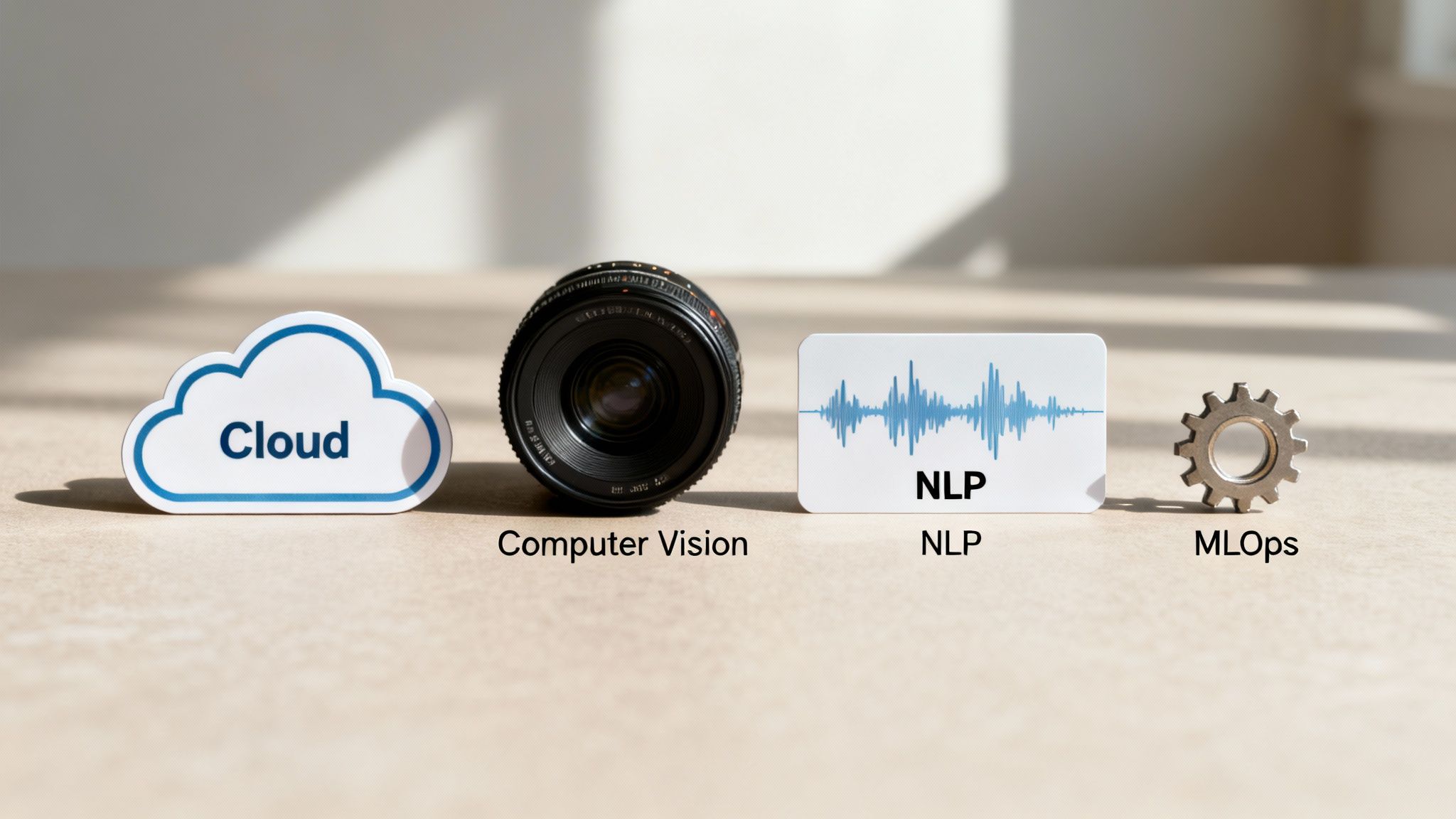
- Natural Language Processing (NLP): This is the magic that powers the chatbots we actually want to talk to, the search engines that just get what we mean, and the tools that can summarise a 50-page report in seconds. Businesses are drowning in text-based data, and they’ll pay top dollar for experts who can build models to make sense of it all.
- Computer Vision: Ever wondered how retail stores can automatically track stock on shelves or how agricultural drones spot diseased crops from the air? That’s computer vision. The ability to teach machines to see and interpret the world is a game-changer in industries from autonomous vehicles to medical imaging.
- Reinforcement Learning (RL): While maybe not as common as NLP or Computer Vision, RL is where the really cutting-edge work is happening. It’s the brain behind systems that teach themselves, like algorithmic trading bots that optimise their own strategies or complex robotics in manufacturing. Because so few engineers have deep RL skills, those who do can command exceptional salaries.
MLOps and Cloud Proficiency: The Non-Negotiables
Look, building a clever AI model on your laptop is one thing. Getting it to work reliably, 24/7, for thousands of users is a completely different beast. This is where Machine Learning Operations (MLOps) comes into play.
MLOps is the set of practices for deploying, monitoring, and maintaining machine learning models in a live production environment. It’s what ensures they don't break, drift, or become irrelevant over time.
MLOps is the bridge between a cool data science experiment and a profitable business application. Companies will pay a significant premium for engineers who can build this bridge because it directly impacts reliability, efficiency, and ultimately, the return on investment.
A few years ago, MLOps was a nice-to-have. Today, it's a standard requirement for any serious senior role. It proves you understand the full lifecycle of an AI product.
Working hand-in-hand with MLOps is deep expertise in the major cloud platforms. It's almost impossible to do AI at scale without them.
- Amazon Web Services (AWS): The long-time leader, with a huge ecosystem of tools like SageMaker.
- Google Cloud Platform (GCP): A powerhouse in AI and data, particularly with its Vertex AI platform.
- Microsoft Azure: A strong favourite in the enterprise world, centred around its Azure Machine Learning service.
Being proficient in at least one of these isn't just a bonus anymore—it's a baseline expectation for any well-paid AI Engineer in Australia.
Soft Skills That Translate to Hard Cash
Pure technical brilliance will only get you so far. The engineers who really clean up are the ones who can connect their complex work to simple business outcomes.
Two "soft" skills, in particular, are massive salary multipliers:
- Business Acumen: This is about seeing the bigger picture. It’s the ability to ask why you're building a model, not just how. Can you articulate how your NLP model will cut customer service costs by 20%? Can you explain how a new computer vision system will improve factory safety and reduce insurance premiums? Engineers who think like this are treated as strategic partners, not just coders.
- Storytelling with Data: You can have the most accurate, ground-breaking model in the world, but if you can't explain its value to a non-technical executive, it might as well not exist. The real skill is translating a mess of metrics and model outputs into a clear, compelling story that decision-makers can understand and act on. This ability to communicate value is often what separates a $150,000 engineer from a $220,000 one.
How to Secure the Salary You Deserve
Having elite technical skills is one thing, but knowing how to communicate their value is what truly unlocks a top-tier salary. Landing the compensation you deserve isn't luck; it's a strategic process. It takes solid preparation, confident negotiation, and a crystal-clear understanding of your market worth long before you even walk into an interview.
Think of it like this: you're presenting a business case, and you are the investment. Your job is to prove you’ll deliver a fantastic return.
Build Your Case Before You Talk Numbers
First things first, you need to gather your evidence. A strong portfolio is your most powerful asset here, but it needs to do more than just list what you've built. It needs to tell a compelling story about the impact you’ve made.
For every project, zero in on the outcome:
- Did your model boost user engagement by 15%?
- Did your MLOps pipeline slash deployment times from weeks down to days?
- Did your computer vision system cut manual error rates in half?
Put a number on your achievements whenever you can. These hard figures are far more persuasive than a simple list of programming languages you know. Before you even start applying, dig into the current AI engineer salary Australia benchmarks. Use platforms like Glassdoor, industry salary guides, and the job listings on AI Jobs Australia to set a salary target that's both realistic and ambitious.
Walking into a negotiation without a clear salary range in mind is like trying to navigate without a map. Arm yourself with data so you can anchor the conversation around what the market says you are worth, not just what the company first offers.
Master the Art of Negotiation
So, you’ve got an offer. Great! Now the real conversation begins. Remember, the initial number is almost always a starting point, not the final word.
When the offer comes through, show your excitement for the role, but calmly state that you need a moment to review the complete package. This buys you valuable time to prepare a thoughtful counter-offer.
When you respond, bring it back to your key strengths and connect them directly to the company’s specific needs. Reference the market data you gathered and articulate your value with confidence.
And don't forget to look beyond the base salary. The total compensation package is what really counts:
- Superannuation: Are they offering the standard rate, or is it higher?
- Bonuses: Are these guaranteed or tied to performance? What do the typical payouts look like?
- Equity: If shares are on the table, what’s the vesting schedule and current valuation?
- Benefits: What’s the real value of their health insurance, professional development budgets, and leave policies?
A $180,000 base salary with a strong bonus structure and great benefits could easily be more valuable than a flat $190,000 offer with nothing else attached. By understanding the entire picture, you can negotiate much more effectively and land a role that truly reflects your expertise.
Frequently Asked Questions
When you're trying to figure out what an AI engineer salary in Australia really looks like, a few common questions always pop up. Things like contract versus permanent roles and what's included beyond the base salary can make a big difference to your take-home pay and overall financial picture.
Let's clear up some of the most frequent queries so you can evaluate any job offer with confidence.
Permanent Versus Contract Roles
One of the first things people wonder about is the pay difference between permanent and contract AI jobs. It’s easy to see why. The daily rates for contractors can look incredibly attractive, often sitting somewhere between $1,000 to $1,500 per day.
But that big daily number doesn't tell the whole story. As a contractor, you’re essentially running your own business. That means you have to cover your own superannuation, and you don't get paid for holidays, sick days, or any time you take off. When you add up the value of paid leave, super contributions, and the stability that comes with a permanent job, the full-time role often works out to be a much better deal over a full year.
It really comes down to a trade-off. Contracting gives you flexibility and a higher daily rate, but permanent roles offer security, a full suite of benefits, and a predictable annual income.
Understanding Your Full Compensation Package
Your base salary is just the starting point. To understand your true earning potential, you need to look at the entire compensation package, which usually includes two other major components: superannuation and bonuses.
- Superannuation: It's easy to overlook, but this is a big one. In Australia, your employer is legally required to pay an additional 11% on top of your salary into your super fund. This is a massive boost to your long-term wealth that you don't see in your fortnightly paycheque.
- Bonuses and Equity: This is where things can get really interesting. Performance bonuses or equity (shares in the company) can add another 10% to 30% (or even more) to your annual earnings. These are particularly common in big tech companies and well-funded startups, designed to reward you for making a real impact on the business.
What’s the Future Look Like for AI Engineers in Australia?
Put simply, the future is bright. The demand for skilled AI engineers here in Australia is set to explode over the next few years. Just about every industry you can think of—from finance and retail to healthcare and even agriculture—is weaving AI into its day-to-day operations.
This creates a classic supply-and-demand problem: there are far more jobs than there are skilled people to fill them. For anyone with the right skills, this imbalance means fantastic job security and the likelihood of salaries continuing to climb. It’s a great time to be in the field.