
Guide To Gross Salary for AI and ML Roles

When you're looking at a job offer, the big number that jumps out at you is almost always the gross salary. It’s best to think of this as the 'sticker price' of your role—the full, top-line figure you’ve earned before anyone takes a slice. This is the amount you’ll see on your employment contract and the number advertised for exciting AI and ML roles across Australia.
What Gross Salary Really Means for Your Paycheck
Your gross salary is the starting point for absolutely everything. It’s the total amount of money you make before any deductions—like tax or superannuation—are taken out. For AI professionals comparing offers in Sydney or Melbourne on platforms like AI Jobs Australia, this figure is the foundation for any negotiation.
But why does this pre-deduction number matter so much? Because everything else is calculated from it. Your income tax, mandatory super contributions, and even how much a bank might lend you for a home loan are all based on your gross salary. Getting your head around this concept is the essential first step for anyone in the Australian tech scene looking to compare job offers or simply manage their finances better. You can always check out broader earning trends from the Australian Bureau of Statistics for more context.
The Full Amount vs The Take-Home Pay
It's incredibly common to mix up gross salary with net salary, but they tell two completely different stories about your income. Your gross salary is the whole package, while your net salary is the actual cash that hits your bank account each payday.
Here’s a simple way to think about it: if your gross pay is the entire pizza, your net pay is the pile of slices you actually get to eat after the tax office and your super fund have taken theirs.
Understanding the difference between gross and net pay is fundamental. Your gross salary reflects your market value and negotiating power, while your net salary dictates your monthly budget and lifestyle.
To make this distinction perfectly clear, let's lay out the key differences side-by-side.
Gross Salary vs Net Salary At a Glance
This quick table gives you a clear visual breakdown, helping you see how the 'full price' of your salary compares to the cash you actually have on hand.
| Concept | Gross Salary (Your Full Paycheck) | Net Salary (Your Take-Home Pay) |
|---|---|---|
| Definition | The total earnings before any deductions. | The amount left after all deductions are made. |
| Where You See It | On your employment contract and job ads. | On your payslip and in your bank account. |
| Main Purpose | Used for salary negotiation and loan applications. | Used for personal budgeting and daily spending. |
In short, one number shows your earning potential, and the other shows your living reality. Knowing both is key to smart financial planning.
The Building Blocks of Your Australian Gross Salary
When you look at a job offer, it's easy to fixate on one big number. But your gross salary isn't just a single figure; it’s more like a recipe. The main ingredient is your base salary, but several other elements get mixed in to create your total earnings. Getting your head around each component is essential, especially when you’re weighing up offers in the competitive Australian tech scene.

The first, and most obvious, building block is your base salary. This is the predictable, fixed amount you get for doing your job, paid out regularly. It’s the rock-solid foundation of your pay packet. For example, a Machine Learning Engineer might be offered a base salary of $130,000 per year. That’s the figure you can count on for budgeting and planning your finances.
Beyond the Base Salary
While the base is critical, it’s often just the starting point. Many pay packages for AI and data science roles throw in other variable bits and pieces that can seriously bump up your total gross earnings. It pays to look past the base and see what else is on the table.
These extra elements might include:
Performance Bonuses: This is extra cash you get for hitting specific targets. A Data Scientist could earn a 10% annual bonus for rolling out a predictive model that saves the company money.
Commissions: While more common in tech sales, this is a cut of the revenue you bring in.
Allowances: These are set payments to cover particular expenses, like a work-from-home setup allowance or a car allowance if your job involves a lot of travel.
Overtime Pay: If you put in hours beyond your standard contract, this extra pay gets added to your gross income.
Your gross salary is simply the sum of all these parts. It’s your base salary plus any bonuses, commissions, and allowances you earn before anything gets taken out.
How It All Adds Up
Let’s go back to our Machine Learning Engineer with the $130,000 base salary. If they also land a $13,000 performance bonus (10% of their base), their total gross salary for the year jumps to $143,000. And it’s this higher figure that the tax office will look at when working out their income tax.
This is exactly why it’s so important to understand the whole picture. A job with a lower base but a generous, realistic bonus structure might end up paying more than one with a higher base and nothing else. It’s a frequent puzzle when comparing different software engineer salary packages in Australia. By breaking an offer down, you get the clarity you need to make the right move for your career.
From Gross to Net: Understanding Your Deductions
So, you’ve got the job offer and a great-looking gross salary figure on the contract. Fantastic! But how does that impressive number shrink before it actually lands in your bank account?
The journey from gross to net pay is all about deductions—the various amounts your employer is required to subtract from your pay for taxes and other contributions. It’s less about money vanishing and more about it being channelled into different, essential pots.
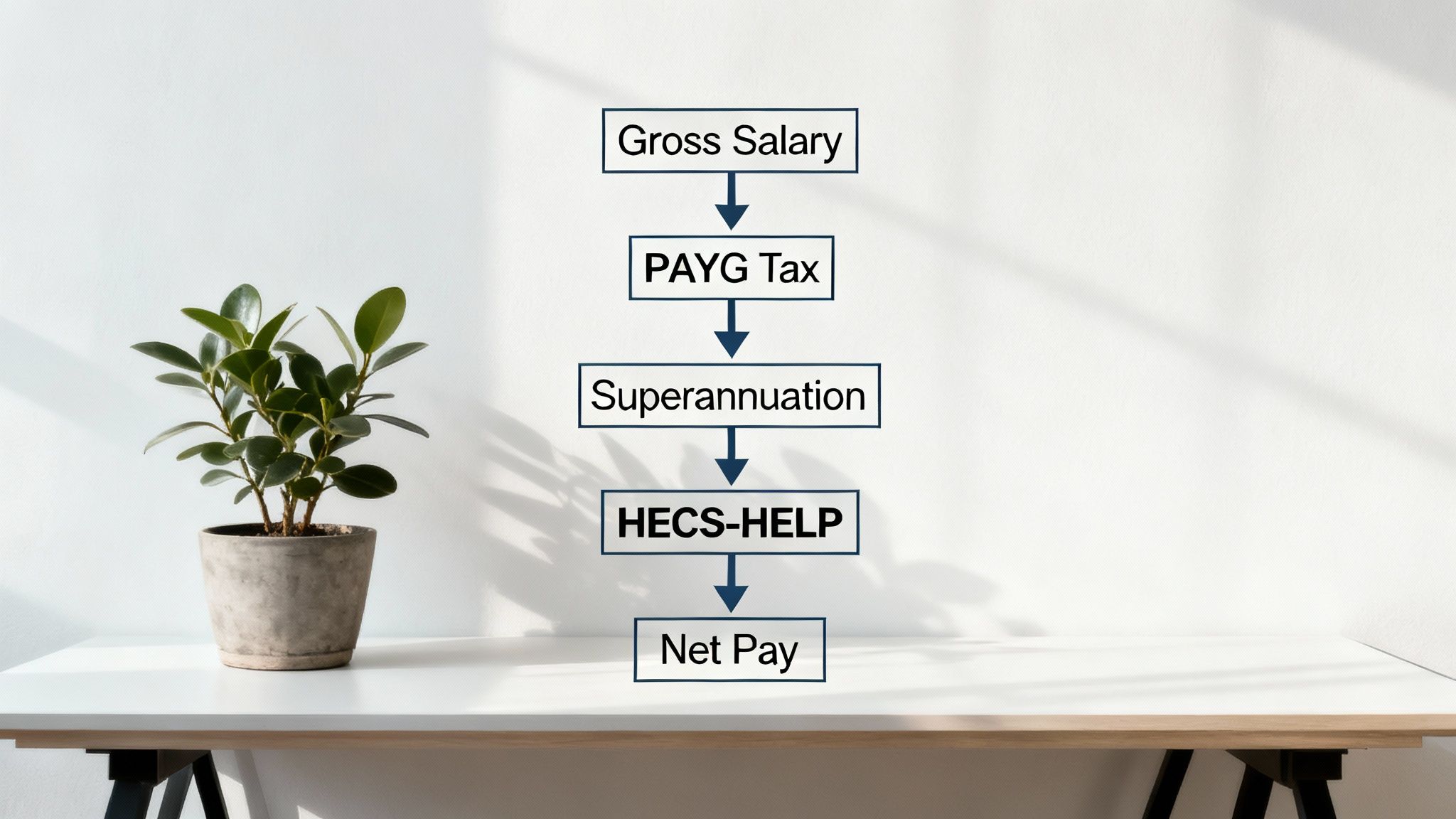
For anyone working in Australia, a few key deductions are universal. Getting your head around these is the secret to figuring out what your real take-home pay will be.
The Major Players: PAYG Tax and Superannuation
Two big items will always come out of your gross salary: PAYG withholding and superannuation. They serve completely different purposes but are fundamental to how pay works in Australia.
Pay As You Go (PAYG) Withholding: This isn't a separate tax. Think of it as the Australian Taxation Office's (ATO) "pay-as-you-go" system for your income tax. Your employer estimates your annual tax bill based on your salary and deducts a slice from each paycheque to send to the ATO on your behalf. This drip-feed approach saves you from getting hit with a massive tax bill at the end of the financial year.
Superannuation: This is your retirement nest egg. By law, your employer must contribute a set percentage of your earnings into a super fund for you under the Superannuation Guarantee. While you can't touch this money until retirement, it’s a critical part of your overall compensation package.
The core idea is simple: PAYG covers your tax obligations for today, while superannuation builds your savings for tomorrow. Both are calculated from your gross salary.
Other Common Deductions
Beyond the big two, a few other things might be deducted from your gross pay, usually depending on your personal choices and circumstances.
These can include:
HECS-HELP Repayments: If you have a student loan from university, repayments are automatically deducted by your employer once your income hits a certain threshold.
Private Health Insurance: Some people arrange to have their health insurance premiums paid directly from their pre-tax salary.
Salary Sacrificing: This is a neat arrangement where you agree to a lower take-home pay in exchange for your employer covering certain expenses with your pre-tax dollars. Common examples include leasing a car or making extra contributions to your super.
Knowing how these deductions add up is crucial. For example, recent analysis shows that an average gross salary of AUD 100,000 often results in a net salary of AUD 73,476 after tax. That's an effective deduction rate of 26.6%. You can dig deeper into insights into average Australian salaries and deductions to see how these figures compare across the country.
Each of these deductions plays a role in transforming your headline gross salary into your final net pay.
Let’s Crunch the Numbers: A Real-World Salary Calculation
Theory is one thing, but seeing how the numbers actually break down is where the real understanding happens. Let's walk through a practical example to see how a six-figure salary on paper translates into the cash that hits your bank account each month.

We'll follow an AI specialist, let's call her Alex, who just landed a new role in Sydney. The contract proudly states a gross salary of $120,000 per year. That's a great number, but what does it actually mean for her day-to-day finances?
Let’s break it down.
Step 1: Find the Monthly Gross Pay
First up, we simply convert that annual figure into a monthly one. This gives us our starting point before the tax man and any other deductions get their slice.
- The Math: $120,000 (Annual Gross) ÷ 12 (Months) = $10,000 per month
So, Alex’s gross monthly pay is a neat $10,000. This is the figure that all deductions are based on.
Step 2: Estimate the Income Tax
Now for the big one: PAYG (Pay As You Go) income tax. Based on the Australian Taxation Office (ATO) rates, a salary of $120,000 means the total annual tax bill will be around $29,467.
Let's see what that looks like each month.
- The Math: $29,467 (Annual Tax) ÷ 12 (Months) = $2,455.58 per month
Alex’s employer will withhold this amount and send it straight to the ATO. It never even touches her account.
Step 3: Factor in Other Deductions
For this example, let's say Alex also has a HECS-HELP student loan to pay off. The repayment rate is tiered, and for an income of $120,000, the rate is 8.0%.
The Math: $120,000 (Annual Gross) × 8.0% = $9,600 per year.
Monthly Deduction: $9,600 ÷ 12 = $800 per month.
Don't Forget Super! It's crucial to remember that the mandatory Superannuation Guarantee (currently 11.5%) is paid by the employer on top of the gross salary. It's not a deduction from Alex's $120,000.
Step 4: Calculate the Final Net Pay
Alright, time to put it all together. We take the gross monthly pay and subtract all those deductions to find Alex's final take-home amount.
$10,000.00 (Monthly Gross)
$2,455.58 (Estimated Monthly Tax)
$800.00 (Monthly HECS-HELP)
= $6,744.42 (Estimated Monthly Net Pay)
This detailed breakdown shows how that impressive $120,000 gross salary becomes roughly $6,744 in your pocket each month.
To give you a clearer picture, here’s a table that lays it all out.
Sample Calculation From Gross to Net Salary
| Item | Annual Amount | Monthly Amount | Notes |
|---|---|---|---|
| Gross Salary | $120,000.00 | $10,000.00 | The starting figure from your employment contract. |
| PAYG Tax Withholding | -$29,467.00 | -$2,455.58 | Based on ATO tax brackets for the financial year. |
| HECS-HELP Repayment | -$9,600.00 | -$800.00 | Based on an 8.0% repayment rate for this income level. |
| Net Salary (Take-Home) | $80,933.00 | $6,744.42 | The actual amount paid into your bank account. |
As you can see, the difference between the headline number and your net pay is significant.
Running these numbers yourself is the best way to gain the clarity you need to compare job offers fairly and plan your finances with real confidence. For a calculation tailored to your exact situation, check out a specialised AI & ML Salary Calculator.
Why Gross Salary Is Your Most Powerful Career Tool
Getting your head around gross salary is about more than just seeing a number on a contract. It’s about understanding its central role in your career strategy. When you're juggling multiple job offers, your gross salary is the only reliable benchmark for a true apples-to-apples comparison.
One company might offer a slightly different take-home pay because of their specific payroll setup or benefits structure, but it's the gross figure that tells you the real market value they’re placing on your skills. Focusing on this number lets you compare the foundational earning potential of each role, not just the net pay, which can fluctuate for all sorts of reasons.
Your Anchor in Salary Negotiations
When it's time to negotiate, your gross salary is your anchor. This is the number you talk about, debate, and ultimately agree on. Trying to negotiate your net pay is a dead end – it brings in too many personal variables, like your individual tax situation, which are frankly not your employer's concern.
Your negotiation should always revolve around the gross amount. Build your case around this figure, using market data, your experience, and the unique value you offer to justify it. Knowing the typical gross salary range for your role in the industry gives you a solid, confident place to start.
For example, skilled AI and ML professionals are in a great spot right now. While the national median hourly rate sits around $42.90, roles that require a university degree often push that up to between $50 and $60.90 per hour. ICT Professionals, a category that covers many AI jobs, have a median annual income of $119,600—that’s a full 40% above the national average. You can dig into the detailed employee earnings data from the Australian Bureau of Statistics to arm yourself with the facts.
Your gross salary is the number that defines your professional value in the market. Negotiating it effectively is one of the most direct ways to accelerate your financial growth throughout your career.
By getting good at negotiation, you can make a huge difference to your earnings over the long haul. If you want to sharpen those skills, take a look at our guide on how to negotiate salary in the Australian tech industry.
The Foundation for Your Financial Life
Looking beyond job offers, your gross salary is the key that unlocks major financial milestones. When you apply for a mortgage, a car loan, or other types of credit, lenders and banks look straight at your gross income.
This figure shows them your ability to handle repayments before tax and other deductions are taken out. A higher gross salary can lead directly to:
Greater borrowing power for a home loan.
More favourable interest rates on personal loans.
A stronger foundation for long-term retirement planning.
In short, this number is your financial horsepower. It signals your stability and earning potential to the institutions that help you achieve your biggest life goals. So, it's time to reframe what gross salary is—it's not just a payroll term, but a critical tool for building the career and financial future you want.
Answering Your Top Questions About Gross Salary
Even when you’ve got a handle on the basics, real-world pay scenarios can throw up some tricky questions. To make sure you’re never caught off guard, we’ve pulled together the most common queries we hear from tech professionals in Australia. Here are the clear answers you're looking for.
Is Superannuation Part of My Gross Salary?
This is easily the biggest point of confusion, but the answer is usually quite simple: no.
Your gross salary is the amount you and your employer agree on for the work you do. The compulsory Superannuation Guarantee (SG) is a separate, additional payment your employer is legally required to make on top of that salary.
Think of it this way: your gross salary is your pay cheque, while super is a mandatory investment your employer makes towards your retirement. If your contract says your gross salary is $120,000, you get paid that amount (before tax), and your employer also pays an extra percentage (currently 11.5%) into your super fund. It doesn't come out of your $120,000.
The key thing to watch out for is how job offers are worded. An offer of "$133,800 inclusive of super" is really just a $120,000 gross salary with the superannuation already bundled in. Always ask for clarification on whether an offer is "gross salary plus super" or a "total remuneration package".
How Does Salary Sacrificing Affect My Pay?
Salary sacrificing is a common arrangement where you agree to take home a bit less pay in return for your employer covering certain benefits with your pre-tax dollars. This is a smart move because it lowers your taxable income, which can mean you pay less tax overall.
Some of the most popular items to salary sacrifice include:
Extra Super Contributions: A great way to boost your retirement nest egg using pre-tax money.
A Novated Car Lease: Bundling car payments and running costs into a single pre-tax deduction.
Laptops or Other Work Gear: Paying for eligible tech directly from your pre-tax earnings.
Even when you salary sacrifice, your official gross salary on your employment contract doesn't change. For example, if your gross pay is $150,000 and you sacrifice an extra $10,000 into super, your taxable income drops to $140,000. But your employment is still based on that $150,000 figure, which is crucial for things like negotiating your next pay rise or applying for a home loan.
Salary sacrificing is a strategic tool for reducing your taxable income. While it changes your take-home pay and tax bill, your foundational gross salary—the number that reflects your market value—stays the same.
Should I Negotiate a Gross or Net Pay Rise?
This one is a no-brainer: always, always negotiate your gross salary. It’s the standard across every industry in Australia and provides a firm, clear benchmark for any discussion.
Trying to negotiate your net (or take-home) pay just doesn't work. Your net pay is influenced by all sorts of personal circumstances that have nothing to do with your employer, like:
Whether you have a HECS-HELP debt.
Your marital status.
Any other personal deductions or tax offsets you claim.
Sticking to the gross figure keeps the conversation focused on what matters: the value you bring to the company. It's a clean, professional number everyone understands. When it's time for a pay review, make sure that conversation is also based on gross salary to keep things fair and transparent.
Are Bonuses Included in My Gross Salary for Tax?
Yes, they absolutely are. Any bonus, commission, or overtime payment you receive is considered income and gets added to your base salary for the financial year. The total amount becomes your gross earnings.
The Australian Taxation Office (ATO) sees all of it as taxable income. So, if your base salary is $140,000 and you land a $20,000 performance bonus, your taxable gross income for that year is $160,000. Your employer will withhold tax from your bonus—often at a higher rate to be safe—to make sure you're on track to cover your total tax obligations for the year.
Ready to put your salary knowledge to the test and find your next big role? At AI Jobs Australia, we only list high-quality, verified AI, ML, and data roles from across the country. Start browsing opportunities today!