
Data Engineering vs Data Science: Which Path Is Right for You?
When people try to explain the difference between data engineering and data science, they often reach for an analogy. Here’s my favourite: data engineers are the architects and builders of a library, while data scientists are the researchers who use the books inside to make groundbreaking discoveries.
One designs the structure, ensures it's stable, and makes sure every book is correctly shelved and accessible. The other dives into the contents, connects disparate ideas, and produces new knowledge. Both are essential, but their focus is worlds apart.
Understanding the Fundamental Roles
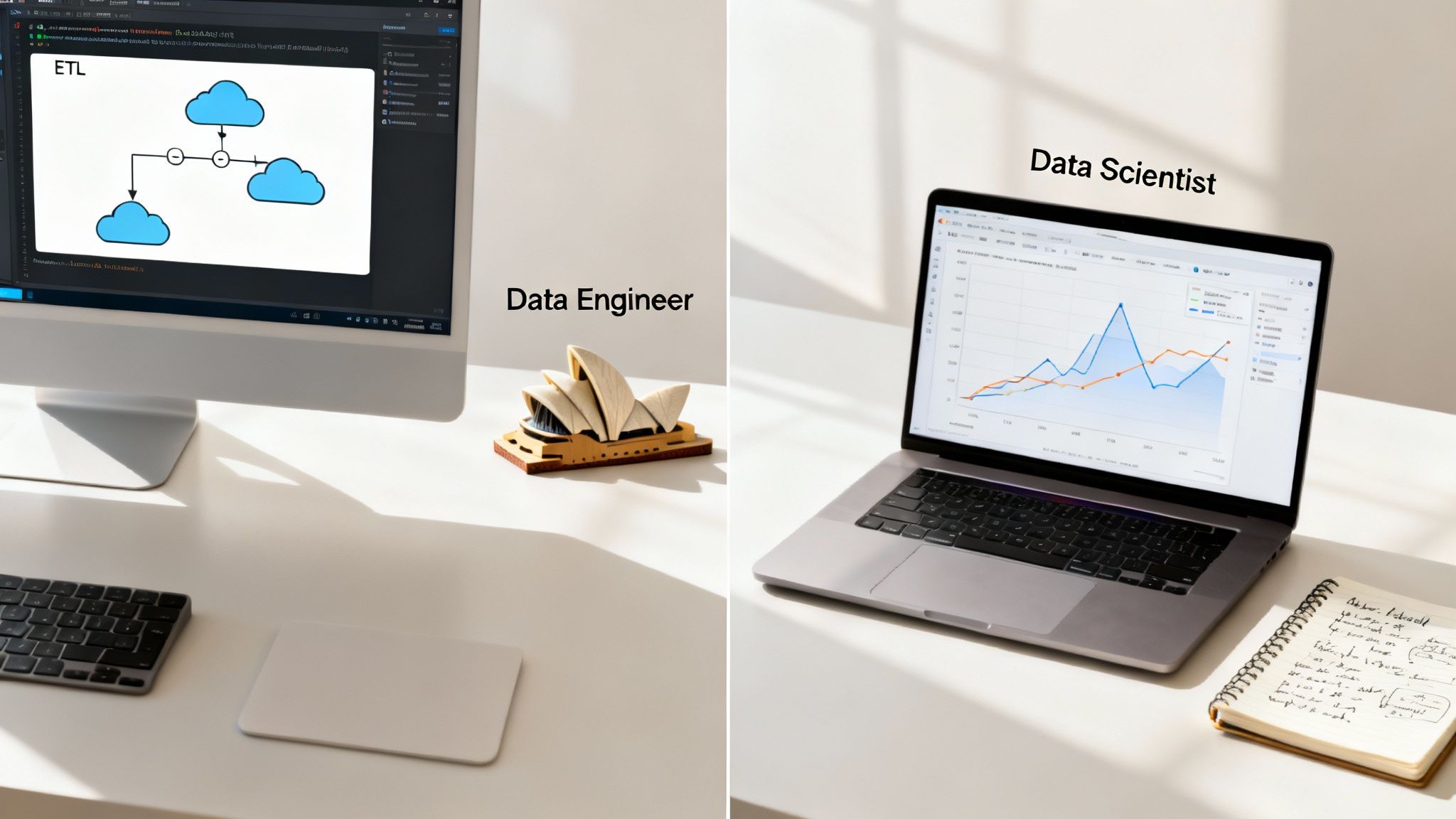
At its heart, data engineering is about building the systems that make data usable. It's a foundational role focused on infrastructure, reliability, and scale. A data engineer’s main job is to ensure a business has a clean, consistent, and dependable source of truth.
A data scientist, on the other hand, is an investigator. They take that well-organised data and use it to answer tough business questions, forecast future trends, or build new products powered by artificial intelligence. Their work is exploratory, focused on uncovering insights and creating strategic impact. This distinction is critical in the Australian tech scene, where companies are betting big on data to get a competitive edge.
High-Level Role Comparison
To really nail down the differences, it helps to look at their core functions, outputs, and guiding mindsets side-by-side. While their work is deeply connected, they approach problem-solving from completely different angles.
| Aspect | Data Engineer | Data Scientist |
|---|---|---|
| Primary Mission | To build, maintain, and optimise scalable data pipelines and infrastructure. | To analyse complex data, build predictive models, and extract business insights. |
| Typical Outputs | Data warehouses, ETL/ELT processes, and real-time data streams. | Statistical models, machine learning algorithms, and data-driven reports. |
| Core Mindset | Focused on reliability, scalability, and the efficiency of data systems. | Driven by curiosity, experimentation, and translating findings into value. |
Ultimately, this relationship is a partnership.
Data scientists are only as effective as the quality and accessibility of the data that data engineers provide. One simply can't deliver maximum value without the other’s foundational work.
This guide will break down every aspect of these two vital careers, from daily tasks and required skills to salary expectations across Australia. If you're keen to see what the market looks like right now, have a look at the current data roles across Australia to get a feel for what employers are searching for.
A Day in the Life: Comparing Daily Workflows

To really get to the heart of the data engineering vs. data science debate, you need to look past the job titles and see what these professionals actually do all day. While they both work with data, their daily routines, core priorities, and problem-solving mindsets are worlds apart.
Let’s step inside a busy Melbourne-based e-commerce company for a day. The data team is working to find insights for the next big marketing push, and this is where the two roles really show their different colours.
The Data Engineer’s Day: All About Infrastructure
A data engineer’s day almost always starts with a system health check. First things first: they scan the monitoring dashboards. Did all the overnight data pipelines run without a hitch? A failed job trying to load yesterday's sales figures from Shopify into their Snowflake data warehouse isn't just a minor glitch—it's a critical fire that needs putting out, fast.
A typical morning for them could involve:
Debugging a Pipeline: Diving into code to figure out why a data transformation job fell over. This could be anything from a subtle bug in a Python script to a surprise API change from a data source.
Optimising Queries: Spotting a database query that’s running sluggishly and chewing through cloud credits, then rewriting it to be faster and cheaper.
Architecting New Data Flows: Sitting down with the analytics team to map out the best way to bring in a new source of data, like customer reviews from a third-party platform.
This work is the bedrock of the entire data operation. The data engineer’s main job is to build and maintain a bulletproof data superhighway. Without them, the rest of the team is left stranded with messy, outdated, or completely inaccessible information.
For a data engineer, success is a system that runs so smoothly, no one even notices it. They are obsessed with reliability and scale, making sure the data infrastructure is always on and can handle more and more data without cracking.
Their mindset is all about building the "what" and "how" of data movement, applying rock-solid software engineering principles to the world of data.
The Data Scientist’s Day: The Hunt for Insights
While the data engineer is shoring up the foundations, the data scientist's day is kicking into high gear. They begin with a specific business question. For example, "Which of our customers are most likely to leave us in the next three months?"
Over in a Sydney fintech firm, a data scientist’s afternoon might look like this:
Exploratory Data Analysis (EDA): Firing up a Jupyter Notebook to dig into the pristine customer data prepared by the engineers. They’ll run visualisations to find interesting patterns and start forming a few hypotheses.
Feature Engineering: Getting creative by building new data points from the raw material. This might mean calculating a customer's 'average time between purchases' to feed into a predictive model.
Model Development: Building and training a few different machine learning models to predict customer churn. They'll test each one to see which gives the most accurate predictions.
Communicating Findings: The final, crucial step. They translate complex statistical outputs into a compelling story for the marketing director, complete with clear charts and solid recommendations for a campaign to keep those at-risk customers.
A data scientist lives and breathes discovery and impact. Success for them is measured by the quality of their insights and the tangible value their models deliver—whether that's cutting customer churn, boosting sales, or spotting a new market opportunity.
Their work is far more experimental. It's an iterative blend of statistics, coding, and business savvy aimed at turning raw data into a genuine competitive edge.
Comparing Essential Skills and Technologies
While you can get a feel for the roles from their day-to-day tasks, the clearest difference between a data engineer and a data scientist is what’s in their toolkit. Each professional relies on a specific set of technologies to get the job done, though you'll find a few key skills overlap. If you're planning a career in data, getting your head around these differences is a must.
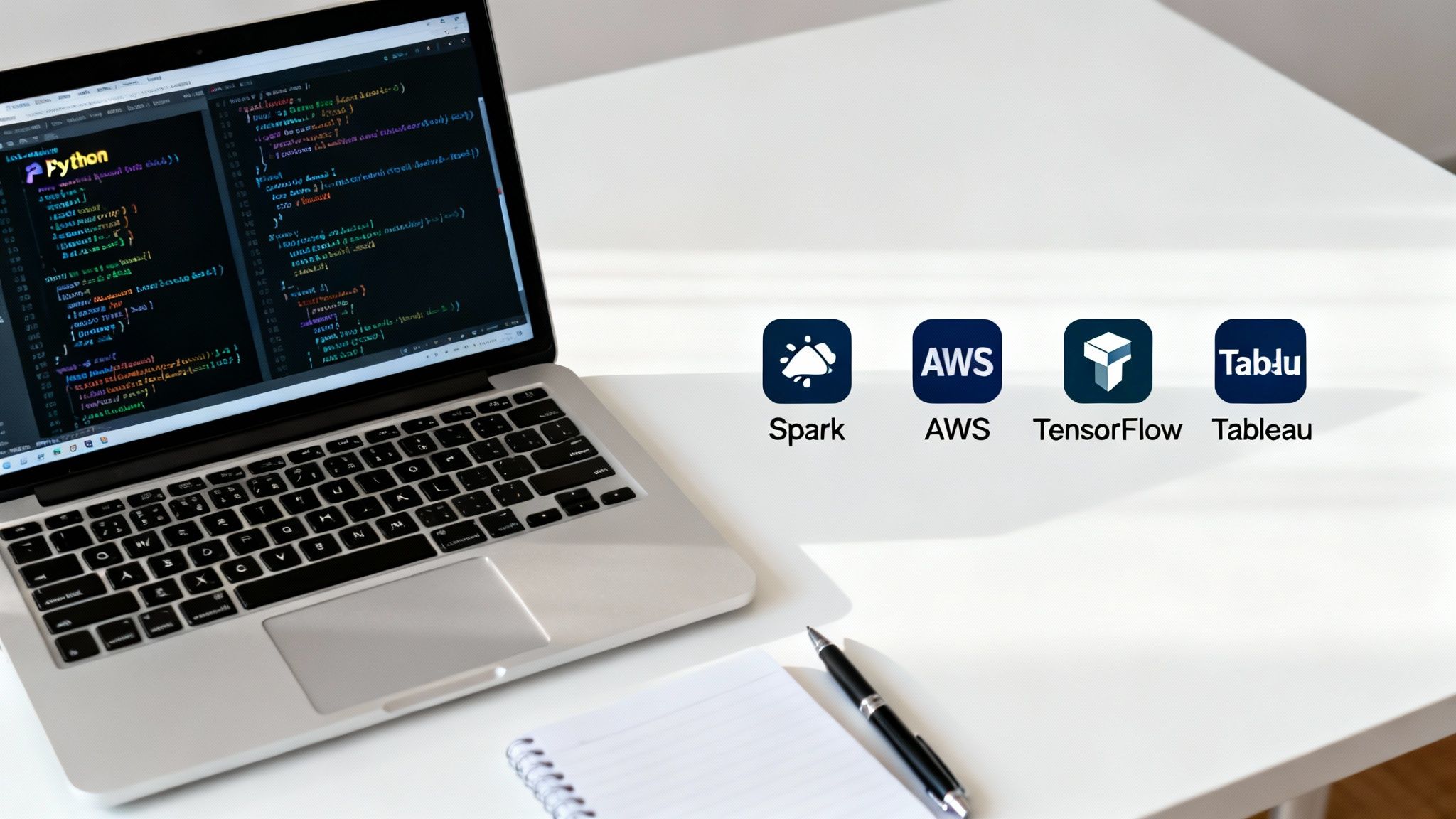
Let's break down the core competencies for both professions, showing where their skills converge and where they really specialise.
The Data Engineer's Toolkit: The Builders
At its core, a data engineer's skill set is a blend of software engineering and systems architecture. Their whole world revolves around building robust, efficient, and scalable data infrastructure. This demands a strong command of tools designed for moving, storing, and processing data, often at a massive scale.
Looking at Australian job ads, you'll see a few technologies pop up again and again:
Programming Languages: Python is king for scripting, automation, and building data pipelines. And SQL? It's completely non-negotiable for talking to and managing databases.
Cloud Platforms: You absolutely need experience with at least one major cloud provider. In Australia, that means Amazon Web Services (AWS), Google Cloud Platform (GCP), or Microsoft Azure.
Big Data Frameworks: To wrestle with huge datasets, you’ll need to know your way around distributed computing frameworks. Apache Spark is the big one here.
Workflow Orchestration: Tools like Apache Airflow are critical for scheduling, automating, and keeping an eye on complex data workflows, making sure everything runs smoothly and on time.
In short, a data engineer’s tech stack is all about construction and maintenance. They're the architects and plumbers of the entire data ecosystem.
The Data Scientist's Toolkit: The Investigators
A data scientist’s toolkit, on the other hand, is built for analysis, experimentation, and storytelling. Their skills are a mix of statistics, computer science, and business acumen, which they use to unearth powerful insights from the very data the engineers have so carefully prepared.
Here’s what a data scientist needs in their arsenal:
Programming and Analysis: Python and R are the languages of choice for statistical analysis, manipulating data, and building models. Libraries like Pandas and NumPy are used every single day.
Machine Learning Libraries: You can't be a data scientist without deep knowledge of ML frameworks. That means Scikit-learn for classic machine learning, and TensorFlow or PyTorch for deep learning.
Statistical Modelling: It's not just about the tools. A rock-solid foundation in statistics and maths is essential for designing valid experiments and knowing if a model is actually any good.
Data Visualisation: Getting insights is one thing; explaining them is another. Skills with tools like Tableau, Power BI, or Python libraries like Matplotlib and Seaborn are vital for showing complex findings to people who aren't data experts.
Their focus is on using technology to ask the right questions and find the answers, making their toolset deeply analytical.
While both roles require sharp problem-solving skills, a data engineer’s success is measured by system uptime and data availability. In contrast, a data scientist’s success is measured by the accuracy of their models and the business value of their insights.
Common Ground and Diverging Paths
The most obvious overlap? A solid command of Python and SQL. Both professionals live in these languages, but they use them for completely different reasons. An engineer uses Python to build a data pipeline; a scientist uses it to analyse a dataset and train a model. Likewise, an engineer writes SQL to tune a database for performance, while a scientist writes it to pull a specific slice of data for an experiment.
This shared foundation is what makes it possible to switch between the roles, but don't be mistaken—it requires some serious upskilling.
To give you a clearer picture of what Australian companies are looking for right now, the table below highlights the most in-demand skills we're seeing in the job market.
In-Demand Skills and Technology Stacks
| Skill Category | Data Engineer | Data Scientist |
|---|---|---|
| Core Programming | Python, Advanced SQL, Scala/Java | Python, R, SQL |
| Cloud Environment | AWS (S3, Redshift), GCP (BigQuery), Azure (Data Lake) | AWS (SageMaker), GCP (Vertex AI), Azure (ML Studio) |
| Data Processing | Apache Spark, Kafka, Flink | Pandas, Dask, Spark MLlib |
| Databases | Snowflake, PostgreSQL, NoSQL (e.g., MongoDB) | Relational Databases, Knowledge of Data Warehouses |
| Orchestration & DevOps | Airflow, Docker, Kubernetes, Terraform | Git, Basic Docker knowledge |
| Machine Learning | Basic understanding of ML concepts for MLOps | Scikit-learn, TensorFlow, PyTorch, XGBoost |
| Visualisation & BI | Minimal focus, perhaps Metabase or Grafana | Tableau, Power BI, Matplotlib, Seaborn |
As you can see, the specialisations are quite distinct. If you're drawn to building and maintaining systems, your focus should be on cloud infrastructure and big data tools.
A great way to see what's currently in demand is to have a look at live job descriptions. Browsing data engineer jobs in Australia will give you real-world insights into the exact technologies companies are hiring for today.
Looking at Career Paths and Australian Salary Benchmarks
Beyond the day-to-day work, you've got to consider where each path leads. What does the career ladder look like, and what's the pay packet at the end of the day? In Australia, both data engineering and data science roles are in hot demand and offer clear, lucrative career progressions. But they definitely appeal to different professional goals and reward very different kinds of expertise.
The Australian market tells a really interesting story right now. Data science might get all the media attention, but businesses are waking up to the fact that none of it happens without solid data engineering. That realisation is having a direct impact on salaries.
The Data Engineering Career Progression
A data engineer's career often starts from a software engineering or IT background. It’s a builder’s journey. You're constantly getting deeper into the weeds of creating more complex, scalable, and bulletproof data systems.
A typical trajectory looks something like this:
Junior Data Engineer: You're learning the ropes. This means looking after existing data pipelines, writing simple ETL scripts, and fixing minor problems with a lot of oversight.
Data Engineer (Mid-Level): Now you're taking ownership. You'll be building new pipelines from scratch, tuning databases for better performance, and working directly with business teams to figure out their data needs.
Senior Data Engineer: This is where you step up to architecture. You're designing large-scale data solutions, mentoring the junior members of the team, and making the big calls on tech stacks and cloud infrastructure.
Lead/Principal Data Engineer: You're now setting the technical vision for the entire data platform. Your focus is on driving innovation, solving the gnarliest scalability problems, and leading the way.
This career path is all about deep technical mastery and thinking in systems.
The Data Science Career Progression
The data scientist's career ladder, on the other hand, is more of a mix—you need both technical depth and a growing influence on the business itself. The goal is to move from simply running analyses to actively shaping company strategy with your insights.
Here are the usual stages:
Junior Data Scientist: You’ll be given well-defined problems to work on. Your day is spent cleaning data, running analyses, and building basic models under the guidance of senior colleagues.
Data Scientist (Mid-Level): You're now running your own projects, from forming a hypothesis all the way to deploying a model. You’ll tackle more complex predictive modelling and present your findings to business units.
Senior Data Scientist: At this level, you're leading high-stakes projects, mentoring other scientists, and often pioneering new machine learning techniques within the company.
Lead/Principal Data Scientist or Head of Data Science: Your role becomes strategic. You're defining the company's entire data strategy, managing a team, and turning broad business goals into a technical roadmap.
This track is for people who love analytical rigour but also have a sharp commercial sense and leadership potential.
While both paths lead to great places, the market right now has a real hunger for the specialised skills needed to build and maintain robust data infrastructure. This often means data engineers can command higher salaries, particularly as they become more senior.
Australian Salary Benchmarks: A City-by-City View
Money is where the data engineering vs. data science conversation gets really interesting. Looking at the Australian job market in 2024, data scientists pull in a strong average salary of around $135,000 plus super. But it's the experienced data engineers who often pull ahead, with a median salary around $125,256 per year but frequently out-earning their data science counterparts in infrastructure-heavy companies.
This salary advantage for engineers points to a critical trend: Australian companies are wrestling with huge datasets for AI and machine learning, and they're willing to pay a premium for the people who can build the foundations. You can find more details on what's hot in the market from Horizontal Talent's 2024 report.
This is especially true in Australia’s big tech hubs. A whopping two-thirds of all data scientists are based in Sydney and Melbourne. The fierce competition for talent in these cities inflates salaries for both roles, but the relative scarcity of top-tier data engineers often gives them the upper hand in negotiations.
To give you a clearer idea, here's a breakdown of typical salary ranges (excluding super) across the major cities.
| Role and Seniority | Sydney Salary Range | Melbourne Salary Range | Brisbane Salary Range |
|---|---|---|---|
| Junior Data Engineer | $85k - $110k | $80k - $105k | $75k - $95k |
| Data Engineer | $120k - $160k | $115k - $155k | $110k - $140k |
| Senior Data Engineer | $160k - $220k+ | $155k - $210k+ | $145k - $190k+ |
| Junior Data Scientist | $80k - $105k | $75k - $100k | $70k - $90k |
| Data Scientist | $110k - $150k | $105k - $145k | $100k - $135k |
| Senior Data Scientist | $150k - $200k+ | $145k - $190k+ | $135k - $180k+ |
These numbers make it pretty clear. While both careers are financially rewarding, the data engineering path can often lead to a higher salary more quickly, especially if you have serious skills in cloud platforms and big data tech.
How to Choose the Right Data Career for You
Deciding between data engineering and data science isn’t about picking the "better" role. It’s about figuring out your own mindset and what kind of problems you actually enjoy solving. Forget a simple pros and cons list; let's use a more situational approach to see where you naturally fit.
This really boils down to asking yourself some honest questions about what gets you fired up. Do you get a buzz from architecting a complex system that just works flawlessly behind the scenes? Or is it the thrill of spotting a hidden pattern in data that nobody else has seen? Your answer is a huge clue to which path will feel more rewarding.
Are You a Builder or an Explorer?
At its core, the difference between a data engineer and a data scientist comes down to this single question. Think about your ideal project.
You might be a natural Data Engineer if:
You love designing and building robust, scalable systems. The thought of creating a data pipeline that chews through terabytes of data without breaking a sweat genuinely excites you.
You have a software engineering mindset. You’re always thinking about efficiency, reliability, and automation.
You find deep satisfaction in providing the clean, structured data that helps everyone else do their best work. Your success is a stable, high-performance platform.
You might be a natural Data Scientist if:
You’re driven by relentless curiosity and a need to answer tough questions. The "why" behind the data is what keeps you up at night.
You enjoy the experimental, iterative nature of statistical analysis and modelling. You’re comfortable with a bit of uncertainty.
You get a kick out of translating dense technical findings into a compelling story that shapes business decisions. Your success is a game-changing insight or a killer prediction.
This builder vs. explorer distinction is the best place to start. One constructs the library; the other uncovers its secrets.
Guidance for Different Career Backgrounds
Your professional background also offers some pretty strong hints. Let’s look at how people from different fields might approach this choice.
For the Software Engineer
If you're already a software engineer, moving into data engineering is often the path of least resistance. You’ve already got the core programming logic, system design principles, and experience building production-grade applications. The main challenge is just applying those skills to the world of data—getting your head around tools like Spark, Airflow, and cloud data warehouses.
For a software engineer, a move into data engineering is a natural specialisation. It takes your existing strengths in building reliable systems and applies them to a high-demand field. The leap to data science is certainly doable, but it demands a much deeper dive into stats and machine learning theory from the ground up.
For the Recent STEM Graduate
If you've just finished a degree in mathematics, statistics, or physics, you'll likely find data science a fantastic fit. Your academic training has already given you the rigorous analytical and quantitative mindset needed for modelling and experimentation. The next step is to sharpen your programming skills (usually in Python or R) and get some hands-on experience with messy, real-world datasets.
For the Business Analyst
Coming from a business analysis background, your superpower is understanding business problems and talking to stakeholders. That’s a massive advantage for any aspiring data scientist. Your journey would focus on building out your technical toolkit—learning statistical modelling and mastering data visualisation tools to turn that business acumen into powerful, data-driven strategic advice.
Finding Your Next Role on AI Jobs Australia
Now that you have a solid grasp of what separates data engineering from data science, you can approach the job market with a clear plan. AI Jobs Australia is built to help you sift through the noise and find verified, high-quality roles that genuinely match your skills, whether you’re the one building the data highways or the one driving insights from them.
Getting your foot in the door is all about telling the right story. Your resume and professional profiles need to align perfectly with the role you're after. If you’re targeting a data engineering position, your projects should scream cloud data migration, pipeline orchestration, and database optimisation. If data science is your goal, you'll want to highlight the machine learning models you’ve built, the business-changing insights you've uncovered, or the tangible impact your analysis has delivered.
Optimising Your Search Strategy
A smart job search is more than just plugging in keywords. On AI Jobs Australia, you can obviously filter by role and city to zero in on opportunities in hubs like Sydney or Melbourne. But the real trick is learning to read between the lines of a job description.
Think about it: a post that’s heavy on "ETL/ELT processes," "data warehousing," and "scalability" is a clear signal they need a data engineer to build or fortify their core systems. On the other hand, a description peppered with "predictive modelling," "statistical analysis," and "A/B testing" is a call for a data scientist to start making sense of the data they already have.
The language in a job ad tells you a lot about a company's data maturity. A focus on infrastructure often means they're in a building phase. A focus on analytics and modelling suggests they're ready to extract serious value.
Understanding this difference is your secret weapon. It helps you tweak your application and, just as importantly, brace for the right kind of interview questions.
Preparing for Technical Interviews
This is where the whole data engineering vs. data science comparison gets very real. The interview hot seat will throw very different technical challenges your way depending on which path you're on.
Sample Data Engineer Interview Questions:
How would you architect a data pipeline to handle real-time streaming data from several different sources, and how would you make it scale?
Talk me through the differences between a data lake and a data warehouse. In what scenario would you advocate for one over the other?
Describe a time an ETL job failed on your watch. How did you troubleshoot it?
Sample Data Scientist Interview Questions:
Walk me through a machine learning project you've owned, from the initial data gathering right through to model deployment.
How do you explain concepts like p-values or confidence intervals to a marketing manager or someone else who isn't technical?
Imagine you're given a dataset of customer transactions. How would you start building a model to predict churn?
By preparing for these kinds of targeted questions and setting up specific alerts, your job search becomes a whole lot less stressful and far more effective. To see what's out there right now, start by exploring the latest Data Scientist roles across Australia and get your journey started.
Frequently Asked Questions
When you're trying to map out a career in data, it’s natural to have questions. Let's tackle some of the most common ones we hear from data professionals across Australia.
Are the Lines Between Data Engineering and Data Science Blurring?
Yes, they absolutely are. You see this most often in smaller companies and startups where a single person often needs to cover a lot of ground. We're also seeing hybrid roles like the "Machine Learning Engineer" pop up, which sit right at the crossroads of building data pipelines and putting models into production.
That said, in bigger, more established companies, the specialisations are still quite distinct. Data engineers are squarely focused on building and maintaining scalable data infrastructure, while data scientists are busy with analysis and modelling. The real change is that data scientists are now expected to have better engineering chops, and engineers need a much deeper understanding of what data scientists are trying to achieve.
The rise of MLOps (Machine Learning Operations) really highlights this trend. It’s a whole field dedicated to bridging the gap between developing a model and actually using it in the real world, and it demands skills from both sides of the fence.
What this all means for you is that professionals who can blend these skills are becoming incredibly sought-after in the Australian job market.
Do I Need a PhD to Be a Data Scientist?
Not like you used to. It's true that a PhD in a quantitative field was once seen as the golden ticket for senior data science roles, but the industry has moved on. These days, what really counts is hands-on experience, a solid portfolio of projects, and proven skills in programming, statistics, and machine learning.
For the vast majority of data science jobs in Australia, a Bachelor's or Master's degree in a relevant area like computer science, stats, or maths is perfectly fine. The emphasis has shifted from academic qualifications to your ability to solve real-world problems.
What’s the Future Outlook for These Roles with AI?
The future looks incredibly bright for both, but the nature of the work is definitely changing. As AI and automation start to take care of the more repetitive tasks, the jobs will become more about high-level, strategic thinking.
For Data Engineers: The demand will only grow for experts who can build and manage the enormous, real-time infrastructure needed to support large-scale AI. Their role in creating a rock-solid data foundation becomes more critical than ever.
For Data Scientists: The role is set to become more strategic. It'll be less about just building models and more about identifying the right business problems to solve, making sense of complex AI outputs, and ensuring AI is used ethically.
Ultimately, both career paths offer fantastic job security and plenty of room to grow within Australia's booming tech scene.
Ready to find your place in Australia's data landscape? AI Jobs Australia researches thousands of company sites to find the best AI-focused roles that aren't on generic job boards. Explore verified positions at https://www.aijobsaustralia.com.au and take the next step in your career.