Unlocking AI Success with Essential Team Working Skills
Let’s be honest, team working skills are more than just a line item on a job description. They're the collection of crucial abilities that allow people to actually work together—to communicate well, solve problems, and hit common goals without driving each other mad.
These skills are the human glue that holds everything together, turning a room full of smart individuals into a cohesive, high-performing team. This is especially true in a field as complex and interwoven as AI and data science.
The Hidden Engine of High-Performing AI Teams
In the world of AI, it’s easy to get fixated on the algorithms, the code, and the raw technical genius. We put brilliant data scientists and machine learning engineers on a pedestal. But lurking just behind every groundbreaking AI project is the real engine driving its success: exceptional teamwork.
Think of it like a Formula 1 crew. You can have the best driver on the grid, but if the pit crew isn't perfectly synchronised, the race is lost. A split-second delay, a miscommunicated instruction, or a moment of indecision can be the difference between a podium finish and last place. AI and data teams operate on that very same principle.
More Than Just a Soft Skill
For far too long, the ability to collaborate has been dismissed as a "soft skill"—something nice to have, but secondary to pure technical know-how. This view is not just outdated; it's a dangerous misunderstanding, especially in Australia’s booming tech industry. In truth, these skills are the scaffolding that holds technical brilliance up, stopping projects from crumbling under the weight of poor communication and internal friction.
Team working skills are not an alternative to technical ability; they are a multiplier. They ensure that every individual's expertise is fully used and integrated, transforming isolated contributions into a unified and powerful outcome.
In the context of an AI project, effective teamwork is about much more than just being friendly in stand-up meetings. It’s a specific set of behaviours that directly impacts the bottom line. These include things like:
Seamless Communication: The skill to break down a complex neural network for a non-technical manager or clearly explain the reasoning behind a model to a fellow data scientist.
Constructive Conflict Resolution: The ability to debate different modelling techniques or data pipelines respectfully, ultimately finding the best solution instead of leaving tensions to fester.
Shared Ownership: Creating a culture where everyone feels responsible for the project's success, not just their little piece of the puzzle. It’s about owning the outcome, together.
The Economic Imperative for Collaboration
The importance of these skills isn't just a hunch; the numbers back it up. Research has shown that strong collaboration adds a massive $46 billion to the Australian economy every single year.
What's more, a detailed report found that 53% of Australian employees feel they save time by working together, with some individuals working up to 15% faster in a collaborative setting. If you’re curious, you can dive into the full findings on Australian workplace collaboration on ANZ BlueNotes.
In a field so dominated by data and algorithms, it’s the quality of the human connection that gives a team its real edge. As we go on, we'll look at exactly why Australian tech employers are prioritising these skills just as much as your technical chops.
Why Teamwork Is Your AI Career Superpower
In a field as technical as AI, it’s easy to think your career hinges entirely on your coding prowess or the elegance of your models. But the real gap between a good AI professional and a truly great one often boils down to something far more human: team working skills. These aren't just 'nice-to-haves'—they're career-defining assets that directly shape project success, innovation, and your ultimate value to any organisation.
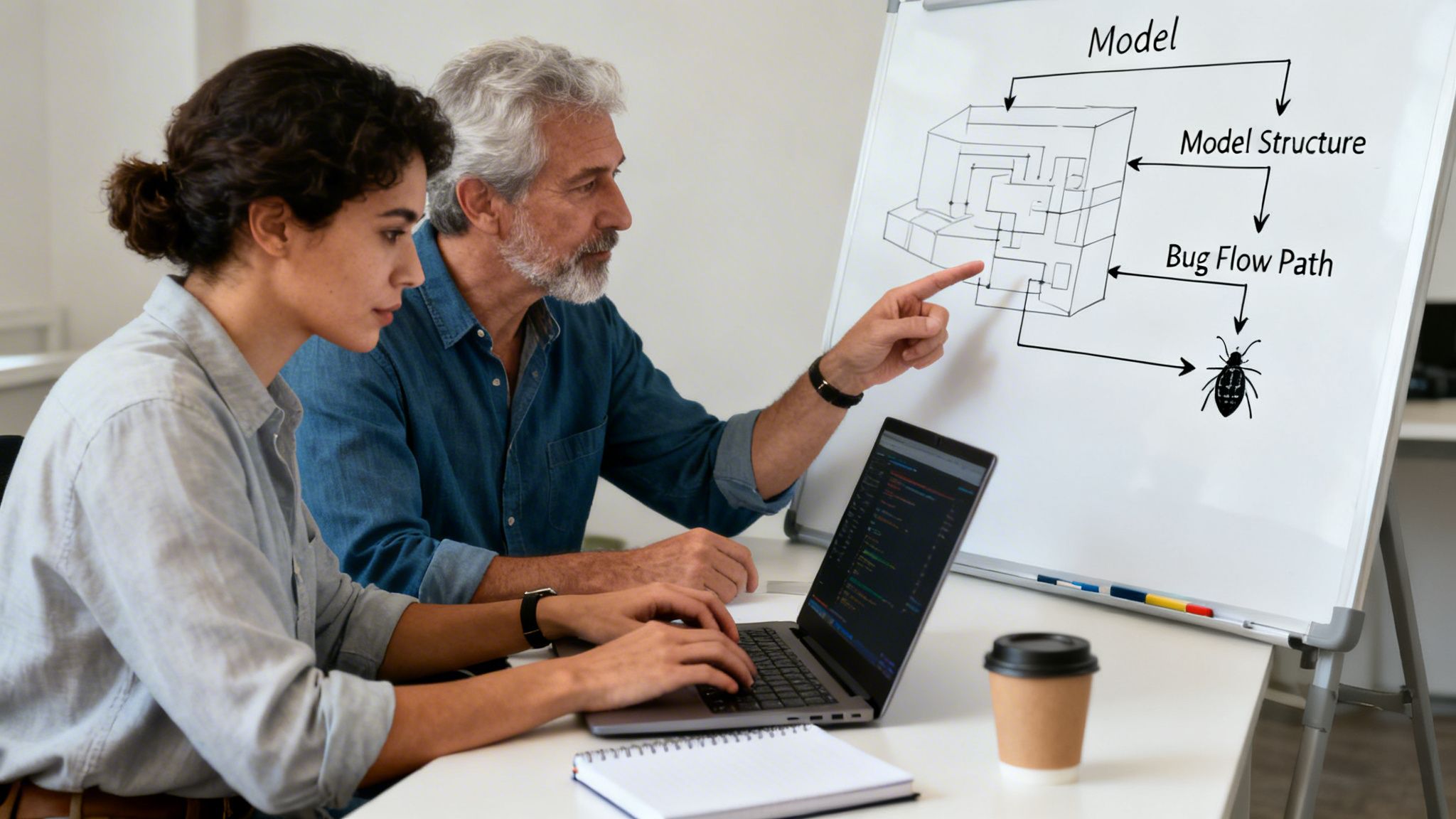
Great teamwork is the secret sauce that speeds up development and elevates code quality. When data scientists and machine learning engineers communicate openly, knowledge flows freely, and roadblocks that could stall one person for days get solved in hours. This collaborative spirit leads directly to fewer bugs and much quicker fixes when they do pop up.
Instead of a single person wrestling with a complex problem in isolation, a tight-knit team can swarm it from multiple angles, bringing their collective intelligence to bear. More perspectives almost always lead to a better, faster solution.
Fuelling Innovation Through Diverse Ideas
Breakthroughs in AI rarely happen in a vacuum. Real innovation sparks from the creative friction of different minds and ideas colliding. A team with a mix of backgrounds, experiences, and technical specialisations is a powerful engine for discovery, but that engine only fires up if people know how to collaborate effectively.
This means being able to give and receive constructive feedback, and challenging ideas respectfully without making it personal. Imagine a data scientist proposes a novel model architecture. An ML engineer can then offer practical insights on deployment hurdles, and a product manager can weigh in on user impact. This back-and-forth ensures the final product is not just clever, but also robust, practical, and truly innovative.
Teamwork transforms a group of experts working on the same project into a unified force working toward the same goal. It ensures that the sum is always greater than its parts, preventing project stalls and aligning technical efforts with business objectives.
The High Cost of Poor Collaboration
The connection between teamwork and results isn't just a feeling; it has a clear impact on the bottom line. In Australia, for instance, highly engaged teams are known to deliver 23% higher profitability and are 14% more productive overall.
The numbers don't stop there. When people work well together, they produce 73% better quality work and are 60% more innovative. This isn't about office harmony for its own sake; it's about delivering superior outcomes. If you want to dive deeper into the data, you can explore key workplace statistics on HireBorderless.com.
Think about a classic real-world scenario. A data science team creates a predictive model that boasts incredible accuracy in a test environment. But they fail to properly communicate the model's limitations and assumptions to the business team. The model gets rolled out, makes flawed predictions on messy, real-world data it wasn't designed for, and the entire project is shelved as a failure.
The root cause wasn't a technical flaw; it was a breakdown in teamwork. True success in AI and machine learning depends on seamless collaboration between data scientists, engineers, and business leaders. Mastering these skills isn’t just about being a good colleague—it’s about making sure your hard technical work actually delivers lasting, meaningful value.
The Five Pillars of Team Working Skills in Tech
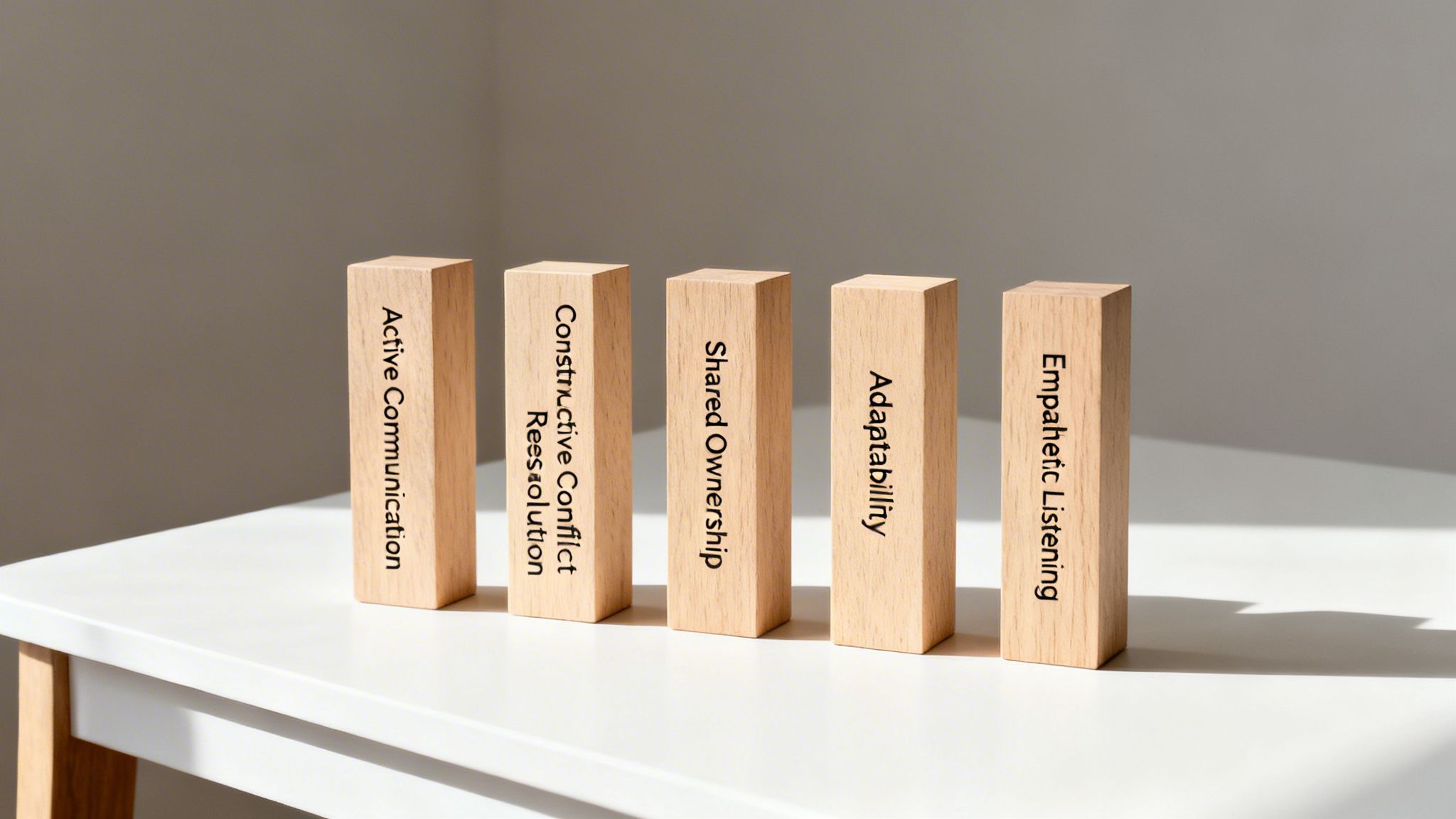
It’s one thing to know why team working skills matter, but it’s another to know what they actually look like day-to-day. Great teamwork isn't some fuzzy, abstract idea; it's a set of concrete, observable behaviours.
We can break these down into five core pillars. Think of them like the essential components of a complex machine learning model—if one part is off, the entire system’s performance suffers. By strengthening each one, you build a team that’s resilient enough to handle the toughest challenges in AI and data science.
Pillar 1: Active Communication
This is so much more than just talking during stand-up. Active communication is the lifeblood of a project, ensuring everyone has the information they need, when they need it.
In an AI team, this might be a Data Scientist clearly explaining a model's limitations to a Product Manager, or an ML Engineer leaving such good documentation that a colleague can jump in and contribute without missing a beat. It’s a two-way street that prevents silos and keeps technical work aligned with the bigger picture.
For a deeper dive, check out our guide on interpersonal communication skills for AI jobs in Australia.
Pillar 2: Constructive Conflict Resolution
In any high-performing technical team, disagreements aren't just common—they're necessary. Constructive conflict is about debating the merits of different algorithms or questioning a data pipeline's architecture without making it personal. You challenge the idea, not the person behind it.
Effective teams use technical debate as a sharpening stone. They create an environment where it's safe to voice dissent, leading to stronger solutions instead of quiet resentment.
This skill turns potential friction into a powerful tool for innovation and much smarter decision-making.
Pillar 3: Shared Ownership
Shared ownership is the feeling that everyone is rowing in the same direction. It’s the difference between hearing "that's not my code" and "how can we fix this bug?"
When a team truly shares ownership, people don't just stick to their job description. A Data Analyst might suggest a feature based on their findings, or a Software Engineer might help debug an ML model, all because they feel accountable for the project's success. It builds a culture where everyone has each other's back.
Pillar 4: Adaptability
The AI field moves at a breakneck pace. Models become obsolete, project requirements change overnight, and new tools pop up constantly. Adaptability is what keeps a team from getting left behind.
It’s about being open to new approaches, learning new tech on the fly, and seeing a failed experiment not as a waste of time, but as valuable data for the next iteration. An adaptable team doesn't just survive change; it thrives on it.
Pillar 5: Empathetic Listening
This is the pillar that holds all the others up. Empathetic listening isn't just waiting for your turn to talk; it's about genuinely trying to understand where your colleague is coming from—their perspective, their pressures, their reasoning.
When a teammate raises a concern about a deadline, it’s about hearing the stress behind their words, not just the words themselves. This is how you build the trust and psychological safety that great teams are made of.
To bring this all together, let's look at how these pillars show up in real-world scenarios. The table below outlines what to aim for ('Green Flags') and what to avoid ('Red Flags') in your team.
The Five Pillars of Team Working Skills in AI Teams
| Pillar of Teamwork | What It Means for an AI Team | Green Flag (Positive Behaviour) | Red Flag (Negative Behaviour) |
|---|---|---|---|
| Active Communication | Clearly sharing technical details and project status. | Documenting code with clear comments and updating the team on progress without being asked. | Working in a silo; assuming others know what you are doing without communicating. |
| Constructive Conflict | Debating technical approaches to find the best solution. | Respectfully challenging a proposed model architecture with data-driven counterpoints. | Avoiding technical disagreements or making criticism personal and unprofessional. |
| Shared Ownership | Feeling collective responsibility for project success. | Proactively helping a colleague debug their code to meet a team deadline. | Blaming others when a feature fails; saying, "That's not my responsibility." |
| Adaptability | Adjusting to new data, tools, or project goals. | Quickly learning a new library when a project's requirements pivot unexpectedly. | Resisting change and insisting on using outdated methods despite new information. |
| Empathetic Listening | Understanding and considering colleagues' viewpoints. | Asking clarifying questions to fully grasp a teammate's concern before offering a solution. | Interrupting colleagues or dismissing their ideas without fully hearing them out. |
By keeping an eye out for these green flags in yourself and your colleagues, you can actively build a stronger, more effective team.
Fostering Teamwork in Remote and Hybrid AI Teams
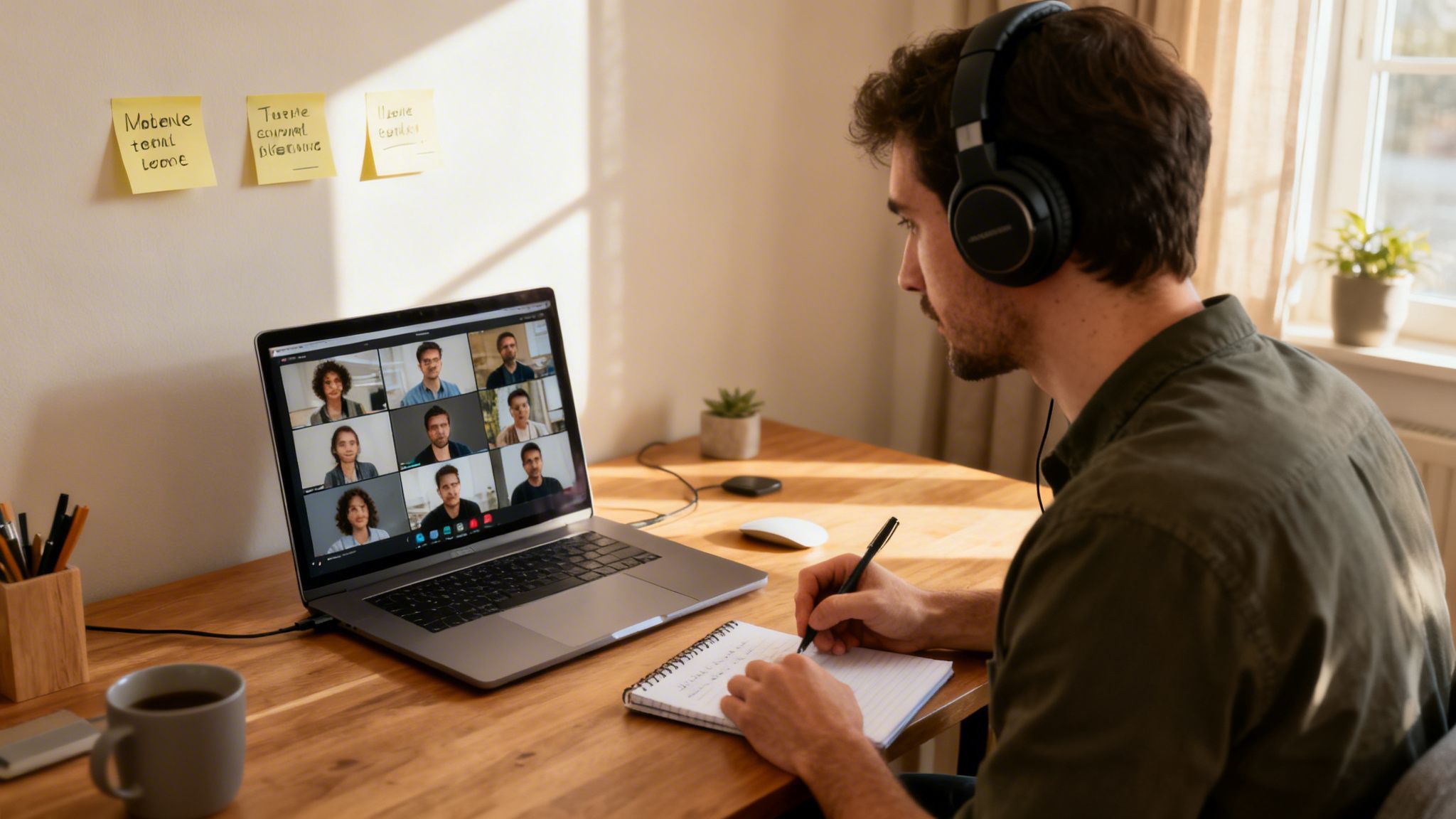
Solid team working skills are essential in any workplace, but they get a real stress test when your team is remote or hybrid. You lose all those spontaneous chats by the coffee machine and the simple act of sketching an idea on a whiteboard together. This means you have to be so much more deliberate about how you connect and collaborate.
If you’re not careful, that physical distance can quickly create silos, breed misunderstandings, and water down any sense of a shared mission.
For AI and data teams, this challenge is even bigger. The work is complex, highly iterative, and relies on a constant, crystal-clear flow of communication. The real danger is that physical distance morphs into professional distance, stifling the very creative problem-solving that drives innovation.
Mastering Asynchronous Collaboration
When your team is spread out, you simply can't rely on real-time chats for everything. The secret to keeping things moving—without burning everyone out on endless video calls—is mastering asynchronous collaboration. It’s all about creating clarity and context that lasts, no matter the time zone.
This is a mindset shift. It means moving from quick verbal check-ins to more structured, thoughtful documentation of your work. The goal is simple: make your contribution so clear that a teammate picking it up hours later has everything they need to run with it.
Here are a few practical ways to do this:
Detailed Pull Requests: Don't just list what you changed. Explain why you made the change, link it back to the problem it solves, and note any dependencies. This turns a simple code update into a lasting piece of documentation.
Structured Project Updates: Use a shared space like a Confluence page or a project management tool to post regular, detailed updates. A good update summarises progress, flags specific blockers, and clearly states what you need from others.
Thoughtful Comments: Instead of a generic "looks good," leave specific, constructive feedback on documents or code. Point to the exact line or section and briefly explain your reasoning.
Running Inclusive Virtual Meetings
While working asynchronously is key, you still need real-time meetings for brainstorming, big decisions, and simply connecting as a team. The trick is to run them in a way that makes every single person feel heard and valued, regardless of where they’re dialling in from. An inclusive meeting doesn't just happen; it's designed with intention.
Remote work can easily create an 'out of sight, out of mind' dynamic. A great virtual meeting actively pulls everyone into the conversation, ensuring that the best ideas—not just the loudest voices—win the day.
This is particularly important when you consider the risk of isolation. Recent data on Australian workplaces paints a worrying picture, with employee engagement for hybrid workers sitting at 15% and for fully remote workers at a mere 7%. Researchers point to a major disconnect from team and company culture. This really highlights why deliberate inclusion is non-negotiable. You can read more about these Australian employee engagement findings on HCAMag.com.
Creating Digital Water Cooler Moments
One of the biggest casualties of remote work is the informal, spontaneous chat that builds genuine trust and connection. These "water cooler" moments are where colleagues truly become teammates. To get them back, you have to consciously create them online.
Try weaving some of these into your team's rhythm:
Dedicated Social Channels: Set up a non-work channel in Slack or Teams for sharing hobbies, weekend plans, or just funny memes.
Virtual Coffees: Schedule short, optional 15-minute video calls with no agenda. The only goal is to catch up and chat, just as you would in the office kitchen.
Team-Building Activities: Organise online games or virtual events that let the team interact in a relaxed, fun setting. It’s amazing how much these can strengthen bonds beyond project deadlines.
By intentionally building these practices into your team’s routine, you can bridge the physical gap and foster the strong, collaborative spirit your team needs to thrive, no matter where they are.
How to Showcase Team Skills on Your Resume and in Interviews
Knowing you’re a great team player is one thing. Proving it to a hiring manager? That’s a completely different challenge. Your resume and the interview are the two moments where you absolutely have to translate your collaborative skills into solid proof that you’re the right person for the team.
So many technical professionals fall into the trap of only listing their individual achievements. They focus on the 'what'—the algorithm they built, the pipeline they optimised—but they completely forget about the 'how'. In today’s highly collaborative AI teams, I can tell you that hiring managers are looking just as closely at how you got those results.
Transforming Your Resume from a Solo Act to a Team Player
Your resume needs to tell a story of collaborative success, not just a list of your technical accomplishments. This is all about reframing your bullet points to shine a light on teamwork, shared goals, and the measurable outcomes your group achieved. It's amazing what a simple shift in language can do.
Let’s look at a few practical before-and-after examples.
Before (Focuses on the individual task):
- Developed a recommendation algorithm using Python and TensorFlow.
After (Focuses on the team achievement):
- Collaborated with a cross-functional team of three to develop a recommendation algorithm that increased user engagement by 15%.
Before (A bit vague and purely technical):
- Responsible for data cleaning and preprocessing for a new ML model.
After (Specific and collaborative):
- Partnered with a Senior Data Scientist to define data quality standards, leading to a 20% reduction in model training errors and helping us hit our project deadlines sooner.
See the difference? The "After" examples bring the work to life. They use action verbs like "collaborated" and "partnered," they put you in the context of a team, and—most importantly—they connect your work to a real business result. This shows not just what you did, but the impact you made as part of a group.
Nailing the Teamwork Questions in Your Interview
Once your resume has done its job and landed you the interview, it's your time to shine. This is where you can bring those collaborative stories to life. Hiring managers will use behavioural questions specifically to figure out how you really operate within a team setting.
You should definitely prepare for common questions like these:
"Tell me about a time you had a conflict with a teammate. How did you handle it?"
"Describe a project where you had to work with people from different technical backgrounds."
"How do you make sure everyone on your team is on the same page?"
"Give an example of a time you had to support a team member who was struggling."
The absolute best way to answer these questions is with a structured story. The STAR method (Situation, Task, Action, Result) is perfect for this. It stops you from giving vague, wishy-washy answers and forces you to provide concrete evidence of your skills.
The most common mistake I see candidates make is just saying, "I'm a great team player." Without a specific, compelling example to back it up, that statement is completely empty. You have to show, not just tell.
Let's walk through a STAR response for the question: "Tell me about a time you disagreed with a teammate's technical approach."
Situation: "In my last role, my team was building a fraud detection model. I was convinced a gradient-boosting model was the right call, but a senior engineer was pushing hard for a deep learning solution."
Task: "My job was to make sure we chose the most effective and maintainable solution for the business. That meant we had to work through our technical disagreement in a constructive way."
Action: "I set up a meeting where I presented the data from my prototype, which showed my model had comparable accuracy but a much faster inference time. I also made sure to actively listen to their points about the long-term scalability of deep learning and acknowledged they were valid. From there, we worked together to create a simple decision matrix, scoring each approach on accuracy, speed, and ease of maintenance."
Result: "Looking at the matrix, we all agreed to move forward with the gradient-boosting model for the first version, but we also created a plan to explore the deep learning solution down the track. This collaborative approach stopped us from getting stuck, we delivered the MVP on time, and honestly, our working relationship became much stronger because of it."
By preparing a few stories like this, you’re giving the interviewer undeniable proof that you can communicate, resolve conflict, and always put the team's success first. For more help with this, you can learn about answering specific behavioural interview questions for AI roles to make sure you're fully prepared.
Your Action Plan for Developing Stronger Team Skills
Knowing the theory behind great team working skills is one thing, but real progress happens when you put it into practice. To get there, you need a clear, manageable plan. This simple 30-day roadmap will help you build stronger collaborative habits through small, consistent efforts.
The aim here isn't a massive overnight change. It's about gradually strengthening your teamwork muscles. By focusing on one key area each week, you can make real, tangible progress without getting overwhelmed. Think of it as a focused training program for how you work with others.
Week 1: Active Listening and Clear Communication
Your first challenge is all about the foundation of teamwork: how information flows between people. For one week, make a conscious effort to listen better and speak more clearly.
- Daily Exercise: In at least one meeting each day, try summarising what a colleague has said before you offer your own point. You can start with something like, "So, if I'm hearing you right, you're suggesting we..." or "Just to make sure I've got it, your main concern is..." This simple trick forces you to actually listen, not just wait for your turn to talk.
It does more than just prevent misunderstandings. It makes your colleagues feel genuinely heard and respected, which is a huge step toward building real trust.
Week 2: Giving and Receiving Constructive Feedback
Feedback is the fuel for improvement, but it’s an area where many technical professionals struggle. This week, your focus is on giving input that is both helpful and respectful.
- Daily Exercise: Look for one opportunity each day to offer specific, constructive feedback. It could be during a code review, in comments on a project plan, or in a quick one-on-one chat. Try framing your input using a "What/Why/How" model: "I noticed what in this section. My concern is why it might cause an issue down the track. How about we try this alternative approach?" This structure keeps the feedback objective and focused on solutions.
Week 3: Proactive Problem-Solving
Great teammates don't just wait for problems to land on their desk; they anticipate them and help clear the path for everyone. This week is all about shifting your mindset from reactive to proactive.
- Daily Exercise: At the start of each day, ask yourself, "What's one potential roadblock for our team today, and what can I do to help clear it?" It could be as simple as clarifying a vague requirement for a junior developer or creating a small piece of documentation to save a colleague some time. This shows you're invested in the team's success, not just your own. To pinpoint where your help might be most valuable, a tool like our AI Skills Gap Analyzer can show you where your team has strengths and where a little extra support could go a long way.
Week 4: Fostering a Growth Mindset
The final week is about building resilience and a positive outlook when things go wrong. A growth mindset sees challenges not as failures, but as valuable opportunities to learn something new.
A team with a strong growth mindset doesn't get derailed by setbacks. Instead, they use them as data points to refine their approach, becoming more effective and innovative over time.
- Daily Exercise: When a setback happens—a nasty bug, a missed deadline, a model that underperforms—actively reframe it. Instead of thinking, "Well, that didn't work," ask, "What did we learn from this?" Even better, share that learning in a team channel or meeting. It encourages everyone to adopt the same forward-looking perspective and helps shift the culture from one of blame to one of continuous improvement.
Your Team Working Skills Questions, Answered
Even with the best intentions, navigating team dynamics can be tricky. Let's tackle some of the most common questions and sticking points when it comes to team working skills, especially in the high-stakes world of AI and data science.
Are Team Working Skills More Important Than Technical Skills?
This is a classic question, but it sets up a false choice. It's not about one being more important; they are equally critical partners for success. Your technical prowess gets you in the door, but your ability to collaborate is what helps the team deliver something truly exceptional.
Think of it like this: your technical skills are the engine of a race car, but teamwork is the chassis, the tyres, and the pit crew working in sync. You can't win the race without both.
As you move into more senior roles, these collaborative abilities often become the main thing that sets you apart. Your job shifts from simply executing tasks to empowering the entire team, making these skills absolutely essential for career progression.
How Can I Show Team Skills if I Mostly Work on Solo Projects?
Working alone doesn't mean you work in a vacuum. You can still demonstrate your collaborative spirit by highlighting how you interact with others to get the job done.
Working with clients or stakeholders: Talk about how you defined project requirements, kept them updated on your progress, and handled their feedback to deliver what they needed.
Engaging with the community: Have you contributed to an open-source project? Do you help others on technical forums or participate in professional meetups? That's teamwork.
Getting feedback: Describe times you've asked mentors or peers to review your work. This shows you're open to input and committed to improving.
The goal is to prove you can work constructively with others toward a common goal, even if you’re the one writing all the code.
The most common mistake is being too generic. Simply stating, 'I am a good team player,' is a meaningless claim without solid evidence. You must use specific examples to prove your collaborative capabilities.
What's the Biggest Mistake People Make When Discussing Teamwork in an Interview?
Vagueness is the enemy. Instead of making empty claims, walk the interviewer through a real-world example using a framework like the STAR method. Set the scene, explain your specific task, detail the actions you took to collaborate, and describe the positive outcome. This provides concrete proof, showing the interviewer what you can do, not just telling them.
How Should I Handle a Teammate Who Isn't a Team Player?
This is a tough one. The best first step is to open a direct, professional line of communication, focusing on shared goals. Try to address the issue privately, using "I" statements to explain the impact on the project—for example, "I'm finding it hard to move forward on my part without the updated data from your side."
If that doesn't resolve things, start documenting specific examples of how their behaviour is affecting deadlines or results. When you escalate to your manager, you can then focus the conversation on the project's success rather than making it personal. This approach demonstrates your maturity and your commitment to getting the job done right.
Ready to find a team that values both your technical and collaborative skills? AI Jobs Australia is the go-to platform for AI, machine learning, and data science roles nationwide. We connect brilliant people with innovative companies that know great teamwork is the key to success. Create your smart profile today and discover your next role at https://www.aijobsaustralia.com.au.